Nine new reservoirs are planned by 2050 apparently. But as general point reservoirs are...
a) only part of the solution (water reuse schemes can be much cheaper and more effective)
b) really difficult to build! Finding an appropriate location (google the Tryweryn reservoir in Wales for an example of the consequences of building one in a problematic location), planning constraints, environmental impact and subsequent pushback from locals and environment groups etc etc.
Yeah, I'm with you on this one. Surely in most instances it is easier to just bash out the email plus you get the added bonus of exercising your own mind: vocabulary, typing skills, articulating concepts, defining appropriate etiquette. As the years role by I aiming to be more conscious and diligent with my own writing and communication, not less. If one extrapolates on the use of AI for such basic communication, is there a risk some of us lose our ability to meaningfully think for ourselves? The information space of the present day already feels like it is devolving; shorter and shorter content, lack of nuance, reductive messaging. Sling AI in as a mediator for one to one communication too and it feels perilous for social cohesion.
Yes, good points. It's not a wild stretch of the imagination that Mr P and gang are actively trying to drag China into the Ukraine conflict and I'd imagine Beijing is pretty pissed off today about being (ostensibly) implicated in this sabotage. So the usual underhand scheming from the Kremlin imho, don't fall for it. China and Russia's relationship is very complicated of course and there's many a convincingly analysis out there that predicts conflict between them in the near future (an example flashpoint being Siberia).
The article explicitly references donations to the Democrats too btw, the authors overarching point appears to be this idea that the vastly wealthy consider themselves above the state and the rule of law. This is not a new phenomena, history is resplendent with examples of the abundantly rich desiring, obtaining and then exercising absolute power. Spoiler alert: it usually doesn't end well for the populace at large or ultimately themselves. I'd agree with the authors point about the ostensibly short sightedness of Elon et al's seeming desire for a rich absolutism: they are barking up the wrong, unsustainable tree. A well functioning and financially supported democracy is very very good for the economy and good for them! A better provision of public goods, infrastructure and a healthy populace is very very good for business isn't it? Democratic decline also brings with it instability, anti competitive kleptocracy, stagnation, and consumers strapped for cash; not the ideal conditions within which to sell their services. Which makes me wonder: is Elon's current political posturing not really based on any canny reasoning, but just plane old reactive emotional impulse. I really wouldn't be surprised if, as the author suggests, Elon's perceived Biden snub is really a big part of this or at least behind its genesis. Which is a good final point on unchecked power and its pitfalls, who wants to be at the mercy of an individual's emotional petulant whims, compulsions and outbursts? Surely none of us right?
Checking my news feed it is intriguing to see how little exposure Kirkpatrick's statement is getting verses the media frenzy that followed David Grusch and his cohorts outlandish congressional hearing. I guess this is a great example of Kirkpartick's point about the modern media cycle driving stories faster than sound research. Farcical. Surely such time, money and effort could be better spent fixing real tangible problems as opposed to investigating fanciful stories, conjecture and sensationalist nonsense? I can't see any chat here too on HN compared to the debate previously about alien remains etc. This quote from the article stood out for me:
"Members have a responsibility to exhibit critical thinking skills instead of seeking the spotlight. As of the time of my departure, none, let me repeat, none of the conspiracy-minded “whistleblowers” in the public eye had elected to come to AARO to provide their “evidence” and statement for the record despite numerous invitations. Anyone that would rather be sensationalist in the public eye than bring their evidence to the one organization established in law with all of the legal process and security framework established to protect them, their privacy, and the information and to investigate and report out findings is suspect"
Clegg's credibility in the UK is pretty poor due to some well publicised policy u-turns during his tenure in political power, most notable being tuition fees. He went from hero to zero very quickly over there, becoming almost an archetype of the slimey, untrustworthy politician.
I can’t help but feel that Clegg get an unfair rep for that. The tuition fees thing was never going to happen, and was always put out by the Lib Dem’s to apply pressure to the two main parties (Conservative and Labour).
The Lib Dem’s then made the fatal mistake of actually making it into government, which they obviously never anticipated happening when they originally made the tuition fees promise.
Personally I think Clegg and Lib Dem’s did a fantastic job of reigning in the worst aspects of the Tory party, and the UK public raking them over coals for tuition fees has only benefited the Tories by removing the only thing that stopped them going off the rails completely. Which of course happened immediately after the Tories got rid of the Lib Dem’s and we got Brexit a year later
Nah, they made a commitment against tuition fees which they then reversed spectacularly. If they'd merely said, "since we're unable to agree on the changes to tuition fees they will be left at current levels in this parliament", I think people would have accepted that. It was the (three-line whip) voting to treble them that did them in.
It was the Cameron/Clegg government that normalised food banks in British society.
I'd like to know what the fantastic job they done was, because if it's solely holding off a Brexit situation for 5 years I could argue their relatively weak opposition whilst in coalition actively enabled a shift further to the right and their extremely weak position by 2015 allowed Cameron to be so assured of the centre-right vote that he could court the UKIP vote with a referendum he assumed would never pass.
He did get voting reform to the point of a referendum in the UK at least, which regardless of how badly it was executed is something (and I don't think I can blame him for that too much, it was doomed with the UK's media), it's just a shame that seems to be the entirety of what he managed.
There may be some truth to that, and they did get the Conservatives to run a referendum on changing the electoral system from "First Past The Post" to "Alternative Vote". In some ways, getting that referendum should have been an incredible win worth sacrificing some short term policies. Unfortunately the campaign for the change was a disaster, and the misinformation and fear mongering about the change pushed the country to vote it down.
Good points. I guess a counter is if seemingly 'cast-iron' pledges are put out there for the electorate (such as the scrapping of tuition fees) and people subsequently turn out in big numbers to vote for them (this was the year people were turned away due to large queues forming at the polling stations - obvs not all students voting for Lib Dems but you see my point) it's understandable that people will expect said pledges to be delivered on. The Lib Dem’s flagship political broadcast was titled “Say goodbye to broken promises” for example. The ire is understandable, whether one agrees or not.
> Unfortunately the campaign for the change was a disaster, and the misinformation and fear mongering about the change pushed the country to vote it down.
It was an absolutely extraordinary level of bullshit, especially the ads trading off changing the voting system cost vs NHS funding, which was really a prelude to how bad the Brexit debate would be.
I dunno how much the campaign for reform can be blamed really; the bulk of the political and media classes were rabidly against it and it's very easy to make any kind of PR sound more confusing than it is.
It was the electorate that got rid of the LibDems, not the Tories. They went from 57 MPs to 8, largely because they broke promises like the one on tuition fees.
I like to collect music and have been building a library of certain genres. I had been buying a lot of vinyl over the last few years but recently I’ve been getting back into CD’s in a big way because of how cheap they are second hand. Like you say, a couple of decades ago one could pick up a stack of second hand vinyl for next to nothing and the current market for second hand CD’s really reminds me of those days. For example, I picked up a recent album I’d been after on CD, second hand, for less than 10% of its price on vinyl (again, a second hand copy). The disc arrived in excellent condition with detailed sleeve notes and photos, plus it was a remaster so probably sounded better than the vinyl copy anyhow and is potentially more durable. I get the aesthetic appeal of vinyl of course, but gazing at that disc as I slotted it carefully into the player, made me think what a fascinating artefact a compact disc is too.
> ... made me think what a fascinating artefact a compact disc is too.
They are!
And compact disc have a great thing going for them: 16 bit 44.1 kHz stereo is basically where it's at. Sure some are going to say you need 88.2 / 24 bit or whatever but IMO the creation of the CD audio format in the late seventies / early eighties was a stroke of genius. 16 bit 44.1 kHz stereo is my endgame. I'm totally fine with it since my first "portable" CD player (was weighting a ton) in the late eighties up until today. And it's going to be sufficient until my last days.
I don't need "more" than that.
Nowadays I don't listen to my CD directly: I rip them to FLAC and listen mostly to my FLAC files (my car takes WAV or mp3, not FLAC though, so I convert my FLAC to mp3 for the car) and, rarely, I listen to a CD (weirdly enough my car still has a CD player).
I'm stockpiling on CDs while they cost nothing. And I don't care if they start failing: I legally own bitperfect archives.
I love to own my music.
I still cannot believe that the first documents describing the CD format came out in 1980... That's 43 years ago.
I'm with you regarding CDs, but 16 bit 44.1 kHz is only sufficient if you have good playback hardware (like a good DAC).
If not, a lower-end DAC can give more accurate audio reproduction just by throwing more data at the problem. For people who don't own/store their music but just rent/stream it, going to higher that 16 bit 44.1 kHz makes sense.
Think like screen resolution and text: displaying text shouldn't be that different in 1080p vs 4k. However, due to the algorithms use for scaling that also smooth the pixels at the border of each letter like ClearType (https://www.howtogeek.com/28790/tweak-cleartype-in-windows-7...), the higher resolutions get an advantage unless you use an old fixed-size font.
It's roughly the same with audio: if you use CDs as a source for your FLACs, get hardware a good DAC and the difference is unlikely to be perceptible. Use your ears and experimentation.
I remember Fireworks very well and completely agree it was exceptionally well optimised for UI. As well as the ability to easily edit both bitmaps and vectors, the combination of frames and layer sets nested within the frames allowed for super rapid iterations on layouts. The export features were super optimal too at the time. Rather irrational of me, but I took the slow death of it rather personally and never forgave Adobe.
Some fair points, though I don’t agree with all of them. What are your thoughts on the DNC hack and subsequent leaks btw? It seems reasonable to credit the disclosure and the way the Trump campaign encouraged it and then capitalised on it as significant. 12 alleged Russian intelligence officials have been charged as part of Mueller’s investigation. Also there was the the Internet Research Agency "troll farm", based in Saint Petersburg and the alleged intrusions into state voter-registration systems. It’s a combination of all of these events that I believe is making it ‘loom large’ and it’s fair to say this transcends the categorisation of ‘meme’ doesn’t it? What do you think?
It's not proven (as in, no verifiable evidence was presented) that it was a "hack" rather than a leak in the first place. The emails could have been leaked by an insider. There is some evidence (albeit very weak: file timestamps) that the leaked data was collected locally before it was sent over. I also find it extremely suspicious that the DNC did not allow the FBI to investigate the "hack", but rather chose a private firm to do so, and not just any firm, but Crowdstrike, one of the founders of which, Dmitri Alperovitch, is a senior fellow at the Atlantic Council, a think tank with openly anti-Russian sentiments that is funded by Ukrainian billionaire Victor Pinchuk, who also happened to donate at least $10 million to the Clinton Foundation.
As to the Mueller investigation: no US person has been charged with _anything whatsoever_ related to collusion thus far. It's all "tax evasion" or process crimes. And he can charge anybody he wants in absentia: it's no secret that governments spy on each other and wage psy-ops campaigns all the time. Heck, Obama even listened in on Merkel's phone calls. Russia is not unique in that regard. In fact it's somewhat unique in how _little_ it interferes in affairs of other countries it has no common borders with.
For a bit of a historical aside to give some color to my perspective, consider that the US helped to re-elect Yeltsin in broad daylight in 1996 (he would have lost to a communist if it wasn't for the US), and was heavily involved in getting Poroshenko elected in Ukraine, also in broad daylight just a few years ago. US influence in Ukraine predates Poroshenko, though: see e.g. Manafort.
So to sum up: I do believe that there was "interference" to the extent proven by concrete evidence such as Facebook spend. I do also believe that such interference is part and parcel of international affairs: the US itself interferes all the time, often in a rather heavy-handed way. I have seen no evidence thus far that the DNC hack was indeed a hack, and not a leak. I believe about 0% of what Crowdstrike says, given its affiliations. I don't really believe in "alleged intrusions in voter registration systems" in absence of independent evidence. As far as I can tell it's fake news.
My point was that dismissing the ongoing investigation and its emerging findings as a “meme” implies it is un-substantive and trivial when this appears not to be the case. Conflating all the multiple stands of a complex and far reaching investigation as “fake news” is, I believe, dangerous and reductionist. For example, Muller’s 37 page indictment against the Kremlin’s Internet Research Agency and its leadership and affiliates is detailed and has been widely reported on. Mounting evidence suggests we are talking about something significantly larger in scale than the $100,000 advertising campaign. Is the US not right to investigate it and the press to report on it? Isn’t this in our, the publics, interest? Using terms like “fake news” and “meme” in such a context is unhelpful and I believe dangerous. I increasingly see the term being used to shut down debate, undermine opposing viewpoints and sow doubt. It is myopic and doesn’t help discourse and I think we'd all do best to drop the term. I’m assuming we both want to know the truth right? I know some argue that the concept of absolute truth itself is a fallacy but I don’t subscribe to that, do you?
Indictment is not a proof of wrongdoing. It's merely an accusation. The accused will never be tried, and therefore they will remain innocent since they aren't proven guilty in the court of law. But that's just a formality, albeit an important one. That 37 page indictment isn't worth the paper it's written on _unless_ the accused are tried in court.
Note that I did not say that there wasn't an influence campaign - evidence suggests otherwise. I merely said none of the candidates colluded to benefit. If they had, something would have leaked already, and/or collusion-related indictments would have been made against the people involved (note however, that indictment is once again not a proof of wrongdoing).
The "meme" I was referring to is that Putin is this omnipotent evil mastermind who has the capability to decide who gets elected in the US. He's just a thief and not much more. You're de-facto putting him on a pedestal he does not deserve to be on.
And stop the histrionics, will you? Challenging a point of view is not "dangerous". Neither of us has any verifiable evidence either way, so it's a faith-based argument.
I’m not on about the “collusion” accusations (I agree we have still to see hard evidence of this though I’d suggest it may be forthcoming). I am specifically talking about the idea that a Kremlin initiated campaign of influence is the stuff of memes. I also agree to a degree with your assessment of Mr Putin and I am not seeking to imply or promote the simplistic Bond villain caricature (read above, I am not saying this at all). Finally, ref your point about “histrionics”… the concept of “fake news” and its use as a rhetorical tool is, I believe, insidious and I would classify as dangerous in the way it is being wielded. I’m obviously not saying challenging a point of view is dangerous!? Where did you get that from? Why would I come to a site like this if not to have my views challenged? I’m very interested in having my viewpoints challenged, thank you very much. Shutting down discussion with accusations of “fake news” is exactly my point.
You make an interesting point about expanding social spheres and influence, nice. However, do you really believe in this concept of a conspiratorial all powerful MSM, that spans the political spectrum and co-ordinates efforts to refute viewpoints they disagree with!? How would such a cabal work? With respect, it sounds a bit infowars/trumpian to me.
>However, do you really believe in this concept of a conspiratorial all powerful MSM, that spans the political spectrum and co-ordinates efforts to refute viewpoints
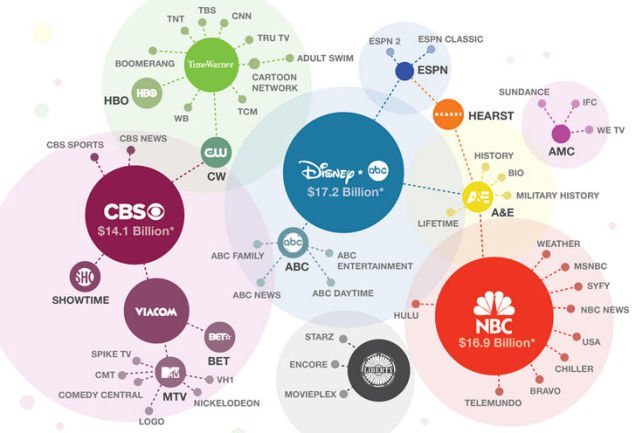
Pretty much all the media we see is controlled by a handful of corporations with varying degrees of connection
It's worse now than the image above because AT&T is purchasing Time Warner
With relation to Facebook it's pretty obvious that everybody in the traditional media industry would like to see them lose influence because it costs them money. Instead of watching the news or buying newspaper subscriptions people get the info from Facebook. There really doesn't need to be coordination because it's in their self-interest to pile on Facebook.
Go back 20 years before social media and if the news and the newspapers didn't cover it, it basically didn't happen. The MSM has lost a massive amount of influence due to social media because they can't completely control what information is spread around.
Hmm, I’d add that being owned by corporations does not always equate to being controlled. Editorial policy will be set by a range of people within these organisations, it can be very complex this chain of command, and the degree of influence that the board will have will vary considerably. I’d also posit that the current negative press around Facebook is of its own making to varying degrees and is the result of various substantive academic studies. The media would be doing us a disservice if they did not report on such things, as they are there to mediate, create awareness to the public against malpractice, accountability etc. This generalisation of ‘MSM’ is reductionist and not an entirely helpful to me. It is also the language that Trump and Alex Jones use and that is something that makes me very wary.


a) only part of the solution (water reuse schemes can be much cheaper and more effective) b) really difficult to build! Finding an appropriate location (google the Tryweryn reservoir in Wales for an example of the consequences of building one in a problematic location), planning constraints, environmental impact and subsequent pushback from locals and environment groups etc etc.
I don't disagree the UK needs more of reservoirs but they ain't trivial things to build. A good overview in this news article here: https://www.bbc.co.uk/news/articles/c2k147dkgx8o