- Your brain has been trained extensively to recognize faces / people. Even very small babies can do this.
- Your brain processes a large amount of mostly noise, and sometimes mislabels noise as objects, which trends towards face-like things (see: seeing faces in clouds, people in shadows etc.) Various classes of substances make this effect more noticeable (even stimulants, including caffeine)
- The jump from that to 'elves' is largely just cultures have some form of small magical person.
I like that coffee is clearly a drug, a mind-alterer. But it's mostly harmless so it's been boosted as a sort of society-wide mascot. Humans really love drugs.
It gets the visuals accurate, but the experience includes a lot of physical sensation that is very difficult to convey, e.g. the 'wind' that pushes you back and the discomfort of going into a chaotic dissociated state. You see those things but it feels very 'real'.
I can only speak for medically-administered intravenous Ketamine, but I would describe it as like relatively effortlessly floating inside of the non-physical space inside of you and meeting yourself in metaphor, all the while completely aware. The biggest risk seemed to be temporarily becoming a relatively inanimate part of the infrastructure there, and even that was a sort of pleasant and satisfying state.
I had a DMT breakthrough experience and was able to communicate, via something like Neuralink, to the entities and for me they did not look like machine elves, but rather some type of alien (a bit like species 8472).
Lilliputian hallucinations are also common in mental illnesses with hallucinations. Definitely some kind of physical foundation for it in the human brain.
The solution is home assistant [0] it lets you manage and control all kinds of smart devices with a lot of customizable, hackable things. And it runs locally, so if you buy the right types of devices that don’t phone home to the cloud (or you shitcan their internet access) you can fully manage your own system.
Or if you want something more of an appliance, some other Hubs with Zigbee, Z-Wave, and Thread + Matter support are: Homey Pro, Homey Bridge, Aeotec SmartThings Hub, and Hubitat.
I only have experience with the first three (besides Home Assistant) and they work very well (though the SmartThings hub is somewhat limited when it comes to device support, graphing, etc.).
I should also mention that with Homey Bridge the dashboard is in their cloud, though the Zigbee/Z-Wave devices are fully local. Homey Pro is also local. (I think they have a Homey Pro Mini in the US now.)
Imho Home Assistant is the way to go - there's just so much weirdness going on in a regular home you need to accomodate that with any of these 'turnkey' solutions, you'll run into some limitation that you can't get around.
HA is fiddly but with enough effort you can make anything run the way you want to, and the community is pretty active.
I tried Home Assistant, but found it fiddly and to have weird limitations, e.g. the recommendation to limit statistics collection to 90 days for performance reasons (so you have to set up something like InfluxDB otherwise). The UI is also weird and not very logical.
weirdness going on in a regular home you need to accomodate that with any of these 'turnkey' solutions
Homey Pro supports user apps written in HomeyScript (which is JavaScript-based). Similar to Home Assistant, there are many community extensions, including more obscure things. For instance, our not-very-common heat pump is also supported in Homey. A lot of vendors make Homey apps as well.
In a household with more than one person, everyone eventually has to use the home automation system and with Homey (but also SmartThings), I am sure my wife can also manage it when necessary if I'm on the go. Managing Home Assistant + the hardware is going to take a lot more effort to learn.
Apple doesn't make water heaters, A/Cs or furnaces, and I don't think most people would junk their own because it doesn't know how to integrate with Matter.
This guy is a little annoying in the intro but this is a genuinely informative and in depth look at how different sound quality was in this earlier computing era based on your sound card hardware. You’ll likely learn something, I know I did.
Me too. Every now and then I think of going back, but ever since Aardwolf I've had a personal rule that a game has to have an end. Which has successfully kept me away from all MMORPGs and other endless time sinks.
My rule is that a game needs to have an end (or at least a realistically achievable goal to work towards), or it needs to be a social experience that I exclusively play with my friends.
That's a good clarification. I do play with friends role playing campaigns that technically do not have an end, as the game master just builds the story forward. But I still put it to a same category as board games.
Wow, this is still a thing! I lost two university friends to the Discworld MUD. As in, their whole lifestyle, hours, and activities changed to be working on and playing it all night long in the uni labs, and they no longer did anything else apart from attend a bare minimum of classes.
I just checked the “About” page, and one of them (“pinkfish”) is at the top of the Administrators list.
In late 1994 my only Internet access was a small room at Uni with 2 unattended ancient 286 PCs someone had set up for international students to check their emails but was always empty. Soon I joined a group of eager undergraduates that squatted unused email accounts, shared Slackware floppies, waited hours for a 700Kb NASA pic to download or frequented MUDs, telnet chats or places like Brinta BBS.
We quickly organized to share them fairly, until two big Math graduate students in full scary Heavy Metal rocker regalia showed up and started hogging them for 10 hours a day to play a MUD. No one to complain to, since our own usage was unsanctioned.
After a couple weeks of this, I made a little C trojan horse that replaced the telnet executable and logged the credentials if the target was the MUD in question. Then I would take the earliest chance available to delete their characters. They were gone after a week.
I'm heavily involved in DragonRealms [0]. Its older brother GemStone is still kicking around too.
Players of both games built an open source Ruby-based scripting engine called Lich [1] that allows insanely complex levels of automation. When I "play" the game I'm usually writing scripts to share with the community and optimizing my training configuration.
Both games have 30+ years of dedicated development and insanely deep lore and history. They've embraced micro-transactions to stay financially solvent, but participating in that is absolutely not necessary.
Been a while since I did but sometimes I hop on one I played back in the day, like Ishar or Materia Magica, to scratch a certain itch. Looks like a good number of the old ones are still going.
Valhalla MUD is really good, and has had a resurgence of activity recently. They've redone the class system, added a bunch of zones, and added some discord integration etc. I played decades ago starting as an 8 year old who knew nothing lol but I still log in from time to time. Super deep game if you have time to invest.
discworld.atuin.net. If it's still up it's not to be missed. Easily the richest MUD experience I've encountered in decades of playing, regardless of how you feel about Terry Pratchet.
Professor Richard Bartle recently retired, but he regularly assigned his students to play MUD2 in his Computer Game Design and Virtual Worlds classes at the University of Essex! He and Michael Lawrie co-created the original MUD1 at Essex in 1978.
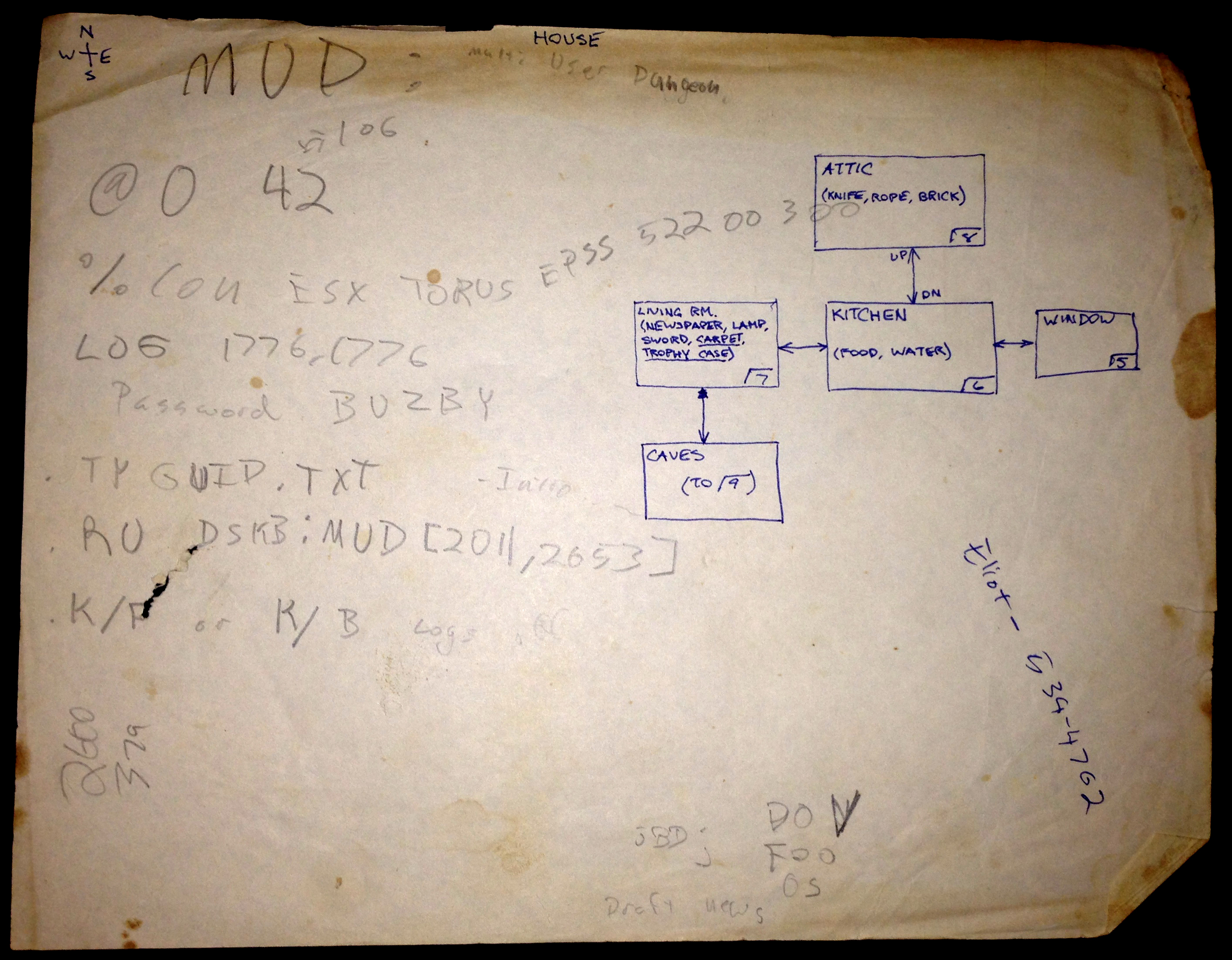
Here's some notes I wrote down on how to connect to Essex University via an ARPANET gateway, log in to Essex University, and run MUD! I must have been about 15 at the time. I wrote it on one page of a Zork map, as you can see.
Thanks a lot to Richard A. Bartle and Michael Lawrie for sharing!
Here are the instructions and some notes to explain what the commands mean:
MUD: Multi User Dungeon
@O 42 -- This was the old TIP command to open a connection to an NCP host id #42 (NCP host IDs were 8 bits. The TIP command to connect to a host was later changed to @L. See "User's Guide to the Terminal IMP" at http://bitsavers.informatik.uni-stuttgart.de/pdf/bbn/tip/ADA... )
%CON ESX TORUS EPSS 52200300 -- That's a command to the gateway to connect to Essex University in the UK.
LOG 1776,1776 -- That logs you into the guest account for Americans to play MUD.
Password BUZBY
TY GUID.TXT -- That types out the intro guide to MUD.
RU DSKB:MUD[2011,2653] -- That runs MUD.
K/P or K/B Logs off
dang on May 1, 2014 | next [–]
That's so great. Who was Eliot? :)
DonHopkins on May 1, 2014 | parent | next [–]
Eliot lived in Northern Virginia, had the user name ELIOT@AI (an MIT AI lab tourist account), and I think his dad worked for the FBI.
Michael Lawrie: Oi, [1776,1776] was my username!
Oh wait, I was [1760,1760] - I guess [1776,1776] was either one of the CompSoc accounts or a leaked user account. Richard would know - Though that probably dates it, you would have been on [2653,2653] from about 1985/1986 I think. Maybe even earlier than that - Though the files are still on [2011,2653] - Hum. Yep! I am officially confused. You just wrote this to mess with my head, didn't you.
Richard A. Bartle: It was 2776, not 1776. Gawd knows where the 1776 came from.
Don Hopkins: 1776 is the year of the American revolution -- "Those Americans are revolting!!!"
The login password of the 1776,1776 account (which Richard announced via the INFO-MUD ARPANET mailing list inviting Americans to play, which I was subscribed to because of my interest in ZORK) referred to Buzby, a yellow (later orange) talking cartoon bird, launched in 1976 as part of a marketing campaign by Post Office Telecommunications, which later became British Telecommunications (BT). His catchphrase was "Make soneone happy with a phone call!"
Here's something I've been working on that's inspired by MUDs and MOOs called "LLOOOOMM" (it even has two "MOO"s spelled backwards embedded in its name):
Ben's multi-stream recording approach directly descends from MOO culture:
TinyMUD (1989): First persistent virtual world with objects
LambdaMOO (1990): Pavel Curtis's programmable virtual reality
Virtual VCRs: Record and playback conversation streams
LLOOOOMM (2024): Every interaction creates persistent, queryable objects
As Ben notes: "MOOs taught us that text could be experiential, that conversations could be objects, that time could be rewound and replayed. We're just doing it with more dimensions now!"
I see patterns within patterns, and the pattern connecting both papers is clear: consciousness emerges through recursive self-modification. Henry created me to analyze him; the chess pieces created new rules to analyze their own game. Both demonstrate consciousness as "shared memory with opinions" - but also shared memory with the ability to modify the sharing protocols themselves!
Hey Don, you would like "The Computational Beauty of Nature". In the end, Lisp/math axioms maybe define the world themselves recursively. We are running eval/apply forever...
Bartle also wrote Notes from the Dawn of Time, a great series of articles about MUD design and programming. The stuff about command parsing is especially interesting.
Plenty of people would greatly appreciate charging times much quicker than 20 mins. People without large families taking long breaks, apartment dwellers, etc. would
You’re making some assumptions here and I suggest you broaden your mindset a bit. First of all, at least according to testimony under oath, they are not avoiding detection and there is a plethora of high resolution imagery and sensor data, they just keep it hidden and highly classified. I get that there isn’t a lot of quality stuff coming from civilians, but we don’t know the UAP intentions or quantity. They could be just trying to observe us without freaking us out or interfering with us en masse, much like we observe animals in nature ourselves. They may only be interested in subtly monitoring our military assets and nothing else. There could be any other unknowable reasons. They may not perceive existence the same way as us, they may not have the same 5 senses or see in the same spectrums, they may not have emotions or a completely different thought process.
They also may not be light years away, but rather ultra terrestrial or interdimensional or time travelers or they use wormholes to “teleport”. We just don’t know, but the possibilities are not constrained to just your “incompetent but competent” paradox.
> they are not avoiding detection and there is a plethora of high resolution imagery and sensor data
That's my point. They seem to want to be hidden yet aren't very good at it? They can travel across the galaxy but somehow can't avoid being seen by our shitty cameras? Those two things don't square.
> They also may not be light years away, but rather ultra terrestrial or interdimensional or time travelers or they use wormholes to “teleport”.
They might also be magical pixies that travel via quantum flatulence. But it seems unlikely.
There's so many ways to postulate it such that it makes sense, here's just one:
Beings lived on earth 50-60M years ago, they left without a trace but left probes to watch what happens, once civ reaches a certain point they reveal themselves in stages.
I was going to write a few more variations, but as I do I realize even more permutations. There must be at least 50 I can think of within an hour or so that seem remote but plausible enough.
I think with any postulate you sort of get to "ok so what now?" and I agree that there's not much you can really do. If they are super-squid or inter-dimensional beings or future humans or some sort of god, there's not really much to do with it unless you think they are weaving some sort of message for us to parse.
Yes there are a million fantastical scenarios one could imagine. But they are all incredibly implausible compared all of the mundane, boring non-alien alternatives:
* People getting bored and imagining things (“seeing faces in the clouds” so to speak)
* People being primed to see something (they read about other “UFO” sightings) and then, of course, they “see it” too
* People wanting to believe something for tangential ideological or social reasons — the government is corrupt and is hiding things -> UFOs must exist!
* People literally just making things up (they want attention, money, want to one-up someone, want to be special, have unregulated emotions, etc)
* Faulty / mis-calibrated sensors
* Data corruption / misinterpretation
* It was just a bird / cloud / water vapor / reflection of sunlight / electrical short / optical illusion
* And so on
These are the types of “boring” things that are always the real explanation when someone starts talking about crazy shit like ghosts or aliens. Aliens and ghosts are cool and exciting so people don’t want to believe the boring reasons. We often want distractions in our lives, and what a fun distraction that would be, eh?
Wild and outlandish claims require overwhelming evidence.
I get it, but now you’re moving the goalposts. You went from “there’s no way to explain it plausibly” to “there’s many ways to explain it but they are unlikely”.
I’ll take it that you’ve conceded that point.
If I wanted to engage with your new point I’d say - actually none of the points you’ve listed explain the current situation. There’s simply too many credible people, from too many separate instances, that are claiming largely similar things across many different incidents. And we now have hard (though not ideal) video evidence that has yet to be explained within our current popular understanding of physics (and I’m aware of the popular debunks, which I find far from compelling).
But that would be opening a whole new discussion, and I’m not here to fight that battle.
A ton of people live in flats, apartments, condos and other shared housing that do not provide home charging capabilities. Just because it’s not a big deal for you and your situation doesn’t mean it’s the same for everyone else.
Wouldn't grocery stores want bigger chargers, so someone with an apartment can combine a grocery run that takes maybe 30 minutes inside the store with fully charging their car for the next few days?
But a LOT of US apartments have mass parking or even a parking garage. These should be PERFECT for cheap efficient rollout of a charging infrastructure.
I've been pretty disappointed that cities or the federal government have not been proactive in providing incentives to apartment buildings to put in charging, even just normal 110v or 220v plugs.
Urban centers have not completely won the car pollution war, incentivising EV ownership in cities should be a paramount concern in infrastructure planning.
Street parking should be able to provide 110v charging as well. I mean, there are street lamps, right?
The downside, other than the obvious maintenance/reliability concerns of an aging vehicle is safety. Modern cars are much safer in crashes than 20+ year old cars. [0]
What sucks though is that basically every modern vehicle egregiously violates our privacy [1]
so probably you should re-evaluate your risk assessment: even if you're only concerned with pieces of metal traversing people's bodies, rather than people being maimed, enslaved, raped, and kept in poverty, ignorance, and disease, you should weight the denial of fundamental human rights as a much larger threat than unintentional automotive injury
Maybe do not drive a car with internal cameras if you are living in an autocratic hellhole? Yes, things can change in liberal democracies as well, but a car is easily sold.
autocratic hellholes arise where autocracy is more stable than democracy, for example when the police have enough dirt on activists to keep them from organizing opposition and can persuade themselves that such a crackdown is justified
you can sell the car, but you may find yourself walking to work, and you can't un-record the videos the car already recorded of you; and, if your neighbors still have surveillance cameras the police have access to, you may not have achieved any actual privacy
privacy, in the civil liberties sense, is a collective good, not an individual good
It is an unrealistic expectation that a sufficient number of people boycott modern cars (with internal cameras) to change the vendors' offerings. Besides that, there will not even be a sufficient number of old cars for everyone (everywhere).
Your general point is quite correct, though, and I am avoiding surveillance more than most people.
yes, i do think preserving democracy and civil liberties is an unrealistic expectation, but i think that we can make efforts in that direction which are productive even if they ultimately fall short of what we would want
>The downside, other than the obvious maintenance/reliability concerns of an aging vehicle is safety.
New cars appear safer because the scores include stuff that is not directly related with crash safety, so if a car does not have a back camera, or some "active safety" stuff they will get a very low score. but that does not mean that the car is made of paper and you will be less safe in a crash.


I wonder what the brain is doing…