"If we combine pastures used for grazing with land used to grow crops for animal feed, livestock accounts for 77% of global farming land.
Of all the land we use for agriculture, 77% of it is used for livestock."
These 77% are only responsible for 18% of the produced calories and 37% of the produced proteins.
So, if you leave out water consumption and most importantly animal walfare, eating meat is the worst thing you can to for the environment (when talking about food).
Nothing said here refutes the parent comment. It turns out that a lot of land is really shitty for growing stuff that isn't a weed (without adding a ton of chemicals to the environment), and humans don't eat weeds. Cows, sheep, pigs, and chicken do.
I doubt that 86% of that 77% is truly unsuitable for farming human food, but I wouldn't be surprised if 30-50% of it was.
The whole point is that you need way more crops in general to "produce" the same amount of calories & proteins. That's because feeding the animals with crops instead of eating them is highly inefficient in comparison to eating them directly.
"As an example: beef has an energy efficiency of about 2%. This means that for every 100 kilocalories you feed a cow, you only get 2 kilocalories of beef back."
With how much meat is eaten right now, there is just no way we have enough grazing land to produce enough meat. 99% of meat comes from factory farms. [1] These animals are always fed with crops, so there will always be land usage to product food for animals. And it is way more inefficient.
The implicit assumption that you are making is that all cropland is fungible and that the 43% used for animal food can be converted directly to human food. That is almost certainly not the case. Also, the original comment's 86% doesn't imply that it is necessarily "cropland" - just that it is land that grows animal feed.
You see this with human crops too - Why do people grow corn when almonds are much higher dollar value per acre? Why not wine grapes? The reason is because not every patch of land is suitable for high-value cash crops. Going down the quality scale, not every patch of land is suitable for food for human consumption either. The reason why is that "cropland" is not fungible - soil has particular characteristics, nutrients, contaminants, and microorganisms, all of which affect which crops you can grow.
Does someone know why the counter for this issue is at "70", but the repo only shows "21" issues in total? Maybe there are deleted issues that are not part of the total counter?
No, that's because GitHub uses the same number for both issues and pull requests. We did about 70 pull requests. You can verify that yourself by going on an issue and incrementing/decrementing the number until you hit a PR at which point you'll be redirected.
If you look at the land usage for animal products and compare it to their calorie & protein supply, the story gets even worse.
In short:
Of all agricultural land, ~77% is used for meat/dairy production.
This 77% are responsible for only 18% of the calories and 37% of proteins, the rest comes from the plants in our diet.
The numbers may vary a bit, but the scale stays the same. It's ridiculous.
Most of our calories are from monocropped commodities like maize, canola & soy. These are indeed efficient. High calorie per dollar value, but also high calorie per land/fertilizer/water/etc. This is true for eggs, but also true for fruit, nuts, tomatoes. Everything compares poorly to maize.
These types of analysis are full of such biases. "Pasturelands" are huge because they are low intensity... think of outback cattle stations in Australia. There certainly is a conversation to be had about rewilding low intensity lands, or farming them in more eco-friendly ways, considering the high land/food ratio. But... most animal husbandry happens at much, much higher density. Egg farming compares pretty well to fruit, vegetables, almonds, etc.
So yes, if we consume commodity crops instead of meat, fruit, vegetables and other non staple foods then the food system becomes much more efficient. I don't think it's realistic or desirable though.
On paper, where I'm dictator of the world, I can make a lot of things efficient. Food, energy, transport. I could easily find an omnivorous formula more efficient to the average vegan diet, also healthier and tastier. This is a disingenuous game.
I agree that it would be good to have more moores and wild lands. Becoming vegan does not help this cause. Unexploited land is only unexploited because of legal protections. Not one acre will go unexploited because enough people became vegan. This kind of "consumer action" mentality never works, is usually built on a disingenuous simplification, and it's ridiculous here too.
> Becoming vegan does not help this cause. Unexploited land is only unexploited because of legal protections. Not one acre will go unexploited because enough people became vegan.
There was a great interview with one of the guys who bought a black rhino tag and pissed the Internet off.
Very thoughtful guy, and his core message was "Given enough time, the only animals left on this planet will be those that are useful to humans or able to hide from us." In that an economic incentive is the only sure motivator of action over the long term, and so if we want to preserve something then we'd better find a financially sustainable model to do so.
Not all pastoral land is able to yield crops though.
There's a reason that Wyoming is home so many ranches, while San Joaquin valley is overwhelmingly money crops like grapes, almonds, and pistachios.
Some fertility problems (hardening, soil compaction) can be fixed in places like the Steppe and the northern American plains, but retention, drainage, and composition are inherent to the environment, and crop yield is one of those things that's damn near exponential to its inputs.
Honestly I'm glad that the terrain is at least useful for some purpose, out in the Appalachian mountains the % of land that can either support crops or livestock is incredibly small.
Adding to your comment, our wheat preference is also sub-optimal (but not to such a large degree). There are alternative crops with much higher cal/ha.
Probably because his current judicial situation is, to say the least, messy. That made a lot of the interest in him vanish for a lot of people. So prob thats why you haven't seen him mentioned.
I can recommend giving your component name (not file name) some identifier (like an underscore), so using VS Code's "Symbols" via command palette makes it easy to find and open them.
Isn't it ironic that even the writers of this article don't follow these rules in the examples on that page?
There is "Mistake 3: Not Enabling Keepalive Connections to Upstream Servers", where it says:
    In the location{} block that forwards requests to an upstream group, include the following directives along with the proxy_pass directive:

    proxy_http_version 1.1;
    proxy_set_header   "Connection" "";
Then, at "Mistake 10: Not Taking Advantage of Upstream Groups", the "location" block does not include these two directives, even though the "upstream" block contains a "keepalive" directive.
The combination of React's native context with hooks and realizing that a lot of your state is just "server cache" data (which can be handled "better" than using Redux) is probably enough for 95% of React applications.
Kent C. Dodds has a great article covering both topics:
You are right, if all your state is "cache state", then you don't need Redux. But at that point you don't need any state management library and are already searching for the wrong tool from the beginning. If you have actual global state, you'll come very quickly to a point where an actual state management library beats writing your own though, both in developer experience as well as performance.
> If you have actual global state, you'll come very quickly to a point where an actual state management library beats writing your own
Which you don't have to. React has been shipping useState, useContext, useReducer hooks for quite some time now - and will get you the exact same patterns seen in Redux (if so inclined).
It's important to note that there _are_ differences in how `useContext+useReducer` behave vs how (React-)Redux works, especially around when and how components will re-render:
Any large codebase should be using multiple contexts - which not only alleviates some of the performance pains but also helps in keeping the code structured (compared to one big state object that Redux recommends - unless that's changed).
Now if we're talking very high frequency updates, you'd probably keep the state in the component. That'd be faster then either approach - and such components are likely few in number.
With a lot of hand-written boilerplate, many required manual optimizations and performance that will in the best case be equal but often doesn't even get close. Context cannot rerender selectively. You change one property in a context object, all subscribers rerender, no matter if they access that property.
> are already searching for the wrong tool from the beginning
Agreed, that's why I wrote "realizing" and not "having". Some devs use Redux as a hammer when they actually need a screwdriver - they just don't know better.


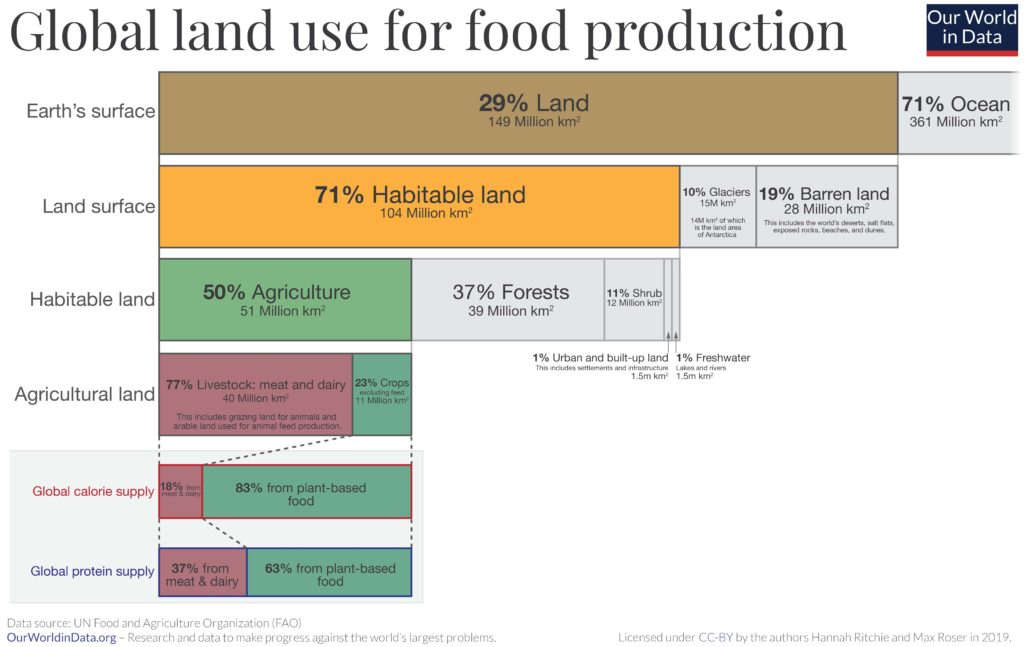
https://ourworldindata.org/land-use#half-of-the-world-s-habi...
"If we combine pastures used for grazing with land used to grow crops for animal feed, livestock accounts for 77% of global farming land. Of all the land we use for agriculture, 77% of it is used for livestock."
These 77% are only responsible for 18% of the produced calories and 37% of the produced proteins.
So, if you leave out water consumption and most importantly animal walfare, eating meat is the worst thing you can to for the environment (when talking about food).