CNO fusion does happen but at a fraction of the rate of pp fusion at the core temperature of the Sun. CNO fusion is more efficient in the sense that it is much more strongly temperature dependent. For pp fusion, the rate goes with T^4, but for CNO it is T^20.
Does that mean hydrogen would be used up much more quickly in high temperature stars? If I remember correctly, that's why large stars have shorter lifespans.
Yup, the more massive a star the short it lives. The Sun for example will live around 10 billion years, whereas a star 10 times the mass of the Sun will only live for 30 or so million years.
Using some hand-wavy arguments you could say that fusion pauses a star's collapse, so the more massive a star is, the more energy generation it needs to stay in equilibrium during this pause.
There's a negative feedback loop there. That is, a star of a certain mass needs a certain amount of energy production in order to keep it from collapsing, and that amount of energy production is automatically achieved, because if it were too low then the star would collapse a bit, and increase it.
Therefore, the rate of energy production isn't a consequence of the temperature. The rate of energy production is regulated, so effectively the temperature is a consequence of the required energy production instead.
No. Size is the dominant factor. Lifespan and what stages of fusion it undergoes are dependent on its size. The more massive the star, the shorter its life span. Red dwarf stars can live for trillions of years, but massive stars may live less than a billion years.
Notice that haiguise wrote "at the core temperature of the Sun." A more massive star has a higher core temperature, and thus haiguise's sentence about fusion rates would no longer apply. Fusion rates are faster at higher temperatures, and that's why more massive stars burn out faster. Notice haiguise wrote "T^4" and "T^20." Our sun is roughly 5000K. Massive stars can exceed 10000K. At twice the temperature, T^4 and T^20 imply 16x and 1,048,576x fusion rates, respectively.
But what is the effect on lifetime of not having any CNO present? If a present-day massive star would have a lifetime of 10 million years, how long would it live if it was a population III star with no CNO?
Carbon is formed in small amounts by normal stellar fusion, and since it is a catalytic process the carbon is conserved. So even an early star would probably have some fusion happening via the CNO cycle.
I'm not sure. I think a lack of metals makes a star less stable and burn out more quickly, but I could be wrong on that. There's some episodes of Astronomy Cast and Ask a Spaceman that I think would answer your question about pop3 stars more reliably than I could.
You seem to know a lot about this stuff. I have a question for you.
If fusion creates the potential for fission (radioactive waste) and radioactive waste can be used to build atomic bombs, how have we not figured out how to make mini perpetual-energy reactors?
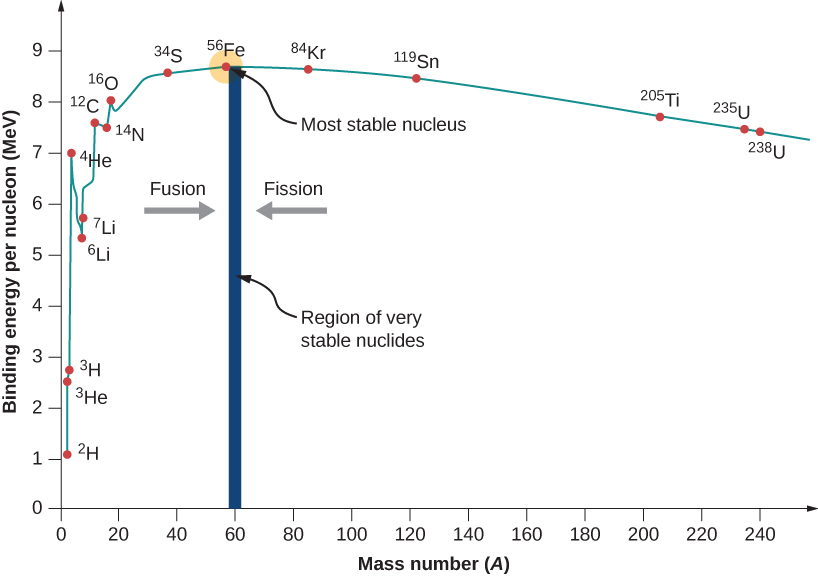
Both fission and fusion release net energy by having products with greater binding energy. The greatest binding energy is iron (and some surrounding elements). Once you get there, no more energy can be released by fusion (or fission).
So it’s not a perpetual motion machine. Iron is the bottom.
(Heavier stuff than iron can be created by fusion, but that absorbs energy instead of releasing it. Supernova create these heavier-than-iron elements like Uranium and gold endothermically... they’re also created by the decaying guts of neutron stars—which are essentially ginormous atomic nuclei held together by gravity instead of nuclear forces—when they collide and some of their guts are released into space.)
I'm not sure if endothermic is the best word. IANAP. It seems to usually be used when discussing fusion-based neutron generation. But AFAICT neutron generation, especially as it relates to the s-process, is still largely a thermal process--the greater the temperature, the more neutrons are generated, the faster the s-process evolves. (If you go back to the beginning of the universe all nuclear synthesis represents an endothermic process, right? Though, maybe such semantic games aren't particularly helpful when distinguishing nuclear synthesis processes.)
Nickel-62 is the most stable isotope, if memory serves. It’s not efficiently generated in star fusion, however, so iron-56 is believed by many to be the most stable.
The term you are looking for is "nuclear binding energy curve". Basically lighter isotopes can gain energy by fusing, and heavier isotopes can gain energy by splitting, but somewhere in the middle (around iron and nickle) the isotopes are the most stable. So you gain energy by moving towards iron, whether from the light end or the heavy end of the periodic table.
Nope. The three laws are unequivocal. The universe can only increase or maintain entropy through physical processes. It can never return to a lower-entropy state. The laws say nothing about the topography of the universe and it wouldn’t matter anyway.
When you dig into it more you realize the second law of thermodynamics is more of a statistical statement and doesn't have the same status as say the laws of quantum mechanics or relativity.
It's possible to create hypothetical situations where all of the must fundamental laws are being followed but the second law of thermodynamics is violated (for example if there are many more 'ordered' states than 'disordered' ones). And there is some vanishingly small chance that it will be violated in our universe for a macroscopically observable length of time.
In practice you won't go wrong by treating it as absolute.
Actually, there is debate about the conservation of energy over cosmological length scales.
e.g. if new voxels of spacetime are created during, and they contain zero-point energy... may account for photons losing energy as they red shift over large distances.
Yes, at large scales space expansion can sort of make it so energy is not conserved: http://www.preposterousuniverse.com/blog/2010/02/22/energy-i... Depending on how you look at it, anyhow. One way or another you end up with some sort of unintuitive concept being introduced.
See for example MESA http://mesa.sourceforge.net/index.html an open source set of modules for software experiments in stellar astrophysics, which is still actively developed.