That's not entirely true. Yes, Puerto Ricans do pay some federal taxes (tariffs, FICA, gift and estate taxes) but do not pay federal income tax unless they have income from sources outside Puerto Rico.
Anyway many Puerto Ricans probably wish they were subject to federal income tax:
  As the cutoff point for income taxation in Puerto Rico is lower
  than that imposed by the U.S. IRS code and because the per-
  capita income in Puerto Rico is much lower than the average per-
  capita income of the US states, more Puerto Rico residents pay
  income taxes to the local taxation authority than if the IRS
  code were applied to the island.
Puerto Ricans do pay certain federal taxes. However, they generally do not pay federal income tax unless they earn income from sources outside of Puerto Rico. I didn’t get this information from Wikipedia-- I already knew this. Also, I never said anything about federal income tax in my original comment. If you believe something I said was incorrect, please point out specifically what was not true.
"I used to resist the boot, too. Then I was successfully conditioned by the environment that's been engineered around me. Now I just lick it subconsciously."
I also thought like you when I was in my 20's.
However... the addolescent need to "rise up" is the first thing to go when you actually start a family and develop a well balanced social network.
If you play your cards right, soon enough, you won't care about all this.
If anything I'm more 'radical' pushing 50 than I was at 20. That "everyone gets more conservative as you age" adage is not universal.
For me I was 'radicalized' by raising children to adulthood and seeing the broken world we're leaving to them. Living in the US, my eldest daughter has less rights than her mother did growing up. Capitulating to the demands of fascists is not the way to a better future. Complacency has a high cost, regardless of whether it affects you personally.
Germany squandered so much money on nonsense, when they could have simply driven the few kilometers over to Eindhoven and bought an ASML machine for "Silicon Saxony".
Sure, it would have taken years and years and serious commitment by the government and private sector to make that a successful move. But instead of putting in the hard work with a clear vision for the future, we mostly spend our time whining and wailing. It's a shame.
High-end chips should be more of a EU concerted effort rather than every country for itself.
The problem is that unlike Airbus, which (highly inefficiently) can be made in multiple countries, you can't really spread out parts of a fab that way. The most you can do is fab machines + chips + chip packaging. Netherlands already has fab machines and in packaging there isn't a high margin.
That leaves chips, and you can be sure that whoever gets the fabs, the other EU countries will throw a shit fit and demand counter investments to compensate. And on top of that there is also regional animosity. So even if it makes logical sense to pop the fab down in the middle of the blue banana, it won't make political sense because France and all of South and East EU will be angry about "the rich getting richer".
>High-end chips should be more of a EU concerted effort rather than every country for itself.
And how are we gonna do that exactly? EU runs on national interests of those footing the bill, mainly France and Germany as the largest net contributors.
When you're relying on national subsidies to build and run a factory and adjacent infrastructure in a country, you're tied to national interests and demands of those countries footing the bill for all that infrastructure.
So the likes of France and Germany aren't gonna give billions in subsidies from their taxpayers' money to semiconductor companies so that they can incorporate in Netherlands to dodge taxes and then create jobs in low-cost Poland and Romania instead of at home, even though that's already been happening to an extent in other industries over the last 20+ years.
It's the same with arms purchases now. France blocked Ukraine from using its money to buy British made weapons that are already available, since it expects that money to go back into the French economy, not to the economy of a competitor, even if the much needed weapons will arrive much later.
Yeah I know, UK isn't EU anymore, but the point still stands, as EU nations are still economically competitors to each other and they're not gonna spend their tax money to fund competing economies even in the EU block.
> And how are we gonna do that exactly? EU runs on national interests of those footing the bill, mainly France and Germany as the largest net contributors.
The top net contributors are countries like Denmark, Sweden, The Netherlands, etc., I'm not sure where you get the idea that France and Germany are.
I will say you point out another big problem with the EU: its budget is tiny compared to the member states themselves. I do think as time goes on and millenials get in real positions of power, the idea of a more unified EU will get much broader support. So more of an EU army, much more of a single market, etc., but this will be a 25-50y timescale. I would have said it might have taken much longer, but the US and China bullying single EU countries has really displayed how exposed the current situation is.
> It's the same with arms purchases now. France blocked Ukraine from using its money to buy British made weapons that are already available, since it expects that money to go back into the French economy, not to the economy of a competitor, even if the much needed weapons will arrive much later.
> Yeah I know, UK isn't EU anymore, but the point still stands, as EU nations are still economically competitors to each other and they're not gonna spend their tax money to fund competing economies even in the EU block.
No, that is just reasonable. Theoretically I am all for open trade in the name of efficiency, but in the coming multi-polar world, there is real advantage to having more onshored production. This also really makes me want to integrate Ukraine into the EU. Their troops are very battle-hardened at this point, and would bring ample experience to EU armies. Especially in the field of drone warfare.
> and millenials get in real positions of power, the idea of a more unified EU will get much broader support. So more of an EU army
Wow, how convenient that millenials who age out of military conscription , become more pro-military conscription.
Also, check the stats, majority of EU youth don't want to fight to even protect their own country, let alone other EU countries. For example Only 16% of Germans would "definitely" take up arms to defend Germany if attacked. Let that sink in.
Because why would they? What's to fight for when you can't afford to own a house and people aren't starting families anymore? Go fight and die to protect your landlord's, Blackrock's and Vanguard's wealth? N'ah bro, I'm packing my bags and fleeing across the border any way I can.
So no, the "EU army" fantasy is not happening no matter the propaganda, unless you put a gun to their head.
> I would have said it might have taken much longer, but the US and China bullying single EU countries has really displayed how exposed the current situation is.
You didn't have to wait for US and Chian to bully, you just had to watch the EU's share of global GDP completely slide into oblivion over the last 20 years compared to US and CHian to figure that when you're economically weak you become more exploitable. More EU military will not change that balance unless the EU military can somehow surpass US and CHina combined to dictate world politics and trade in their favor, which let's be real, is not happening.
You're nuts dude. All the stuff you say is cherrypicked, taken out of context or just a straight up lie, just so you can paint the world in your strange perspective.
> Wow, how convenient that millenials who age out of military conscription , become more pro-military conscription.
The youngest millenials are still ±30 now, they would still be eligible for conscription until 45.
> Also, check the stats, majority of EU youth don't want to fight to even protect their own country, let alone other EU countries. For example Only 16% of Germans would "definitely" take up arms to defend Germany if attacked.
First of all, you decided to be cute and pick the country that is the most reluctant about war, due to having an uneasy past. Like Japan. But let's roll with it. That poll says 16% "definitely", but also an additional 22% "probably". 59% would "probably not" fight. But of those who would not fight, 72% are women who would be unlikely to be in conscripted combat roles, so the real percentage of refusals would more likely be 17% (59% - 42%). And there's also the factor that a people gets incensed when their homeland is actually attacked, so the actual willingness is likely to be higher under pressure.
> Go fight and die to protect your landlord's, Blackrock's and Vanguard's wealth?
You're so unknowledgeable you confused BlackRock with Blackstone. Anyway, all three of those own minimal percentages of EU (or US, for that matter) housing stock.
Landlords are another matter, a huge amount of stock is in the hand of small 1-5 domicile owners. They are mostly boomers.
You are right to be irate at how millenials, gen z and gen alpha are getting the shaft right now. But that has nothing to do with war or the EU's economic situation, and everything with policy choices of the past 30-40 years that coddle boomers (housing stock, pensions, healthcare) at the cost of everyone else.
> N'ah bro, I'm packing my bags and fleeing across the border any way I can.
Good riddance, no one in the EU wants to host a seditious clown.
> So no, the "EU army" fantasy is not happening
The train of progress steams ahead unbothered. A couple of decades ago the EU or the euro "fantasy wasn't happening". And the current population is more pro-EU than ever, and the like has only been trending up since the EU's inception.
> you just had to watch the EU's share of global GDP completely slide into oblivion over the last 20 years
The EU actually had the biggest economy from 2008-2015, although that was more an artifact of exchange prices. The last decade has indeed been mismanaged but we have certainly not "slid into oblivion".
The US has had an economically amazing decade, and China was always going to become number 2 considering the population it has. And then on top of that, lots of countries in SEA, South America and some in Africa have grown to be a much larger slice of the global economic pie. And that's good! A rising tide raises all ships.
In general, the economic center of gravity was always slowly going to shift to Asia, and thus the Pacific seaboard.
> More EU military will not change that balance unless the EU military can somehow surpass US and CHina combined
The US military doesn't surpass the combined militaries of China and the EU either.. nor has it used its hegemon power to "dictate world politics", even if it has meddled in other's affairs sometimes. The main mission of the US military is (was?) security for itself and global stability & free shipping lanes to allow as much trade for the US as possible.
>You're so unknowledgeable you confused BlackRock with Blackstone. Anyway
No, I was talking about Blackrock specifically, don't put words in my mouth. BlackRock is a significant shareholder in many of the EU's biggest corporations, who are the ones lobbying and dictating policies you have to live by.
> people gets incensed when their homeland is actually attacked
That's why the whole EU if full of military aged Ukrainian males, because they all love defending their homeland ... from their apartment in Berlin.
>Good riddance, no one in the EU wants to host a seditious clown
I'd rather be called a clown by losers on the internet and survive, than be a virtue signaling "patriot" online dying in someone else's war.
> And the current population is more pro-EU than ever,
Yeah, the EU population is so pro-EU, that the EU has to constantly buy propaganda ads on radio, TV and social media to remind us to be pro-EU, and then ban/censor/arrest those saying mean things about the EU in public.
I wish you good luck, considering how you appear to be drowning in alt right (or left?) disinformation, probably from some weird filter bubble. You'll need the good fortune.
No, because a Dutch citizen in the EU is paying a lot more into the system than a French citizen in that same EU.
If "per country" is the logical way to compare it, then the Dutch (and all other small countries) are severely lacking. If you compare it per capita, then the citizens of those countries I named are already carrying a ridiculously undue burden.
The solution is to make the EU more like an actual unified economic and monitary union- with a central fiscal authority, unified public debt, all member states joining the Eurozone, unified tax system, etc.
Since when is the quality of arguments and the understanding of economics and politics tied to the age of your account? Is this how arguments are won here? Age discrimination goes against HN rules. Your opinion on global events is not automatically more correct than others just because you've been on HN 10 years longer than others.
>posting doubious takes like this
Universally recognized and factually proven facts = dubious to you?
What (counter-)arguments do you actually bring to this discussion, other than throwing ageism and baseless accusations at people as your strategy to discredit their opinions you dislike?
They're trying to imply that fresh accounts might be used to steer opinions, IOW, they're trying to imply that you are a politically motivated kind of bot...
I agree, its a rather shady approach. But here you go, we'll get more and more of this, its a conveneient method to discredit discussion partners with unwanted opinions.
Except mine is not a fresh account though. THis is just moving the goalposts in search of vapid things to discredit people for unpopular opinions without arguments.
Calling people whose opinions you dislike but can't refute as "bots" is the lowest of the low copes of losing arguments.
Not accusing you of this, just pointing out the hypocrisy of those doing it.
Your response is, completely expected, an appeal to outrage.
You’re asserting that account age shouldn’t matter, and that any scrutiny is morally illegitimate.
Nobody is discriminating against you. It’s just that account age is one of the few signals that an online platform has to go by.
HN absolutely recognizes this in their policy, considering that they give new accounts an entirely different color to make them stand out from the rest, and that they don’t allow downvotes unless your account has achieved a certain karma level.
>Your response is, completely expected, an appeal to outrage.
How do you react towards ageism and discrimination?
>It’s just that account age is one of the few signals that an online platform has to go by.
None of that invalidates or even addresses my arguments. It's still about exclusion of people based on account date rather than WHAT they say.
>HN absolutely recognizes this in their policy, considering that they give new accounts an entirely different color to make them stand out from the rest, and that they don’t allow downvotes unless your account has achieved a certain karma level.
Except that my account is not green, and I AM allowed to downvote.
The goalposts always move whenever you want to discredit someone but don't have any valid counter arguments to their arguments. It's either the age of your account, the karma you have, your username, anything but saying why your argument is wrong.
The EU is exactly the image of a central government and worse of it all, its bureaucrats are not elected by anyone so you get bullshit like the zombie Chat control coming back every 2 months. The most dysfunctional system of all.
"Bureaucrats" are rarely elected, that's what makes them bureaucrats. They're appointed.
As for the EU, you have the Commission who are unelected and the Parliament who are elected. The Parliament has to confirm laws like chat control.
If a majority of Parliament votes in chat control (they haven't and probably won't), that means a majority of the people want chat control. Or think they want it, anyway.
I'm also not sure why you think the EU is the pinnacle of central government. It carries vastly less power over its constituent countries than the US does over its constituent states.
Do the same what? I don't position my personal opinions as statements of truth that "we" all believe, if that's what you mean.
The Eurobarometer and other surveys clearly show the majority of EU citizens want further integration in lots of fields including defence, foreign policy, fiscal matters, etc. Further integration, such as the adoption of the Euro, is legally mandated and pretty much inevitable.
So when you say "we", you should clarify who you're claiming to represent, because it's not most of us.
So in your opinion, the solution is that individual national serenity should be abolished and the EU should have the liberty, nay, the authority to fleece its highest payers into the system, like France and Germany, and then redistribute their money to whoever and whatever it sees fit, for the
"greater good" of the union, with no accountability or obligation to provide them equal benefits in return?
How is this not communist tyranny with extra steps?
How do you expect those people footing most of the bill to give up their status quo and voluntarily sign up for something like this? Oh wait, I remember, that's why they're pushing chat control and digital-ID on us.
> How do you expect those people footing most of the bill to give up their status quo and voluntarily sign up for something like this?
If you do not see how someone like US or China can play 27 individual countries and divide Europe by propping one nation and discrediting another, for example recent Trump admin meddling with Poland, or Musk fiddling with German and Spanish government, then it's going to be difficult having this discussion with you.
Another aspect... Spain stopped being a dictatorship 51 years ago, half of the continent was under Soviet influence until something like 35 years ago, communist for that matter. The continent has been consolidated over the last half a century. Painting EU as the root of all evil is not a way forward.
Secondly, even if the US as a country is tighter integrated and more financially successful than the EU as a union, the US is not a successful model example of a well functioning society that people in the EU would aspire to emulate, on the contrary, they'd rather preserve the status quo than turning into something resembling what the US has become.
>Ok, well I guess if Europe is fine with a continued slide in global economic relevance, they can keep their status quo.
EU citizens understood and recognize that economic supremacy of some private sector industries is pointless if the gains all go to the hands of a few tax dodging trillionaires with sex trafficking private islands, while the externalities get outsourced to the environment and the public sector to deal with leading to increased wealth inequality, homelessness, crime, drug addiction, etc
That's why they want to see policies that will first address the environment and quality of life, before shareholder returns, even if that makes them less economically dominant.
EU people don't want to live in a world of fent zombies on the streets, cars with smashed windows from petty crime, food deserts, homeless people, all in the name of economic superiority.
Right. That's exactly what I'm claiming, that the EU has to become more like a confederation, more closely integrated than it is now but less integrated than modern federations like the USA or Germany. Closer to the early USA (where the states had more power compared to today and the federal government less).
>that the EU has to become more like a confederation, more closely integrated than it is now but less integrated than modern federations like the USA or Germany. Closer to the early USA (where the states had more power compared to today and the federal government less).
Do you see the perfectly exemplified contradiction here? Centralized government power always tends to want more and more control, more and more power over time, while shedding any and all forms accountability. It never stops and says "ok, we have just the right amount of control now, we can start back off and leave everyone be". That never happened in history of humanity.
The evolution of the US central government you gave is the perfect example of this overreach that grew with time and the best argument why we shouldn't try to emulate that. Because so is the EU compared to how it was 30 years ago, and it will just keep growing and swallowing more control and influence over its members, with less and less accountability, and it won't just stop when you think the right balance has been achieved. It will only stop when IT decides it wants to, but by that point it will be too late for you to have a choice in this.
Plus, even ignoring all that, what worked in the US 200-300 years ago, can't simply be applied to Europe now. You can't simply copy-paste policies across continents, cultures and time, and imagine it will simply Just-Work™.
>Isn’t this exactly how the United States and every other country works?
EU is not a country. It's a political and economic union. And I think it can't become a country since peoples of member states desire to keep a degree of national sovereignty.
> So in your opinion, the solution is that individual national serenity should be abolished and the EU should have the liberty, nay, the authority to fleece its highest payers into the system, like France and Germany, and then redistribute their money to whoever and whatever it sees fit, for the "greater good" of the union, with no accountability or obligation to provide them equal benefits in return?
There indeed won't be equal benefits, but instead France, Germany etc are going to benefit a lot more in this kind of situation than without the integration. We've already seen the massive benefits of the single market integration for example for the German economy and industry. It'd be strange to think that further erosion of barriers and better integration wouldn't bring further benefits to the economies involved.
> How is this not communist tyranny with extra steps?
Um, by the fact that the EU wouldn't be taking over the means of production when it'd be integrating? Like come on, this is just silly, to call a block dedicated to free market principles and social capitalism "communist tyranny".
I swear, this kind of economic illiteracy is going to be the end of us all.
> How do you expect those people footing most of the bill to give up their status quo and voluntarily sign up for something like this? Oh wait, I remember, that's why they're pushing chat control and digital-ID on us.
The EU isn't pushing for the Chat Control and whatever, it's only certain member countries like Denmark doing that. They should absolutely be reprimanded for that, but nevertheless the difference is important.
Also, the people "footing most of the bill" would also be benefiting massively, for example by making sure that we would no longer have a situation like the Greek debt crisis messing everything up for the entire currency block.
> Yeah I know, UK isn't EU anymore, but the point still stands, as EU nations are still economically competitors to each other and they're not gonna spend their tax money to fund competing economies even in the EU block.
Uh, no the point doesn't stand anymore if your example isn't actually a reflection of it - at least not anymore then any other unfounded opinion pieces with no collaborating evidence
>Uh, no the point doesn't stand anymore if your example isn't actually a reflection of it
What part of my original statement you quoted
"EU nations are still economically competitors to each other and they're not gonna spend their tax money to fund competing economies even in the EU block"
do you think does not stand anymore and why?
>unfounded opinion pieces with no collaborating evidence
Maybe reading comprehension or understanding of international politics within the EU is not your strength, but I gave you the evidence and arguments in the comment you quoted. Maybe you don't like to hear what I said, but that's another thing entirely.
You again brought no argument when I asked you to. How can anyone have a conversation out of this when you refuse to play ball and are only interested in throwing hissy fits at comments you disagree with?
okay,the preceding paragraph I referenced of yours was
> It's the same with arms purchases now. France blocked Ukraine from using its money to buy British made weapons that are already available, since it expects that money to go back into the French economy, not to the economy of a competitor, even if the much needed weapons will arrive much later.
Which you the followed up with
> Yeah I know, UK isn't EU anymore, but the point still stands, as EU nations are still economically competitors to each other and they're not gonna spend their tax money to fund competing economies even in the EU block.
To which I responded with (just in case your ability to recall that fails you again) with
> Uh, no the point doesn't stand anymore if your example isn't actually a reflection of it - at least not anymore then any other unfounded opinion pieces with no collaborating evidence
>unfounded opinion pieces with no collaborating evidence
My evidence was (as you typed it yourself) that with the war in Ukraine and arms demand flourishing, France only spends money on subsidies with the guarantee that money is going back towards its own economy, as does every other major EU economy, not just for arms, but for semiconductors too.
If you were too thick to get that, or you refuse to belive it on some ideology, or want to die on a hill over a technicality, then I'm sorry, but nothing more I will do or say will convince you, when you've already made up your mind otherwise.
Yes, and you then followed it up with pointing out yourself how this is just your unfounded opinion because the example you cited doesn't actually reflect the situation you extrapolated to, because the UK is not part of the EU
Airbus was never born as a European giant. It was a merging of many national champions (Aérospatiale, DASA and CASA) that were each already making full airplanes. They figured out how to spread out the manufacturing later.
Airbus currently has two factories finalizing the airplane assembly: one in Toulouse and one in Hamburg. You could copy this model and just open different fab in different countries to spread production.
Also, another model is one country making wafers, one country making EUV-lithography machines and parts, one country mining and refining silicon, etc.
There's no "one country making lithography machines". The mirrors come from Germany already. Other parts from about 160 other countries around the world. The EUV tech itself is an American invention and was picked up by ASML. That is why USA has the say in who gets it.
Good point, but gotta remember that people don't buy chips, they buy products. There's plenty of stuff to be produced. From components to PCBs to casing to packaging.
China didn't become the manufacturing giant it is because of a single product, they did because the whole supply chain was moving there while the EU and US were only concerned about higher-margin products and activities.
I'm sure some town in Italy wishes it was still the world's #1 diode manufacturer or something.
>I'm sure some town in Italy wishes it was still the world's #1 diode manufacturer or something.
Except that's exactly what happened. EU semi fabs like the ones in Italy mostly make diodes, mosfets, microcontrollers and other such low margin products. Nobody here tapes out GPUs and CPUs, that's all Korea, Taiwan and US.
I wish more people understood this. Or perhaps they do, but it doesn't fir their political pitches or something.
Funding an enormously complicated semiconductor facility from a blank sheet of paper somewhere in Europe is a very expensive way to accomplish little, if the rest of the supply chain from materials to products is in non-friendly nations.
The way to bring in an industry the same way you do anything complicated: You start small. Get the specialized diode factory up and running again, and then build out supporting industries and value chains as needed. Complex lithography equipment can wait until last.
It wasn't long ago we built mobile phones in Europe. Ericsson, Nokia, Siemens, Alcatel and Bosch all had production and most if not all components were sourced from Europe or the US. Two decades ago is the blink of an eye in the larger scheme of things, not even a generation, and many who worked on this are still in their working years.
Without being directly related, it would also be a good opportunity to chisel out a crack in the Android/Apple monopoly. Then maybe in a decade or so you could actually live as a functioning citizen without giving remote root to the oligarchs and self proclaimed supranational kingmakers.
> you can't really spread out parts of a fab that way. > That leaves chips, and you can be sure that whoever gets the fabs,
"a fab" or "the fabs"? We are commenting on news about TSMC building fabs in 3 countries across 2 continents, multiple fabs in each - I counted 23 of them here [1].
Surely, the EU can commit to a few fabs and research labs in different countries, semis are equipment and labor intensive, there's work for more than the EU. There's no need to build all of them at once, a clear commitment will suffice.
EU has a solid path of a lot of money to be spent in the next 5-20 years. Chips, AI, advanced weaponry, more advanced weaponry etc. If there was a program where everyone gets a slice, I'm sure it would work - a bit like ESA. It is doing it piecemeal that runs into the very problem you describe.
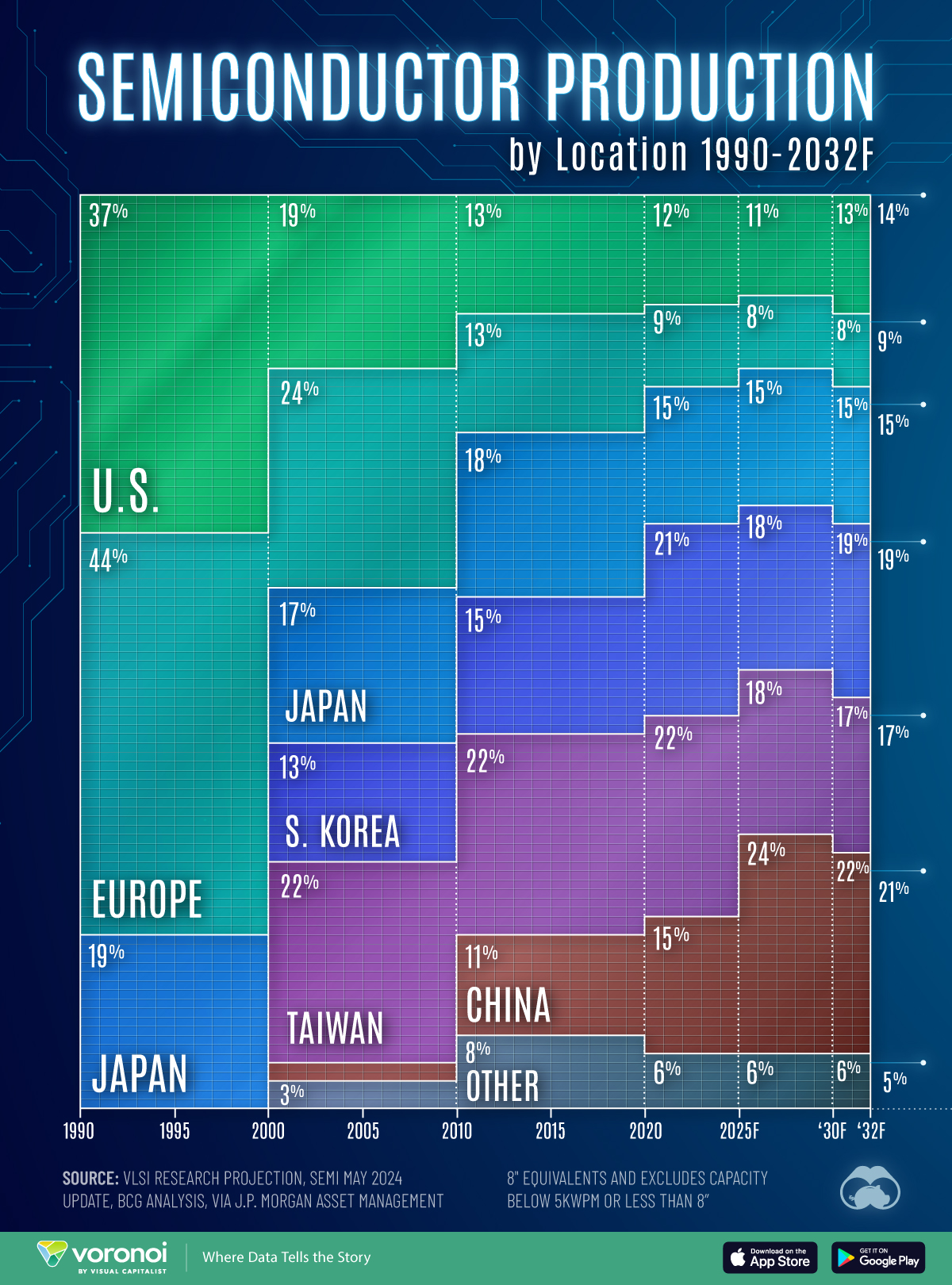
That seems a bit too simple. I saw one particular graph [0] once that really stuck with me illustrating just how decisively Europe was ejected from the semiconductor market. It takes more than just inaction to achieve results like that. In many ways it could be called an impressive feat that only the Europeans could achieve. 44% of production to 9% - losing a steady 1% of the market every year, largest to smallest player. No other region is even in a position to do that badly even if they tried.
It is possible. But that seems out of character for the Europeans, they're pretty consistent about going the distance to make absolutely sure that the next new thing doesn't happen in Europe.
It seems much more likely they had a suite of environmental, social and trade policies carefully calibrated to move semiconductor manufacturing somewhere else.
Part of it is simply the Euro being too strong. Taiwan has a (deliberately) undervalued currency that makes exports a lot more competitive, the EU does not.
It's a super simple strategy with profound effects but somehow still very underappreciated
>when they could have simply driven the few kilometers over to Eindhoven and bought an ASML machine for "Silicon Saxony"
That's not at all how it works. You're talking as if you're buying a plug-and-play Xerox copy machine that you can just unbox and start printing copies of your work and make money.
Buying the latest EUV machines doesn't get you the latest nodes and economically viable yields.
Intel, Samsung also have the latest ASML machines that TSMC has and yet they haven't caught up to TSMC because there's a lot more to semi manufacturing that just the machine itself.
If Germany just buys an ASML machine it would be an expensive paperweight without the process know-how that engineers at TSMC have amassed over the decades in order to get the most economically competitive yields.
It is so absurd to think that an investment in even the most uncompetitive fab while one has currently none is uneconomical.
Even if this fab is 3 times more expensive then other ones, the result of not having one will tank the entire economy and GDP of a nation if things go bad.
We speak here about trillions of damage while a fab costs only a few billions.
> Even if this fab is 3 times more expensive then other ones, the result of not having one will tank the entire economy and GDP of a nation if things go bad.
That's hogwash. Sorry. Human society won't simply stop working just due to the lack of 2nm chips.
There are plenty of chip manufacturers around the world, including EU ones. Taiwan only has the quasi-monopoly over the cutting edge process.
What are you talking about? There's a lot of fabs in Europe, just on much older nodes than Taiwan, US and Japan or even China have.
>We speak here about trillions of damage
Where did you get the trillions from?
>a fab costs only a few billions
Billions just to build, but then who's gonna foot the bill for running it, if the fab is not economically competitive to those from Taiwan and Japan, at EU domestic wages, EU environmental regulations and lacking knowhow supply chains that needs to be built up in the EU? The taxpayers again?
The German government (meaning the taxpayers) are still subsidizing energy costs to keep manufacturing from collapsing or leaving the country altogether because it's not internationally competitive anymore.
So how much more of the private sector should the taxpayers subsidize before we take a look at ourselves in the mirror that everything is FUBAR and that endless taxpayer funded subsidies(aka corporate welfare) are just disguising the endemic rot while not actually fixing the problem?
The only forward facing government that actually had a drive to change anything useful for the future broke apart with internal squabbles, with a big part of it by the market liberals torpedoing things left and right. And now we're back to a government of stand still, like we did the almost two decades before.
Not sure what you're talking about. The last "forward facing" government was about 50y ago, the last one at least driving meaningful reforms almost 25y ago. To me it seems the more Europe got integrated, the more Germany lost the plot.
This standstill mostly started happening when the capitalism took hold too deep and wide, look at Sweden and its golden age that lasted until all the restrictions on capitalism were silently removed.
While capitalism is a good model, it needs to be kept balanced, restricted..
Shareholder primacy is ruining everything, too much influence in politics from too many external sources.
If every time you’re shown an inkblot you see right wing talking points materialize in front of your eyes, it may be time to take a break from social media.
Bringing up net zero in a thread about semiconductor manufacturing is a complete non sequitur. Fabs run on electricity which is quite easy produce without emitting any CO2.
They may be but that doesn’t make them wrong. I don’t keep track of what everyone on any “side” tall about and how many percentages do what. That’s noise. The arguments are valid regardless of who says them.
What you are suggesting is vertical integration. If Europe goes crazy, can do that. From start to finish this chip thingy can become "magic crystals from Europe" as they already have control over the tooling. How many billions it will take to build the fabs with these tools and hire the talent from all over the planet and put all that in special economical zones? I don't know but I bet its less than those who don't have and end up buying the tools.
Europe is already a great place to build your life and despite the narrative about "EU killing businesses with over regulations", Europe is an exporter, that is EU makes physical things in large quantities(that's why USA is able to blackmail EU with tariffs). EU produces and exports so much, more than it consumes. Its closer to China than USA in this regard, you can check out the recent stats here: https://ec.europa.eu/eurostat/web/products-euro-indicators/w...
The infrastructure is in place and there are both many nuclear reactors that were decommissioned early or not yet commissioned but canceled/put on hold as well as regions with plenty of sunshine or hydro power opportunities and also has all the expertise to re-work those quickly.
It's really a political decision to push for something like that or not. Geopolitics may eventually make it happen, who knows? At this time it makes more economical sense to make the tools and send them close to the larger supply chain of electronic products production.
> Europe is already a great place to build your life
Agreed. Its countries' long-standing equivalents of America First policies mean that they spend far more on their own citizens, import far fewer people, and leave most of the charitable, defence, and research spending to the US taxpayer. Good for them.
I kind of agree that "America First" policies tend to be Europeanization type policies and as a result quite un-American and that's also why USA will end up like Europe if it keeps course.
Europe is great in many ways but lacks the dynamism exactly because of its highly controlled immigration policies instead of free market ones. Bureaucrats actually are terrible at picking who should come. A major example are the Turkish immigrants to Germany, where they imported huge numbers of Turkish immigrants for their booming car industry in the 60s and instead of just treating them like normal people they did this "guest worker" thing and as a result those Turks failed to integrate and remained in the low socioeconomic status with exception for some high profile cases like the inventors of the mRNA vaccine or the Crysis founders. In other places like UK or USA, Turkish immigrants tend to have much higher socioeconomic status.
If EU end up doing its chip and energy industry push, better be following the pre-Trump era immigration policies because that's how USA got is all the workforce that make USA leap ahead in many industries. Some French or Swedish immigration officer would not be picking people better than industrialists or startup founders. Immigration and its integration are not Europe's strong traits.
I think that's a good point, but with the caveats that:
Immigration and benefits are in opposition - the more immigration you allow (unless it's careful, skills-based) then there's a strong risk of costs of living rises (e.g. housing becomes more expensive with immigration) and benefits systems requiring higher taxes to pay for them. European countries can sometimes be very strong on immigration (e.g. Denmark) likely because of this reason.
Entrepreneurialism and benefits are in opposition - the more benefits you offer, the higher the taxes need to be, and so the less worth it it is to take risks with money or with time. It's just a tradeoff between risk and safety, and Europe in general (or Western Europe, at least) is more tuned for safety. And why not, if the US is willing to take the risks?
>Meanwhile Europe only got 40k WSPMs of 12+ nm capacity
EU leaders and VCs gave up on the electronics industry 20+ years ago and just kept offshoring it to the cheapest suppliers to lower costs and increase shareholder value.
You can validate this by looking at which sectors pay the highest EU wages and you'll see that hardware and electronics are not in the top.
And working in the electronics industry requires highly skilled knowhow and academic specialization, and you're not gonna attract people there if you don't pay them top wages if they can get more money and an easier job somewhere else like writing CRUD SW or pushing pencils in a bank.
>Not everyone is motivated by the highest wage they can get.
THis idealism always goes away once you have to buy a home, and realize you're working more hours and getting less money than your mates in other industries that are easier to get into, so you start to switch really quick.
People aren't selfless when it comes to being exploited by private sector entities, they'll always go towards the ones with the best wage/hour ratios.
People aren';t stupid. Why would they voluntarily choose to work harder and be less well off? It's not like this is working for the public good like medicine, firefighters, EMT, education, etc.
If Trump was European he would have long ago said “i only allow export of ASML machines if openai/nvidia/tsmc build 5gw urgently here in Europe with advanced nodes”. Fair if you ask me tbh
Well there you go. The EU talks the big talk on "domestic sovereignty" but never puts their money where their mouth is, or when they do, it's breadcrumbs, just enough to keep it on life support, let alone to be in the top contenders.
EU never had significant chip fabrication (instead having a lock on the tooling) whereas Japan and the US essentially pioneered high-end chip manufacturing before losing ground to Taiwan and Korea.
No, the shitty regime has stolen, squandered, and prevented the vast majority of Cuba's (potential) income.
They've received free oil from Venezuela, Mexico, and Russia for decades. This whole crisis is because the country is horribly mismanaged and the free ride is over.
Most countries have to purchase their oil at market prices. Cuba has been spared that burden yet is still worse off than the average country.
IIRC both Russia and China have demanded economic reforms which are not forthcoming. The Chinese aren't stupid and they don't seem too interested in pissing their money away indefinitely on a 'partner' who ignores them.
The entire crisis is because the US has been abusing Cuba since Batista fell, don't get confused. The idea that Cuba is being coddled because it isn't paying market prices when the US has been excluding it from the market for your entire life and most of your parents' lives is sadistic and cynical.
You don't get to criticize the quality of someone's system until you take your foot off their neck.
Reducing the root cause to the US is ludicrous. Cuba had agency and their government made some horrific choices for their citizens.
I was there about 20 years ago and it was the most depressing place I've ever visited: the authoritarianism and corruption and tragedy was so visibly prevalent . . . even to a tourist. It was frightening because problems are usually better hidden from foreigners.
Summarising a complex situation as though it has one simple cause is a human sign of ignoring complexity or systems.
Yes, the impact of US political choices was deeply hideous. That doesn't excuse the Cuban government from their choices about how to deal with that.
But the current crisis is most certainly due to the United States - double confirmed by the U.S. administration. The U.S. President and his Secretary of State have BOTH boasted about stopping oil delivery to Cuba and tightening the screws on them. They want easy regime change.
"THERE WILL BE NO MORE OIL OR MONEY GOING TO CUBA - ZERO! I strongly suggest they make a deal, BEFORE IT IS TOO LATE." The Cuban government is "ready to fall" or "failing pretty soon" due to this cutoff!
Rubio has in slightly less pompous fashion confirmed that the U.S. has now successfully weakened Cuba.
Personally, I despise the current U.S. administration's glee at causing suffering. "Might Makes Absolute Right" & "Vae Victis" are the current American mottos. No old-fashioned velvet glove over the steel fist - it is barbed with titanium and doused with hellfire now.
If Cuba's government had created prosperity when they had the chance then they wouldn't be experiencing this crisis right now. They had a decade plus of no economic blockade from the U.S., and still they squandered the opportunity. They had 6+ decades of subsidies from their friends (minus a brief period following the fall of the USSR), and still they squandered that. This is because Cuba's government does not want prosperity for its citizens (subjects) for whatever reason (probably because they would be harder to keep down), and instead preferred to live off the largesse of the USSR (later Russia), Venezuela, and Mexico.
> They had a decade plus of no economic blockade from the U.S., and still they squandered the opportunity.
Err when was this decade plus of zero economic blockade ? I think you have confused less than two tiny years from 2015-2017. Nothing can be done in 2 years. By the time you setup trade, you are blockaded by the big bully who wants to make you suffer pain and you can do nothing. There is also a big bully base at home to ensure complete compliance to pain.
Blaming a victim for being abused is a really terrific argument.
Canadians have famously enjoyed tourism in Cuba for decades. I've purchased Cuban cigars in Europe. European and Canadian divers have gushed to me about their amazing dive sites.
I'm not going to say US trade policy hasn't hurt Cuba. But it's not like they're totally economically cut off from the world. They ought to be doing much better than they are.
Cuba's problems emanate from Havana, not Washington D.C.
Irrelevant distinction presently. Kindly do your research and study what is absolutely enforced via both law and unofficial pressure on third parties. Some mere cigars available in Europe and some tourists don't change the essentials.
"Cuba's problems emanate from Havana, not Washington D.C."
Only said so arrogantly by a citizen of a nation who has never suffered from economic suppression. Like slavery, you will need to experience the chains yourself, before you understand the pain and suffering. I am frankly just disgusted at citizens of the West who support such suppression through threats and force and then blame the native government. Your own nations would have experienced severe pain if forced to the same situation, but it must be great to issue declamations from your holier-than-thou throne.
And from which perfect utopia held back only by the evil West do you hail?
Given your apparent desire to put us in chains to experience pain and suffering, perhaps that's the next place we ought to suppress through threats and force.
It must be great to issue declamations from your holier-than-thou victimhood. It's much easier, too, as you never have to defend anything, because it's always someone else's fault.
PS: Food, medicine, and medical equipment--the essentials--are exempt from the embargo.
"holier than thou victimhood" ? What a horrible joke. My "utopia", as you term it, is merely asking that Western nations stop bombing, terrorizing and sanctioning other nations before issuing proclamations on "failed states". They would actually get a chance to be successful.
> PS: Food, medicine, and medical equipment--the essentials--are exempt from the embargo.
So deeply ignorant and deliberately blind to the real world. The U.S. significantly constrained Cuba’s ability to buy medical equipment from other countries, not just from the U.S. itself. Cuba cannot legally import any product containing more than "10% U.S. origin components". For some years, it was even 25%!
Even when a product was made in Germany, Japan, or Canada, U.S. parts could make it illegal to sell to Cuba.
2nd order threats and suppression are very effective for propaganda. Permits western supremacists like you to falsely claim that that "the essentials" are exempt.
"For example, the purchase of Vitek 2 Compact 15 laboratory equipment for one of the enterprises that manufactures the Cuban vaccine candidates was cancelled when Canadian supplier North World Industry Inc. (NWI) informed its Cuban customer that the company’s supplier, Biomeriux Canadá, had refused to supply the equipment and its consumables, because the components were manufactured in the US. NWI sought to procure the equipment from Spain, through Biomereux’s European subsidiary, and from Panama, through a Latin American subsidiary, to no avail."
There are a dozen other reports/articles that I can bring up. Most of this research, you could easily find out by yourself. You are just not willing to admit the basic truth to yourself and chosen to deliberately blind your eyes.
(PS: My origin is irrelevant to the evidence. I am not from any NATO nation, obviously not from Cuba myself, belong to a nation formerly under colonial rule and which also experienced Western harsh sanctions in the past.)
A whole bunch of obviously biased reports from the Cuban government's UK propaganda arm and the famously impartial UN. Farcical.
  The economic, commercial, and financial blockade imposed by the US
  government against Cuba is an act of genocide
According to tankies, everything is a genocide these days (except Putin's very halal spetzoperatsiya, of course), embargoes are blockades, and it's all America's fault. It's actually pretty disappointing reading this propaganda. I wish the embargo was as restrictive and effective as they claim!
> the purchase of Vitek 2 Compact 15 laboratory equipment
Was not actually prohibited by the US. The Canadian company denied the sale on its own. Anyway that is dual-use laboratory equipment ostensibly intended for the benefit of Cuba's biomedical industry, not medical equipment intended for the benefit of patients.
> Antoher report of denial during Covid crisis
That looks like either overly-conservative risk management from a company's own leadership, or else a convenient excuse to redirect supply to the US where ventilators were in high demand and short supply and they could command a premium.
> PS: My origin is irrelevant to the evidence.
Your "evidence" is Cuban government propaganda and your origin is highly relevant to understanding your geopolitical motives. But it's clear enough that you hold a grudge against America, just like the Cuban regime.
I actually think the humanitarian exemptions and light restrictions on foreign vessels trading with Cuba are misguided policies. Half measures are usually ineffective, there's no good reason to provide aid and succor to Cuba, and there's no good reason why we should be lenient with those who do. Nobody has a human right to trade with a country against their will.
Cuba has the sovereign right to give the US the middle finger and the US has the sovereign right to return the favor. Why should we trade at all with a regime that hates us and wishes to see us suffer? Let Cubans grow their own food and diagnose and treat themselves with their own equipment. They can build their own supply chains for their own industries. Your bank wants access to US dollar accounts? Don't transact with Cuba. Your company wants access to the US market? Don't transact with Cuba. You wanna dock your ship in US ports? Don't dock your ship in Cuba.
What I showed was two examples from hundreds of documented examples. Because you asked me for an example of medical equipment being denied instead of figuring it yourself. But you shot down standard facts as "propaganda".
It is clear that no amount of evidence from any source that opposes your belief is valid in your eyes - everything is dismissed in your absolute blindness.
You are unfortunately firmly fixed in the Imperialist mindset. Do note that your nation is the one that is making Cuba suffer constantly. Why else would Cubans hate you ? Your nation is the one that also has a torture base on Cuban soil. Anyone objecting to such needless oppression has a "grudge" against America. Good lord.
> how do we explain how so many votes are unanimous when, on the day of the vote, some regents express opposing views?
That reminds me of the Politburo voting scene in The Death of Stalin. Small group politics at their finest.
Anyway, the UC Board of Regents is full of political hacks and corrupt cronies. Diane Feinstein's husband was famously a regent, while simultaneously serving as Chairman of both CBRE and his own leveraged buyout private equity firm.
First: Are these constant dollars? Or nominal dollars? Maybe there should be a toggle?
Second: I suggest you extend the historical time horizon by a decade, as it will help to demonstrate how Prop. 98 and the insane rise of K-12 spending have totally fucked our budget.
Now it looks like Medi-Cal, services for intellectually disabled people, and "Other HHS programs" will fuck our budget even harder in the coming decade.
Finally: I suggest adding per-beneficiary metrics for all services, where possible. How has the K-12 spending per pupil changed? How will developmental services spending per disabled person change? How much has Medi-Care spending risen per enrolled person?
Need historical data for comparison and percentages would make it nicer.
K-12 spending: the same dilemma afflicting everywhere. Despite spending more dollars not getting an equivalent return. Yet teachers are not raking it in. The money is disappearing somewhere. Is it similar to university level: top-heavy administration? Excessive spending on facilities?
I don't know where these estimates are coming from. They seem high. Sometimes an investment in services pays off long-term. CA's cuts to early childhood services only ends up with a bigger bill down the road as more kids fall off and end up either needing help later or getting into trouble.
But I agree with you: in all these areas how much are we spending, in adjusted dollars, per beneficiary and what are the outcomes? If possible how much "overhead" exists in each program? I suspect there is a lot of fat to be trimmed in these areas as admin/management gobbles up bigger slices of the pie while delivering nothing of value. You can see this writ small in San Francisco housing programs. Quite a number of non-profits that claim to be about housing, sucking up funding, then a) opposing all new housing where they don't get to wet their beak b) not actually putting a single person in a home.
> USA spends 3.4%. So 10% would be wildly excessive by any measure
I see this argument a lot, and I think it's totally bunk.
The point of military spending isn't to sacrifice a certain number of goats at the altar to ensure the gods' favor, it's to acquire the means to enforce a nation's interests. In our highly industrial age, that means all sorts of ships, submarines, aircraft, launchers and spacecraft, armed and armored vehicles, autonomous {air, ground, sea, undersea} platforms, all sorts of munitions, deep magazines, production lines, domestic supply chains, etc. etc. etc.
The US has spent 3% - 5% of its GDP on its military since 1990, and the US still enjoys the benefits of much of that accumulated spending. Five Nimitz-class aircraft carriers were built even before 1990, when the US was spending 5% - 7% of its GDP on its military. The US still operates B-52Hs, which were built in the 1960's. Even beyond ships and airframes, continued funding of programs and capabilities sustains a sort of inertia of know-how and industrial capability that, once stopped, is difficult and costly to get going again.
Just comparing military spending at a snapshot in time isn't a good way to compare military capabilities and potential. If European nations wish to replace what the US brings to the table, it's going to take a crash rearmament program and very high military spending (easily 10%+ of GDP) for a decade or more. And also a unified command structure, unified procurement, and ultimately probably proper federalization. All of which are, unfortunately, pipe dreams.
Because we need a low risk system to track whether people are net-contributing or -draining society's resources, otherwise it isn't easy to tell who is creating more wealth so they can be supported. Gold remains the best option after centuries (if not millennia) of experimentation.
You want investment in housing. You don’t want slumlords ramping up prices for slums. Presumably somewhere has got the balance correct. I haven’t been to that place.
Gold is not an investment. It takes otherwise productive capital out of the economy and produces nothing. It's functionally no different than stuffing your money in a mattress.
It has utility though: unlike the dollars in your mattress, it can't be printed into oblivion by your central bank. It is relatively portable, and people have flocked to it as a store of value especially during periods of socioeconomic instability when assets are going down and gov't spending is going up. It's tradeable for fiat in any country, so it allows you to bring value along if you relocate.
Its price reflects that utility and like any modern asset, a lot of speculation. You can speculate on whether it's more or less useful given current events -- nothing wrong with speculating that it is only going to be increasingly useful.
Agree it doesn't generate wealth. It's explicitly a store of wealth.
Investment is a weird term because most people would consider keeping cash or cash equivalents (gold) to be investments, even if they don't generate wealth. Cash is also an opinion, in terms of the market.
What is it that you're arguing for then? That there be some entity that gets to decide what is and isn't a productive use of all of our excess money? Who gets to decide what's excess? Who gets to decide what is and isn't a productive use of the money?
How is this any different than buying a house? Buying a house that's already been built is pretty damn close to the same thing as buying gold. No new "work" is being done into the economy, you're just exchanging dollars for an asset that will likely appreciate a bit faster than inflation but less than $SPY.
The person you bought it from can do something else with that money, sure, but that's also true of the other person in your transaction to buy gold.
Maybe you'll say a house has more utility than bars of gold, but all of this at the end of the day, seems to come down to your specific views and judgements of what it means for capital to be used productively. So to circle back to the beginning, what is it you're advocating for here? That because you don't see gold as a low risk hedge against inflation as being "productive" it should face more taxes to incentivize it not happening?
> Buying a house that's already been built is pretty damn close to the same thing as buying gold. No new "work" is being done into the economy, you're just exchanging dollars for an asset that will likely appreciate a bit faster than inflation but less than $SPY.
I mostly agree with you, but I don't think the house comparison is good. Houses require lots of maintenance, and to hold their value (comparable to other houses) they often need remodeling every decade or so. If instead of houses we just said "land" then I think the comparison would hold up more.
You are forgetting the opportunity cost. The gold does not generate wealth it just stores value, like a mattress stuffed with bills. It has become a dead, stagnant, and unproductive thing and by doing that it has removed value from the overall economy that was previously there.
In this case 1/2 of the trade is a dead end. In another hypothetical transaction we might see that the money was instead used to pay for services, and that profit was then spent on food, and then it was spent on fertilizer, and then it was spent on chemicals, and then it was spent on mining, and then it was spent on energy, and then it was invested in.... You get the idea. You can follow a single dollar around the world for years. The money is exchanged, and then exchanged again and again generating profits and adding value to the economy with every exchange.
With the purchase of gold that half of the transaction is instead just... dead. The money is no longer in the economy, it's locked in some dudes junk drawer or a safe instead. Worse, it's not being used to generate excess returns like all of the items above are.
Gold is just... useless. Except of course as a store of value, but even then it's only good if you think the dollars value will decrease and don't care that it's not great for the world around you to extract money from the economy and render it effectively dead.
So before, person A has the dead thing, and after, person B has the dead thing. The result for the economy is exactly the same as if the transaction didn't occur, except the people have switched places.
In economics this is often referred to as a "sterile asset". Buffet called it an "unprodcutive asset". The terms "Zero Coupon" or "Non Yielding Asset" might also apply. You should be able to google any of them to learn more about why they're not good for the economy or for the 'investor'.
The TLDR being that the money exchanged for that useless rock is now wasted. It could have been used to provide genuine economic value, instead it was used to participate in another silly, wasteful, "greater fool" game.
If they enter the UK, then theoretically, maybe? But realistically: Good luck convincing a prosecutor to charge them.
According to the court opinion[0]:
  It is for all these reasons that anything in the contractual documents between Jagex
  and the players, or in the civil law more generally, which would preclude the player
  having any enforceable private law personal property rights in the gold pieces, is not
  determinative as to whether they are property for the purposes of the definitions in the
  Theft Act.
The court draws a comparison to precedent where drug dealers stole illegal drugs from other drug dealers, which were also found to be "property" as defined by the Theft Act[1]:
  It was confirmed in R v Smith (Michaael Andrew) [2011] EWCA Crim 66 that illegally held
  Class A drugs are property within the meaning of the Theft Act and are capable of being
  stolen. A theft or robbery amongst rival drug gangs can be indicted as such, because the
  criminal law is concerned with the public order consequences of preventing such behaviour,
  notwithstanding that it would be contrary to public policy to recognise any property
  rights for the purposes of civil enforcement between drug dealers.
The court then approvingly quotes another judge, who in turn quotes Smith's Law of Theft, 9th ed.:
  "[...] The criminal law is concerned with keeping the Queen’s peace, not vindicating
  individual property rights." That observation articulates the principle to be applied in
  the present appeal.
So, by that logic, if gamers start doling out murderous retribution against Ubisoft execs for "stealing" their in-game hats, the fact that the gamers have no enforceable property rights in those hats is irrelevant, and the responsible executive(s) could be found criminally liable under the Theft Act because "stealing" gamers' in-game hats threatens the King's peace.


[0]: https://www.torproject.org/about/supporters/
reply