> The Wason selection task is the classic example: most people fail a simple conditional reasoning problem unless it’s dressed up in familiar social context, like catching cheaters.
I've never heard about the Wason selection task, looked it up, and could tell the right answer right away. But I can also tell you why: because I have some familiarity with formal logic and can, in your words, pattern-match the gotcha that "if x then y" is distinct from "if not x then not y".
In contrast to you, this doesn't make me believe that people are bad at logic or don't really think. It tells me that people are unfamiliar with "gotcha" formalities introduced by logicians that don't match the everyday use of language. If you added a simple additional to the problem, such as "Note that in this context, 'if' only means that...", most people would almost certainly answer it correctly.
Mind you, I'm not arguing that human thinking is necessarily more profound from what what LLMs could ever do. However, judging from the output, LLMs have a tenuous grasp on reality, so I don't think that reductionist arguments along the lines of "humans are just as dumb" are fair. There's a difference that we don't really know how to overcome.
Though note that as GP said, on the Wason selection task, people famously do much better when it's framed in a social context. That at least partially undermines your theory that its lack of familiarity with the terminology of formal logic.
Your response contains a performative contradiction: you are asserting that humans are naturally logical while simultaneously committing several logical errors to defend that claim.
commenter’s specific claim—that adding a note about the definition of "if" would solve the problem—is a moving the goalposts fallacy and a tautology. The comment also suffers from hasty generalization (in their experience the test isn't hard) and special pleading (double standard for LLM and humans).
When someone tells you "you can have this if you pay me", they don't mean "you can also have it if you don't pay". They are implicitly but clearly indicating you gotta pay.
It's as simple as that. In common use, "if x then y" frequently implies "if not x then not y". Pretending that it's some sort of a cognitive defect to interpret it this way is silly.
> Precisely. “AI” contributions should be seen as an extension of the individual.
That's an OK view to hold, but I'll point out two things. First, it's not how the tech is usually wielded to interact with open-source software. Second, your worldview is at odds with the owners of this technology: the main reason why so much money is being poured into AI coding is that it's seen by investors as a replacement for the individual.
I know. But the irony is, agents, that is AI, need to collaborate with other agents, so other AI, to get any work done. Collaboration is at the core of how work takes place. As humans or as machines. So I don’t necessarily think Open Source will disappear. It will evolve and turn into something very different and more powerful.
> My question on AI generated contributions and content in general: on a long enough timeline, with ever improving advancements in AI, how can people reliably tell the difference between human and AI generated efforts?
Can you reliably tell that the contributor is truly the author of the patch and that they aren't working for a company that asserts copyright on that code? No, but it's probably still a good idea to have a policy that says "you can't do that", and you should be on the lookout for obvious violations.
It's the same story here. If you do nothing, you invite problems. If you do something, you won't stop every instance, but you're on stronger footing if it ever blows up.
Of course, the next question is whether AI-generated code that matches or surpasses human quality is even a problem. But right now, it's academic: most of the AI submissions received by open source projects are low quality. And if it improves, some projects might still have issues with it on legal (copyright) or ideological grounds, and that's their prerogative.
I get that it says something we like to hear, but it's a content-free post that's almost certainly LLM-generated to get clicks. Serious content mill vibes - here's their latest blog article:
> Different byline, but somehow essentially the same as this story...
Have you considered the possibility that more than one website picked up the volcanic cabins story because it's interesting?
Both articles mention the source: https://plat.asia which is clearly a genuine architecture site.
If you hosted a blog with architecture category, you might also write a post about the volcanic cabins. If the source allows publishing those high-res photos, why wouldn't you?
> A high ratio of upvotes to comments is generally a sign of a high quality HN submission.
I think that the parent is trolling, but I don't think what you're saying is true. Low number of comments usually means that no one understands the topic, but they still want to upvote because it sounds interesting or geeky. High number of comments usually means a topic where everyone feels like they can chime in without reading the article, just reacting to the title.
We're not that sophisticated. And you have evidence of this on the front page right now. A story about AI copyright with 388 comments, versus Scott Aaronson's short rant about quantum algorithms with 12 comments.
> High number of comments usually means a topic where everyone feels like they can chime in without reading the article, just reacting to the title.
Would we be in agreement that this describes a low quality submission? If not in a way that's the submitter's fault, then at least indicating a low-quality discussion?
Edit: I guess even in your cynical framing, I think the topic only upvoted because people think it's geeky is still usually better than the one where people are reacting to the title.
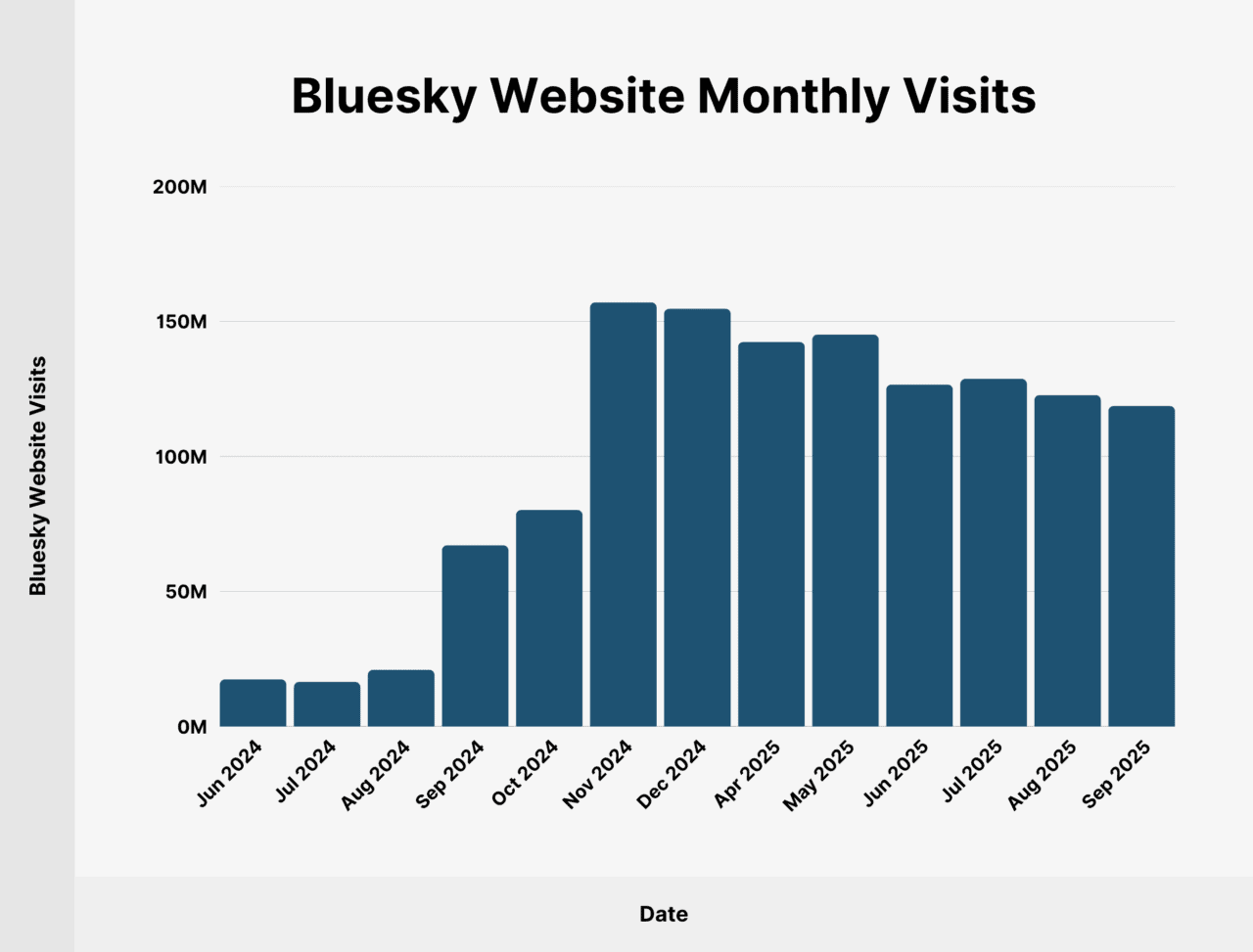
Bluesky is not just a shadow, it's on a pretty steady decline. Their DAU numbers are dropping every month. Which probably tells you something about the unspoken reason for this change.
Ah, I didn't realize the link I shared was Jaz's (it was shared in another comment), but they look similarly sideways over the past 6 months, with a noticeable bump in Dec / Jan.
Without researching actual numbers, it feels like that whole category of social media is pretty much uninteresting at this point. Not sure what really replaces it given that Facebook seems increasingly infested with AI slop and sponsored posts.
It is a zero-sum game in some sense, because you go where your friends or "influencers" are.
Mastodon ended up losing its user base to Bluesky during the early Twitter exodus because many influencers and journalists wanted to have an "elite" status and a special relationship with the platform, so they preferred a platform owned by Dorsey to some hippie open-source thing. Bluesky, in turn, ended up losing back to Twitter/X when it turned out to be a place where you mostly talk about how awful Twitter/X is.
I want to say that we don't need social networks where we constantly interact with hundreds of thousands of strangers, but I'm writing this on HN, so...
Just an anecdote - I never used Twitter/X, and never used BlueSky. Recently (about a year ago), joined Mastodon. I enjoy it, find a lot of value there, and have interesting conversations (recently about Mint Debian Linux & sound-systems, and also maker-space CNC design tools). There seems to be active investment in good features & quality on the platform, including making it easier to host your own organization server.
I believe, due to the format of engagement, its easy to spend a lot of time there scrolling - so consider
(1) only using the platform on your desktop computer, instead of phone,
(2) limiting time - 25 minutes a day is enough!
(3) Mute spammers, complainers, people with negative attiudes - you can't catch them all, but you can intentionally shape your experience over time.
(4) Subscribe to tags of your passions (example: #piano, #makerspace, #drawing, #cats, #jujitsu, #cncrouter, #3dprinting), and try to lean into that instead of getting caught up in endless political reactions - which never ends. You can be intentional, and subscribe to people who have a positive vision for the version of the future you prefer.
> Just an anecdote - I never used Twitter/X, and never used BlueSky. Recently (about a year ago), joined Mastodon. I enjoy it, find a lot of value there, and have interesting conversations
Same, more or less. Twitter started as a place to be interrupted by attention-seekers, and Bluesky was just "that but with less Elon Musk and more implementation throat-clearing." I never saw the point. Mastodon feels more like old-school Usenet, where you could find communities with shared interests, block the attention-seekers, and shrug at the usual human drama.
Curious, how many people do you need on a social network before you can find someone to talk to or before it is engaging enough for you?
I certainly don't need a billion users. I think I'd be happy with 100,000 users -- what is your number?
I think this is related to the question of how big of a city do you need to live in before you can find something to do and are not bored living there. I'm fine with a city of, say, 50,000-100,000. That is more than sufficient for me to find an appropriate number of likeminded friends and neighbors as well as interesting pursuits.
> Curious, how many people do you need on a social network before you can find someone to talk to or before it is engaging enough for you?
I don't think that's a meaningful parameter to think about? I'd say that on any social network, I have meaningful, ongoing relationship with maybe 20 people. I suspect that's the norm. But that doesn't mean you can join a social network with 20 users and get that. I mean, if it's a mailing list for friends and family, sure. But not if it's 20 randomly-selected strangers from around the world.
So the critical mass to make the "random stranger" type of a social network work is much, much higher than the number of daily interactions you need to keep coming back.
Yes, all you use is 20, but as the number increases the odds of you finding your 20 goes up. I'm saying in 100,000 roughly randomly selected people, I have basically a 100% chance of finding my 20. 50,000 is probably enough.
By the way, if your number is not the same as mine, I am not intimating that this makes you deficient in some way. Everyone has their own number.
Yeah and for me it should be mainly people like me. That's really what we do, we now live in a world that's too big for our minds to encompass, so we build little villages with like-minded people.
Some people call that bubbles, I call it sanity. I try not to spend my time giving out about the other side though. It just gives me negative energy.
As solid as the goals of Bluesky were from a technology perspective, the political driver of the user acquisition has the platform in the same category as Truth Social: political echo chambers. Two sides of the same coin. It's unfortunate because I don't think the branding is going away.
Mastodon has been great for tech communities in my experience though.
> It is a zero-sum game in some sense, because you go where your friends or "influencers" are.
Bluesky and Mastodon users can interact with each other (provided both parties opt in). I'm on Mastodon, but I see my friend's messages (he's on BlueSky) and vice versa. My replies show on up on BlueSky and vice versa.
I would love to see that work, but every time I've tried to set that up, it seems to fail. The bridges seem unreliable and non-responsive when trying to set them up or diagnose issues with them.
Sometimes I think more the toxic people who wrote about politics and identity on Mastodon moved on to Bluesky when Trump got elected.
I don’t see why it is “zero” sum, nothing stops you from posting to more than one social. I mean, I have relatives on Facebook and no prospect for getting them to change so I cut-n-paste what I posted on Mastodon to Facebook, Bluesky, LinkedIn, Tumblr, and all sorts of places.
Bluesky won over Mastodon because the fedi model is fundamentally flawed in its UX. For a flood of people wamting "Twitter without Nazis", Bluesky was a good match. I don't think Dorsey had anything to do with it, because the influx happened after he'd already severed all ties.
Some people are getting introduced to similar and in some ways worse UX on Bluesky now that there are some actual efforts to make it slightly less centralized.
I don't think there's a simple answer. For example, someone recommended black ink on white paper, but it really depends on the composition of that ink. Inorganic pigments last forever, but the ink used in black sharpies actually fades pretty quickly.
Pencil definitely lasts if the paper is undisturbed. I have some paperwork that's 100+ years old and with legible pencil text. On the flip side, if the paper is handled a lot, the writing will gradually fade because graphite particles just sit on the surface and can flake off.
On some level, the medium is your main problem. Low-grade paper, especially if stored in suboptimal conditions (hot attic, moist crawlspace, etc), may start falling apart in 20 years or less. Thick, acid-free stock stored under controlled conditions can survive hundreds of years.
Acid-free paper sounds like the way to go. Do you have experience with this? Or is it common knowledge? Just curious!
I also read letters from my grandparents, stored by my parents in a simple shoe box. No special conditions, just light-free and inside the home for decades. They were still very much readable. I did not pay enough attention, but I guess it was blue ink from back in the day that they used.
Many HNers strongly argue that it's absolutely impossible to distinguish between AI text and non-AI text. Some of it seems to be a knee-jerk reaction to some of the occasional, one-sided stories of people who were accused of using LLMs and fired from their jobs. And some of it seems to be just hedging so that we don't develop a culture that could penalize their LLM-generated posts or code.
We had people defending the fired Ars Technica guy, even though he admitted to using an LLM in some sort of a contrived non-apology along the lines of "I did it because I had a cold".
My main problem with that is that you can just generate an infinite supply of LLM op-eds about LLMs, and is this really what we want to read every day? If I want to know what ChatGPT thinks about the risks or benefits of vibecoding, I'll just ask it.
> Many HNers strongly argue that it's absolutely impossible to distinguish between AI text and non-AI text.
And it's becoming more and more difficult - not just by AI getting "better" (and training removing many of the telltale signs), but also because regular people "learn" to write like an AI does. We're seeing it with "algospeak" - young terminally online people literally say stuff like "unalived" in the meatspace nowadays.
Some is also horribly easy. If the text is full of:
- Overly positive commentary and encouragement
- Constant use of bullet point lists, bolding and emoji
- This quaint forced 'funniness', like a misplaced attempt at being lighthearted
- A lot of blablah that just missed the point
- Not concise and to the point, but also not super long
Then that really screams ChatGPT to me.
I think it's because this seems to be the default styling of ChatGPT. When people tailor their prompt to be more specific about style it's a lot harder to detect but if they just dump a few lines of instructions about the content into it, this is what you'll get. So the low-effort slop is still pretty easy to detect IMO.
Sure, it's obviously impossible to ID any single piece of writing as from an LLM without significant false positives.
But in practice, I frequently encounter a comment that either screams generic LLM slop or even just as a vague indefinable "vibe" due to one or more telltale signs, so that's red flag #1. Then, I go to the comment history, at that point if it's really a bot/claw/agent or a poster heavily using LLMs I'll usually find page after page of cookie cutter repeats of the exact same "LLM smell" (even if that account has been prompted to avoid em-dashes/lists/etc, they still trend towards repetition of their own style).
At that point a human moderator would have more than enough evidence to ban an account. It's not like we're talking about a death sentence or something. If no clear pattern of abuse from the long term commenting activity, then give them the benefit of the doubt and move on.
My most straightforward read is that the military simply doesn't want their contractors to have a say in the war doctrine. Raytheon doesn't get to say "you can only bomb the countries we like, and no hitting hospitals or schools". It doesn't necessarily mean the Pentagon wants to bomb hospitals, but they also don't want to lose autonomy.
A less charitable interpretation is that the current doctrine is "China / Russia will build autonomous killbots, so we can't allow a killbot gap".
I'm frankly less concerned about "proper" military uses than I am about the tech bleeding into the sphere of domestic law enforcement, as it inevitably will.
>A less charitable interpretation is that the current doctrine is "China / Russia will build autonomous killbots, so we can't allow a killbot gap".
What's the reason this is less charitable, exactly? Do we think this isn't true, or that we think it's immoral to build the Terminator even if China/Russia already have them?
I don't know what you're trying to argue about here. I meant "charitable" as in "not necessarily implying the thing critics worry about". The less charitable interpretation is that the implied thing is true but is seen as a necessity.



I've never heard about the Wason selection task, looked it up, and could tell the right answer right away. But I can also tell you why: because I have some familiarity with formal logic and can, in your words, pattern-match the gotcha that "if x then y" is distinct from "if not x then not y".
In contrast to you, this doesn't make me believe that people are bad at logic or don't really think. It tells me that people are unfamiliar with "gotcha" formalities introduced by logicians that don't match the everyday use of language. If you added a simple additional to the problem, such as "Note that in this context, 'if' only means that...", most people would almost certainly answer it correctly.
Mind you, I'm not arguing that human thinking is necessarily more profound from what what LLMs could ever do. However, judging from the output, LLMs have a tenuous grasp on reality, so I don't think that reductionist arguments along the lines of "humans are just as dumb" are fair. There's a difference that we don't really know how to overcome.
reply