I'll second this. Just finished his video on landslides the other day. Not only interesting, but also good info if you ever are considering a home on or around hilly terrain.
Your response was to the poster who said "It's a complex system, a feedback loop." That about sums it up. Your seven people operate inside this system. They don't have complete freedom to do what they want willy nilly.
Jerome Powell does actually have the freedom to do what he wants willy nilly. He might have consequences but he has the power and freedom to "set the price" of the USD.
For the physicists here I would greatly like to hear an opinion on what presents the greater physics challenge: keeping the ocean out at the depth of 13K feet or containing a spacecraft's atmosphere in the vacuum of space. I suspect it's the former but don't have the "mathy maths" to back it up.
Obviously there's a difference between pressure vessels that have to keep pressure in (like a spacecraft) vs one that has to keep pressure out (like a submersible). I believe keeping pressure in is generally easier.
But the much bigger factor is the pressure difference we are talking about here: At 13k feet you have about 1 atmosphere of pressure in the sub, and about 400 atmospheres of pressure outside, for a difference of about 400. In a spacecraft you have about 1 atmosphere inside and about 0 outside, for a difference of 1. 1 bar of pressure is much easier to deal with than 400.
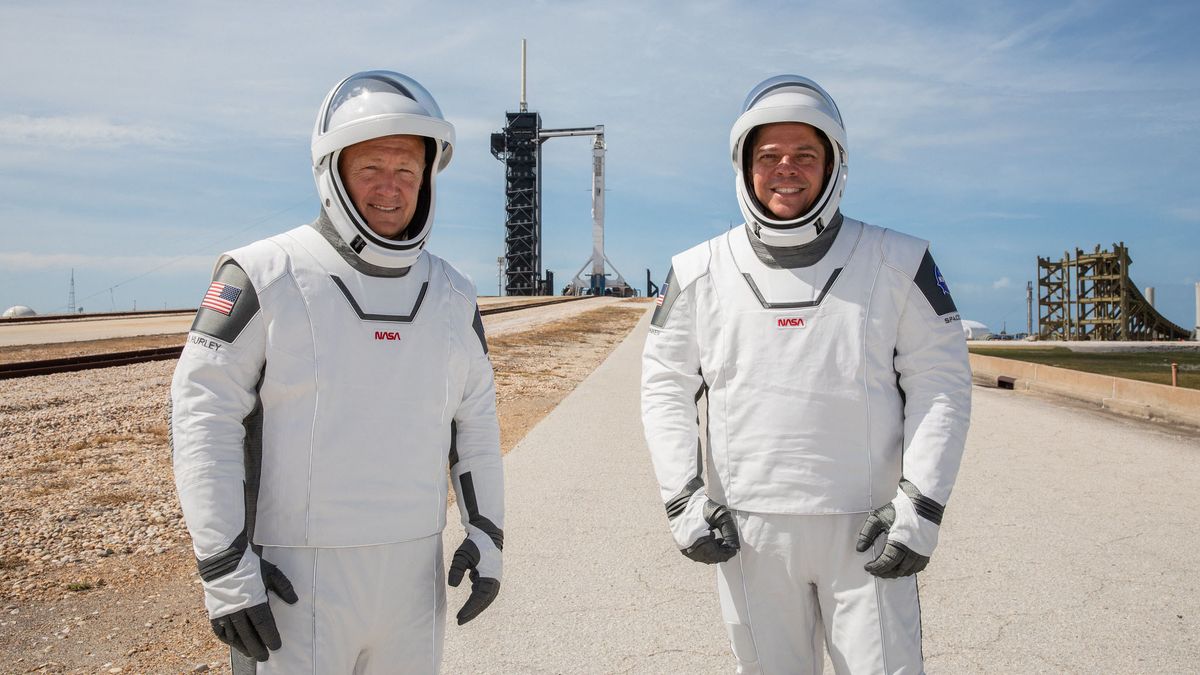
This also changes your emergency procedures: In a spacecraft, losing pressure means you need a pressure suit and a breathing apparatus. Because you still have the spacecraft for general shielding these can be pretty sleek suits like [1] that you can just wear the entire time and connect to an oxygen line as needed. In a submarine at these depths your best defense against sudden hull damage is being in a part of the sub that isn't damaged and has a solid bulkhead to the damaged section. Which isn't viable in a small submersible.
Spacecraft are challenging for other reasons: you want to go up fast to spend less time fighting gravity, which provides challenges because of aerodynamic loads; and when you come back down all the momentum of your orbit gets converted into heat as you slow down, which necessitates a decent heat shield. On top of that you try to minimize weight of everything, because being heavier means you need more fuel, but more fuel means you need more fuel to carry that fuel up, meaning you need more fuel, etc.
there's only ever a difference of 1 atmosphere or so between a spacecraft and vacuum, we're talking about a 400 atmosphere differential at those depths
You're dealing with a lot more pressure at these depths. You get to 1 atmosphere of additional pressure for every ~30ft when diving. That means 13k feet = 433 atmospheres of pressure.
In some areas of the economy, there truly were inflationary pressures that led real price increases. But there's always the human element and FOMO at play. Once "we're experiencing inflation" became a thing, it also presented an opportunity for other companies in the form of a cover or "excuse" to raise their prices simply to improve margins. "If these companies can raise their prices why can't I?" would be a component of that logic. Kingsford Charcoal* tried this but it backfired - mainly b/c there were other alternative charcoal companies that didn't raise their prices.
Obviously there seem to be some compelling reasons why the choice of a carbon hull was a faulty idea to begin with. The CEO would have been familiar with those critiques and proceeded anyway, presumably because of counter arguments he put more confidence in. Anyone out there familiar with what some of those counter points may have been?
They are licensed as a money transmitter like Western Union. It is a lessor form of regulation. So while they look "bank like" in some things they are not legally a bank.
I'm saying this with extreme snark, but wait until smart homes become more commonplace and you won't be able to walk past your thermostat without Amazon pitching you new filters every six weeks over the smart speakers. Yes, there's many if's there, but the point is mostly profit motive usually trumps good taste.
Re: Windows, if we're not paying for it anymore are we still the customer? Even if that's a yes, it represents a cost for msft, so they seem to be looking to extract any amount of value out of it that they can. I doubt I'll use it past Win10, the downsides just keep piling up.
I would venture a guess the logic in some of these cases has a healthy does of practical wisdom baked in. On sailing vessels they are/were? chaotic, violent, noisy, and the crew perhaps wasn't the most experienced/educated(?) so keeping things simple with fixed names was perhaps the optimal safety solution in that environment. In the medical profession it's about the Hippocratic Oath (I am not a doctor), an operating room is more controlled, and everyone (is usually) well trained, so maybe in that environment it makes more sense to make a rule that the perspective should always be the patients? Thinking out loud here more than anything...
This is exactly what I would expect them to do. Amazon (AWS) sells compute resources and generative AI may be a gold mine for that. They need to have the tools and mindshare in place early for this market.