Hacker Newsnew | past | comments | ask | show | jobs | submit | pmcjones's commentslogin

Author here. This is work-in-progress, not linked from top level. I'll keep working.


Remembering John Backus:

> [...] At that time, John was interested in pure functional programming, with no side-effects on storage or the external world. I advocated extending the language to allow writing complete interactive applications. John conceded the importance of this, and came up with a scheme in which one would write a function to express the complete transformation of an application on the global state. I struggled with John’s variable free style, and suggested we allow lambda variables when defining a new functional form (higher-order function), but he stuck to his guns.

(In my project) I’ve reduced extensibility to the meta-composition rule, and I’m using an IO monad for interaction because I believe all functions should remain as simple as possible.


Is this your project: https://github.com/metazip/pointfrip ?


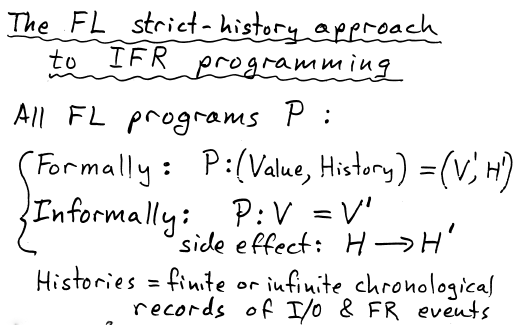
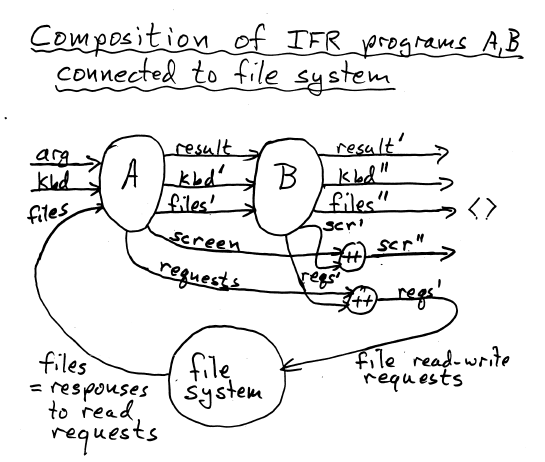
I have looked at the diagrams. If a side effect occurs between Program A and Program B, then referential transparency is violated. Referential transparency is the "sacred principle" of algebra; if it is violated, no algebraic transformation is possible—unless I am mistaken or we are talking about a monadic continuation.


Can we move this conversation to email? I am not sure what diagrams you are referring to.


In that first diagram (https://softwarepreservation.computerhistory.org/FP/Composin...), A and B are supposed to be pure functional programs; side-effects are modeled by each one outputting a new version of each modified input. In the second diagram (https://softwarepreservation.computerhistory.org/FP/Strict_H...), as actually implemented in FL, they stick to strictly leftmost-innermost evaluation order so that side-effects are at consistent (but this presumably prevents parallel evaluation).


Yes, it started with https://esolangs.org/wiki/FP_trivia in Delphi, and the project using the Lazarus-IDE was Pointfrip.


Thanks for the extensive collection. Valuable work. I’ve included a reference to the link collection on https://github.com/function-level/function-level.github.io


Thanks very much; I in turn will add a link the Related Resources section. If you'd like to be recognized as other than metazip then let me know via email.


Videos to FL and FP: John Backus: Function Level Programming and the FL Language 1987 (https://www.youtube.com/watch?v=FxcT4vK01-w&t=15s), John Backus Group Meeting - IBM Research - 5 July 1989 (https://www.youtube.com/watch?v=KzBkb-bvNK4), Backus on functional programming (https://www.youtube.com/watch?v=OxuPZXXiwKk) from Original: Oral History of John Backus (https://www.youtube.com/watch?v=dDsWTyLEgbk)


The first video is the same as https://softwarepreservation.computerhistory.org/FP/#Backus1... .

I hadn't seen the Group Meeting video; I will add it (even though it's very rough).

I will change the entry for [Booch2007] to include the video as well as the transcript.


Wow! How did I manage to miss this treasure trove! Thank you.


For more information about Mesa, see: https://softwarepreservation.computerhistory.org/mesa/


I donated https://www.analogmuseum.org/library/beckman_EASE_installati... to this web site. The original was from my father-in-law, Professor Cyril P. Atkinson at U.C. Berkeley.


https://softwarepreservation.computerhistory.org/mesa/

Mesa had DEFINITIONS modules, exceptions, subranges, and threads.


Last updated 1996.


Ah, didn't check that.

Nevertheless, a useful starting page to begin one's research from.

Somebody needs to create a similar list for current times. Maybe the co-author of "Elements of Programming" and preserver of "Software History" artifacts, named Paul McJones would be the right person? ;-)


The link dump includes scans of the source code and a link to this free-to-read paper on the history of the Lisp 2 project: https://ieeexplore.ieee.org/document/8267589 (I’m the author).


And here's an English translation of the History chapter from Stoyan's 1980 book _LISP-Anwendungsgebiete, Grundbegriffe, Geschichte_ [LISP Application, Basic Concepts, History]: https://softwarepreservation.computerhistory.org/LISP/book/S...


Thanks. Even though I'm originally from Europe, the book has ended up somewhat focused on what happened on the continent where I now live. It's something I'm planning to fix for a potential second edition.


Really nice of you to share it, thank you.


I will read them over the weekend.


Here are some bibliographies, including an extensive (but old) one by Herbert Stoyan. Apologies for the rough formatting of them: https://softwarepreservation.computerhistory.org/LISP/resour...


And it's worth pointing out here that the book itself is now freely available: https://dl.acm.org/doi/book/10.5555/542865


Maybe I’m missing something, but that webpage only seems to provide a PDF containing the beginning of the book (up through the Preface). Perhaps you need a ACM Digital Library Premium subscription to access the entire book?


Sigh -- they keep changing the rules. I think you have to have a free ACM account. If you send me an email (see my home page in my profile), I'll send you a PDF.


I appreciate your offer, but there’s no need. I subsequently found a copy here:

https://softwarepreservation.computerhistory.org/LISP/book/A...


Guidelines | FAQ | Lists | API | Security | Legal | Apply to YC | Contact

Search: