- In college there were basically no women in any of my classes, like 1 or 2 in a class of 30-40. Not having an entire gender being interested in a field(generally speaking) makes numbers overall very low.
- In a Java class I took in college, it was standing room only for the first two sessions, after 3 weeks the class was 70% reduced, by the end of the class it was about 25% of its original size. CS is hard, lets be honest(for most people), to excel you have to love it or be mathematically inclined.
- People, when looking at a career don't see CS as long term choice, they hear of burnout due to extreme overwork, and blatant ageism when you hit 40's. I asked a friend who went into the medical field about CS and they said they want to work into their 60's-70's and didn't want to be forced out of work due to age bias.
- Most engineers don't have much 'clout' in a organization that isn't a pure tech company, I have been solicited by GS and other hedge funds but always pass as I know I will always be 2nd fiddle to finance folks/business majors.
> - In a Java class I took in college, it was standing room only for the first two sessions, after 3 weeks the class was 70% reduced, by the end of the class it was about 25% of its original size. CS is hard, lets be honest(for most people), to excel you have to love it or be mathematically inclined.
Yes CS is hard. But arguably so are Maths, Physics, Psychology, Medicine, Law, Engineering, etc. I wonder what the drop out rates are for those are. And more importantly they seem to be popular in terms of the numbers of people that want to pursue those courses.
> - Most engineers don't have much 'clout' in a organization that isn't a pure tech company, I have been solicited by GS and other hedge funds but always pass as I know I will always be 2nd fiddle to finance folks/business majors.
I think you're right about this. Although you get some clout as a Quant developer in those types of places
>In college there were basically no women in any of my classes, like 1 or 2 in a class of 30-40
In high school, about half my AP CS class was girls, I think.
Maybe it's not so much that "an entire gender" is disinterested but that there was a tidal wave of people who wanted to get into programming after 2000 who were mostly male and changed the culture? And a lot of people, who were good at other things besides computers, said yuck and did something else.
It's easy to assume that when a group dominates a field that they must be better on average at the required skills, but it could be more a result of their lack of other skills.
I don't think it's a post-2000s thing. In a year where hundreds graduated with a CS degree, I think there might have been around 15 females in my year (1994).
My brother did CS as well (mid-1980s). There might have been only one female in his year. There might have been more, but he never spoke about them that I can remember.
I suspect the gender bias has been around for a long time.
> In a Java class I took in college, it was standing room only for the first two sessions, after 3 weeks the class was 70% reduced, by the end of the class it was about 25% of its original size. CS is hard, lets be honest(for most people), to excel you have to love it or be mathematically inclined.
I don't understand how a college survives 75% of their students dropping out like that?
And do they not interview and assess people going in for aptitude?
At my school, generally you would enroll in ~3-5 classes per semester. One or two of those classes would be your "main focus" for the semester, and then you might try to fill a breadth or take something that interests you. You would have a week or two at the beginning before your schedule is fixed to move around classes. So you're not dropping out - you're swapping an Intro to Programming class for something you think you'd get more value out of.
I've dropped classes ~45 minutes in to the first lecture because I just... didn't need to take it and wasn't enjoying the professor speak.
Well it is 75% of a subset, computer science as oppossed to the whole college. That and they are largely a drop out of the class as opposed to the college. They mostly transfer to other easier "back up" majors.
I agree with your points about perceived burnout and ageism. I disagree with the anecdote about difficulty of the Java class. I don't have any first-hand experience with calculus, or any other STEM classes (was a communications major before self-teaching/bootcamp) but I would imagine the difficulty there would be pretty comparable


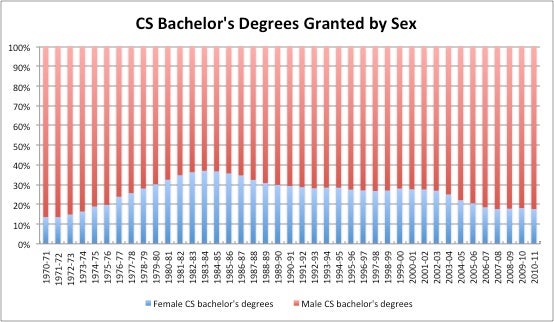
- In college there were basically no women in any of my classes, like 1 or 2 in a class of 30-40. Not having an entire gender being interested in a field(generally speaking) makes numbers overall very low.
- In a Java class I took in college, it was standing room only for the first two sessions, after 3 weeks the class was 70% reduced, by the end of the class it was about 25% of its original size. CS is hard, lets be honest(for most people), to excel you have to love it or be mathematically inclined.
- People, when looking at a career don't see CS as long term choice, they hear of burnout due to extreme overwork, and blatant ageism when you hit 40's. I asked a friend who went into the medical field about CS and they said they want to work into their 60's-70's and didn't want to be forced out of work due to age bias.
- Most engineers don't have much 'clout' in a organization that isn't a pure tech company, I have been solicited by GS and other hedge funds but always pass as I know I will always be 2nd fiddle to finance folks/business majors.