A circle is harder to build and has more issues regarding sunlight. The sun hitting the building(s) is both a benefit (solar cells) and a problem (heat generation) at the same time. A linear structure will get a much more even energy distribution than a circle.
Also one of the goals of the project is to reduce the energy needs of the population by making ways shorter. If you spread a city out on a circle, you got a much more complicated and expensive transportation problem than just the linear structure presented here.
I think transport would be infinitely worse in a linear city.
In a traditional street network, there are many ways to get from A to B and one link being unavailable is not the end of the world. Forcing everyone onto essentially the same street is guaranteed to cause both high fragility and high congestion, since everyone has to squeeze into the same line.
There's no need to have only one line to connect everything, even in a linear structure. It's still about the topology.
At the simplest there would be one line connecting from end to end, which should be the fastest and the one with the fewest stops. But then you have smaller lines, travelling in their own tubes, connecting local areas. That way you can travel between any two points relatively fast and avoid congestion. You can build redundancy into this system. But also, it's not a catastrophe on a normally 20 minute trip if there is blocked section and you have to walk a few minutes, take a local connection to bypass the blockage and then go on. Happens to me all the time...
The big benefit in a linear city is that the transport pods never need to turn around. You also don't need to manufacture curved rails or things like that. You can build structures like that in a "2D" city, but it's harder.
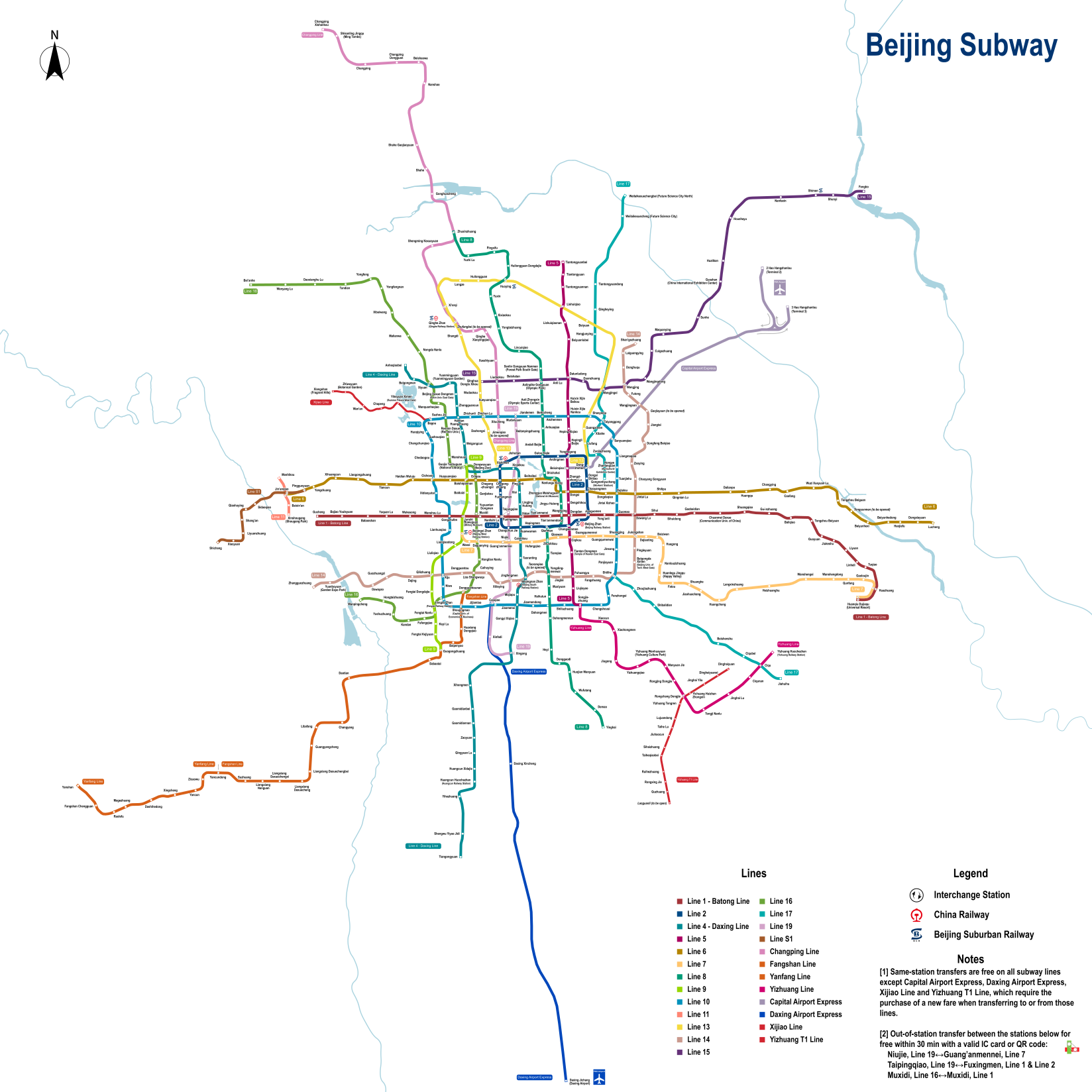
In 2D, you can build a grid of straight line railways. Riders transfer zero or one times. Cost scales proportionally to area (and hence population) assuming constant density. Time between two random points scales as sqrt(size). Ridership on a given rail segment scales like sqrt(size), which may be tolerable.
In 1D, you can build a linear railway. Cost scales proportionally to length (and hence population) if you assume that the the railway merely needs to get longer as population grows, but this gives a system where ridership on a given rail segment scales linearly with population, which is much worse. Time between two random points also scales linearly with population. The added costs associated with improving performance given the worse scaling seem likely to blow the whole thing up.
It's harder to build a grid of straight railways. You need more bridging or crossing at the very least. You are right about 2D being more efficient in terms of the length between two random points, but there could be scenarios where the simplicity still outweighs that benefit, especially given all the other factors in this project, like sunlight.
The length is also much less of a concern than in traditional transport systems because of less friction and less need to brake, so most of the energy is for accelerating and decelerating at the stops.
Of course it would blow up if you wanted to build a fully connected city that is twice that length or even longer, but that's not proposed.
I’d assume this linear city would also involve a lot of bridging, since due to the width trains would basically almost be on top of each other.
Trains crossing perpendicular have to bridge maybe 6m at most. You’d have to bridge the entire length of city for this. And a fire would render any lines above or below unsafe to run until extinguished.
> In 2D, you can build a grid of straight line railways. Riders transfer zero or one times. Cost scales proportionally to area (and hence population) assuming constant density. Time between two random points scales as sqrt(size). Ridership on a given rail segment scales like sqrt(size), which may be tolerable.
I doubt this would work. Cities don't do this for a reason.
Transit lines get built according to transportation needs, not mathematical coverage of the space. You have pockets of housing that need to get to pockets of commerce. You can't practically run transit cars connecting [0,0] and [end, 0].
Grid like comes with a caveat. Most grids are only in city center (so that lines can connect to every other line in the city with most demand), and subways are not often grids but rather interlocking L shapes and curves depending on which radial direction out of city center got to have a subway first (but usually you can still see distinct gridlike patterns). And then there's geographic impediments like where streets and parks are.
Most people in Hong Kong don't own a car, it's just not necessary due to the high density. This city is expected to to be ~15 times as dense as Hong Kong.
You don't need high density to not need a car. Its totally possible to design cities where most people don't need cars that are not full of huge towers.
The idea that car-free or very limited car is only possible if you have absurd density is false.
Its totally possible to have nice suburbs that are totally walkable and don't require a car for 90% of the population.
Remember, this is still a 2D project. The second dimension is up! Instead of XZ axes, it's XY.
There are still multi layer travel options available. And some previously unthinkable possibilities (e.g. moving walkways like the kind you see in airports, for short distances within a block – or different colored trains on different levels like ground/underground) are still possible.
wrong on all counts. A disc has the same transit "solution" that a line does, just draw a spiral. for a line however, this is the only solution, and boy is it terrible. Imagine if society were all in one skyscraper and the only mode of transit was the elevator.




Also one of the goals of the project is to reduce the energy needs of the population by making ways shorter. If you spread a city out on a circle, you got a much more complicated and expensive transportation problem than just the linear structure presented here.