> I think a lot of our current sociological problems, problems associated with wealth inequality, etc.,
I see where you’re coming from, but is this really the main source of the inequality?
Based on numbers relating to workers’ diminishing share of profits, it seems to be that the capital class has been able to take a bigger piece of the profit pie without sharing. In the past, companies have shared profits more widely due to benevolence (it happens), government edict (e.g., ww2 era), or social/political pressure (e.g., post-war boom).
Fwiw, I think that the mid-20th century build up of the middle class was an anomaly (sadly), and perhaps we are just reverting to the norm in terms of capital class and worker class extremes.
I see tons of super skilled folks still getting financially fucked by the capital class simply because there is no real option other than to try to attempt to become part of the capital class.
I think you and the one you're replying to are both very right.
Yes, more of this money is going, instead of middle-class workers, straight to the capital class who own the "machines" that do the work people used to do. Except instead of it being a factory that makes industrial machines owned by some wealthy industrialist, the machines are things like Google and AWS and the owners are the small number of people with significant stock holdings.
It's really striking though that a person graduating high school in say, 1970, could easily pick from a number of career choices even without doing college or even learning an in-demand trade, like plumbing, welding, etc. Factory work still existed and had a natural career progression that wasn't basically minimum wage, and the same went for retail. Sure, McDonalds burger flippers didn't expect then to own the restaurant in 10 years, but you could take lots of retail or clerical jobs, advance through hard work and support a family on those wages. Those are the days that are super gone and I totally agree with you both that something has changed for the worse for everyone who's not already wealthy.
> but you could take lots of retail or clerical jobs, advance through hard work and support a family on those wages. Those are the days that are super gone
Only in certain places, and only mostly due to crazy policies that made housing ridiculously unaffordable. I'm in an area where my barber lives on 10 acres of land he didn't inherit and together with his wife raises two children. This type of relaxed life is possible to do in wide swathes of the country outside of the tier-one cities that have global competition trying to get in and live there, as long as you make prudent choices.
I think 20- to 30-something engineers who have spent their entire adult lives in major coastal cities have a huge blind spot to how middle America lives.
Very anecdotal, but I don't know anyone making minium wage for my area. I do know tons of people making within 1-2 dollars of minimum wage though. If we divvy up the data into groups like that, I wonder how much that 1% jumps.
I don't know how accurate this data is, but this website[0] breaks the US average down to single percentiles, and has detailed data for many metro areas, as well.
The comment I was replying to stated that that lifestyle is achievable for traditionally minimum wage (or close to it) jobs as long as you choose to live in a small city though
I was about to reply the same and I looked up the BLS data. The median wage for a barber is $14.41. Now I know that's at or below minimum wage in cities, but I suspect it's quite higher the minimum wage in rural areas.
I don't see a problem with that, as long as those who may be earning minimum wage at any given time have the opportunity to improve their lot. I see no reason why the lowest incomes would result in median lifestyles.
To be clear, I don't think most people expect that either -- but I'd argue that most entry-level jobs today are just a big endless cycle of unskilled labor staying long enough to get fed up and moving to the next dead-end job, with the companies moving on to the next as well.
In general, I'd argue minimum wage jobs aren't anymore a stepping stone to some sustainable good job; they're basically viewed like consumables by companies. Even someone with a decade of experience, say, at several retail stores or restaurants, can't expect to be offered a position making $50,000 a year plus benefits just for having done his job well every day. By contrast, a dedicated factory worker with a decade of experience 50 years ago could expect to have advanced somewhat, and would expect continued advancement. Today everyone working in retail, restaurants, etc. all know that if they're going to do any better it's going to be by leaving that sector, via learning a trade, going to college, or perhaps founding their own small business. All things which were good options in the past too, but advancement was once a realistic expectation too.
How middle America lives, for a lot of people, is making within a buck or two of minimum wage, with virtually zero chance of significant advancement, trying to scrape together enough to meet your expenses. You might become assistant manager of the big box store, but that won't transform your life. The only way out is learning a skilled trade or certain college degrees (and likely leaving town).
This isn't specific to cities.
In fact, people in rural areas are worse impacted, because the rise of Walmart, Dollar General, and others funnel money out of their towns that would have otherwise enable many local families to capture the profits from local spending. Today a lot of that spending goes mostly to those companies, and only a fraction of the money stays, in the form of a few low-wage jobs.
I'm not saying it's impossible to not live in poverty. I'm just saying it's much much harder, because "advancement" is obsolete in a lot of occupations where it used to be a thing.
The idea that an average working person could buy a house in their twenties was only possible: 1) in America, and 2) for the baby boomers generation, maybe for some of Gen X. Nowhere else, never after. This is the exception of exceptions, not a norm.
Be that as it may, I would like to continue at least this part of American exceptionalism. There is still plenty of room in this country for young families to own their own homes.
The entire world watched in awe. Here in Switzerland (a very well-developed country), buying a house is something done in the forties, if you are middle to upper middle class. Otherwise, you rent forever.
I am curious if your barber can afford health insurance plus out of pocket maximums for a family of four ($30k+ per year just in premiums plus $5k to $10k oop max), not to mention short and long term disability insurance in case he gets hurt and cannot work.
The only situation I can imagine would be if the wife has a government job with extremely generous health insurance subsidies.
Not OP, but I pay my barber $50 for a 15 minute haircut. Runs his “barbershop” out of his house, which he owns, in one of the most desirable neighborhoods in Seattle.
There’s always another appointment lined up before and after mine, so I guess he’s pulling 6 figures without much sweat.
Something tells me a rural barber in a place he can afford to buy 10 acres without inheritance money is not in a location with many people willing or able to pay $50 for a 15min haircut.
You're quite right, people don't pay $50 for a haircut here, but it scales a little less than the cost of living does. I pay $35 inclusive of tip. For what it's worth, the cost of living here is a little over half of that in Seattle.
I live in the principal city of the local Metropolitan Statistical Area; it's by no means a big city, but it's representative of many small cities around the country. My barber lives out in the county, outside of city limits, where it is much more rural and one can indeed buy 10 acres for not a whole lot of money.
I believe his wife is a schoolteacher; I don't believe public employee benefits are especially generous in this state.
They are usually very generous, especially health insurance subsidies. My friend with a teacher wife pays almost zero, for premiums and out of pocket. And they had multiple IVF rounds covered.
Ask them what their deductible/oop max, and how they get that insurance, and I bet you will have your answer for how your friend can afford to raise a family of 4 as a barber and buy and live on 10 acres of land. I doubt a 2 barber couple could pull it off. The security/benefits of one half of a couple being a government employee is pretty valuable.
Probably, but my barber is awesome. Older now, but he was once very prolific and well known in the music & arts scene. He’s an excellent story teller, and an overall entertaining person to interact with.
I’m not just paying for a haircut, it’s an experience that’s worth every penny.
> It's really striking though that a person graduating high school in say, 1970, could easily pick from a number of career choices even without doing college or even learning an in-demand trade, like plumbing, welding, etc. [...] Those are the days that are super gone
Isn't this rather a strong argument for the claim that what high school as of today teaches is a strong mismatch with what the labour market demands? In other words: the pupils are taught skills for many years of their life that are rather worthless for the job market.
This is true, but I dont think high school was ever intended to be preparing kids for the labor market; I thought it was to teach a basic education for understanding the world.
Until maybe four decades ago, high school was exactly intended to prepare kids for the labor market. They taught conformity, punctuality, the three Rs, and civics. It was the final education for the great majority of people in the US, as few went to college.
But high school and college both got dumbed down, and now an education at a state university is comparable to high school in the first half of the twentieth century.
Schools have always been like that. There's a reason that all of those skilled trades require multi year apprenticeships.
School teaches everybody to read, write and reason about things in general to a decent level. You can't teach high school kids the basics of all the careers out there beyond stuff that's generally applicable - you wouldn't have the time or the equipment. And schools do often have elective shop, cooking, electronics etc classes for those who want to do them.
I think there is a risk to the trades as well. Tradesman service prices are skyrocketing, too. With fewer people able to hire them because they cannot afford it, won't trade jobs fall as well?
I think there's risk in trades like any business, but the world will always need plumbers, electricians, etc. Someone will always find the market price for when people are willing to pay to not have to interact with sewage or potentially get shocked.
I hope they would, but in my 40 years of owning homes, prices to have things done double every 7 years. This would mean 10% inflation year over year, but that isn't the case, and wood prices have not gone up that much. Everyone is just charging more because they can. I keep thinking: at some point homeowners won't be able to afford this, but I've been wrong for 4 decades and just keep writing the checks with firmly clenched buttocks every time I need a major repair.
Look .. I am one of the working class here. But I gotta point out. Our standard of living is far superior to someone living in 1970 when it comes to stuff/technology. The stuff is cheaper because of China/globalization. The tech is there because we outsourced production and kept specializing the work force.
I don't think UBI is the solution. Nor is squeezing people more than they are being squeezed. Efficiency and productivity are good things. What is wasteful are things like make-work programs like the DMV or other govt office. That crap needs to be automated away. Hospitals need more funding. Schools are unclear. I think schools would benefit from privatization. I don't think the same of hospitals. Not sure why.
It's not about our "standard of living", it's more about class mobilization. If you were born poor, you could still get a job at McDonalds, go to college on those wages, and buy a home/start a family and live middle class easily, if not upper-middle class if you chose a high-earnings potential career.
Today, that's close to impossible unless you take student loans, go through the gauntlet of getting a higher paying job, and then have to grapple with home prices assuming you don't live in a place with reasonably affordable home ownership.
If you think the DMV and government offices are "make-work" then we need to start with cutting military spending because it's the biggest "make-work" government program we have that the vast majority of U.S. spending goes to.
Well, I paid into SS and Medicare for fifty years, and I’m getting less out than I put in. But, still glad to have them.
Some people call it a Ponzi scheme, but it’s a pool, as designed.
The military is a big jobs program and all the industrial support generates a lot of economic activity. Better if they just dropped it in the ocean, though. Too much temptation to test it.
Standard of living shouldn't be judged purely in terms of "stuff"; that's not how human brains work. There's relative effects ("keeping up with the joneses") as well as the effects of having options and possibilities for advancement ("American dream"). Make those things less accessible and people will feel less well off.
And outside of electronics a lot of physical-goods/land stuff is less attainable in many places in the country anyway.
The problem with non-redistributive approaches is that generational wealth rarely goes away. So if you don't have it, the number of people who don't have to try to out-spend you for whatever you want only goes up as time passes.
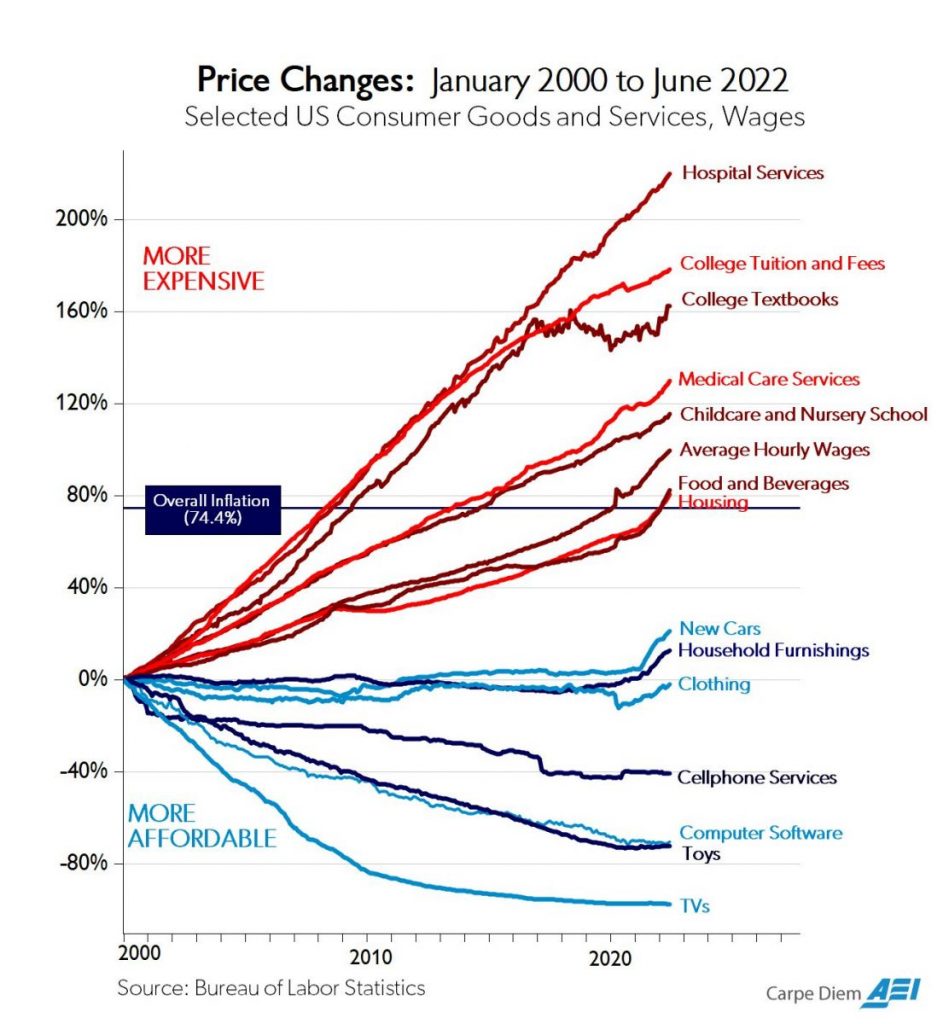
televisions are cheaper, food, housing and healthcare are more expensive [0]
I'm pretty sure the latter 3 are more important to standard of living than the former.
Ergo, I believe your claim that standard of living is superior to 1970 is false. Having a shiny iPhone to distract you from the fact that you're homeless, sick and starving is not a step up.
> I think schools would benefit from privatization
Well, we (in the US), have slowly been privatizing them and it’s bad! If you look at test results though, it’s great! Because private charter schools can drop underperforming students before the end of the term and artificially inflate their numbers. There are many more reasons that education with a profit motive isn’t better than without. I suggest maybe reading up on this before casually suggesting how you think we should radically erode our institution.
I went to private school and this is very true. If you are going to privatize schools well then private schools need to keep students with iep regardless of cost, like public schools , or they should get no funding whatsoever from taxpayers.
Sorry, my phrasing was bad. Totally agree, even today trades are still AMAZING for this. I meant even if you were to set aside the trades, 50 years ago there was plenty of stuff you could at least support a family on without even that level of specialized skill. You could "start in the mailroom" or on the sales floor and end up in middle management after 20 years, in a variety of companies, most of which don't even exist anymore, or if they do, they employ far fewer workers domestically today due to a combo of offshoring and automation.
> the capital class has been able to take a bigger piece of the profit pie without sharing.
In the current world, where do you think a lot of the capital class is able to get their capital?
Technological progress, and especially the Internet, has made much bigger markets out of what were previously lots of little markets, and now th "winner take all/most" dynamics make it so that where you previously could have, for example, lots of "winners" in every city (e.g. local newspapers selling classified ads), where now Google, FB and Amazon gobble up most ad dollars - I think someone posted that Amazon's ad business alone is bigger than all US (maybe more than that?) newspaper ad businesses.
IMO the "main source of inequality" is that tech allows a small number of people to use technological and fiscal leverage to make an outsized impact on society as a whole. Anyone who has a job that produces value in a 1:1 way is positioned to be 'disrupted'. NLP, etc, just provides more tools for companies to increase their leverage in the market. My bet is that GPT-4 is probably better at being a paralegal than at least some small number of paralegals. GPT-5 will be better at that job than a larger percentage.
Anyone who only has the skills to affect the lives and/or environments of the people in their immediate surrounding are going to find themselves on the 'have nots' end of the spectrum in the coming decades.
This is exactly what has happened to commercial and investment banking (market/trading) in the last 30 years. Computers and mass automation. Even if your profits only grow with inflation (in reality, they grow much faster), but you can reduce costs each year (less labour required), then return on equity continues to rise. It is crazy to me that most big commercial banks still have so many physical branches. I guess they exist for regulatory purposes -- probably _very_ hard to close a branch to avoid "banking deserts".
This has changed considerably. Chase remodeled most of their existing branches so they have like, 1 teller, and 2 or 3 people sitting at desks for other transactions. That's it. The days where your usual branch had a line of like 15 tellers are long gone. Out here in southern california, I think they also closed many of their branches in the past few years.
But looking back further - ohhhhhh yeah dude. Oh yeah. Totally. For a brief period my mom worked at a BofA facility that _processed paper checks_. Like they had a whole big office for it. That's completely 100% gone now. The checks get scanned at the point of entry (cash registers, teller counters, etc) and then shredded.
I have family that has been on the front lines of fighting global poverty and corruption, for their entire life (more than 50 years -at the very highest levels).
I submit that it is not hyperbole to say that probably 95% of all global human problems can have their root cause traced to poverty. That is not a scientific number, so don't ask for a citation (it ain't happening).
There is no sharing and there never was. Companies don’t share profits with workers and they never have. Workers get paid on the marginal value of their productivity, not some portion of the total or average.
I don't know what you mean to imply by "government edict (e.g., ww2 era)" but WW2 in the US was the era of the US fixing wages under the authority of the president
> Based on numbers relating to workers’ diminishing share of profits, it seems to be that the capital class has been able to take a bigger piece of the profit pie without sharing.
I was with that site until it compared the US budget to a household budget with a credit card. The average American family doesn't control the federal reserve or set interest rates and employs zero economists, so that seems like a dumb way to think about the problem.


I see where you’re coming from, but is this really the main source of the inequality?
Based on numbers relating to workers’ diminishing share of profits, it seems to be that the capital class has been able to take a bigger piece of the profit pie without sharing. In the past, companies have shared profits more widely due to benevolence (it happens), government edict (e.g., ww2 era), or social/political pressure (e.g., post-war boom).
Fwiw, I think that the mid-20th century build up of the middle class was an anomaly (sadly), and perhaps we are just reverting to the norm in terms of capital class and worker class extremes.
I see tons of super skilled folks still getting financially fucked by the capital class simply because there is no real option other than to try to attempt to become part of the capital class.