I just want to state outright that OP was wronged, and I side with them.
That being said; I dislike both full subscription (i.e. breaks on expiration) and lifetime licenses. Subscriptions are too expensive for software that rarely gets major investment and lifetime licenses are dishonest (e.g. company cannot work for free, so their funded is based on unlimited growth, which isn't realistic for most).
My current favorite business model is the "You're buying the current version and [years] of updates." Then typically you'll get some discount to renew your "[years] more of updates." This incentivizes them to deliver value, or you'll just stick with whatever version you purchased. Your software keeps working no matter what ("lifetime"). One example of someone who does this well is Jetbrains, but there are several companies.
Obviously subscription is the only option if they're delivering most of the value via a web-service of some kind (e.g. ChatGPT Plus).
> lifetime licenses are dishonest (e.g. company cannot work for free, so their funded is based on unlimited growth, which isn't realistic for most).
I don’t really know what you mean by “dishonest”, that seems like a slightly hyperbolic word here. If someone pays for a lifetime license the company isn’t working for free nor necessarily assuming unlimited growth, they just have to understand and correctly price the average value of their contract, and there are many established successful businesses doing exactly already. And it’s common to price the lifetime license below the predicted average total costs, because money in the bank today is more valuable than later (it’s an investment, and the money can be used as such.) If there’s something I really know I’m going to use for years, and I can get a discount by paying up front, I’m totally in favor of doing so when it’ll cost me less and support the company as well.
I'd say it's dishonest in the sense that a company knows the probabilities are such that they can't actually ever truly support a lifetime license, so it's a lie from the start.
At the end of the day, companies usually go out of business or else sell themselves to another company within a certain number of years. And a new company (like in this case) may change their mind about lifetime licenses, because it's a totally different set of owners with different priorities. "Everybody" knows this, but company management knows it even more than consumers, hence the dishonesty.
As a rule of thumb for consumers, anything supposedly perpeutal or "lifetime" for consumers in the business world is probably not even going to last 10 years. It's effectively always a lie.
I agree. The only time a lifetime license will actually be honored as such is of the company’s product fails and it’s no longer around as a company, so it allows you to continue using the current version as is.
When companies that have offered lifetime licenses don’t fail, they inevitably kill the lifetime part of the license by pulling different tricks like, creating a cloud version which now becomes their future version, while the desktop version is no longer maintained, or rebranding the same app as a new app where actual development continues while the old app gets minimal updates at most, or not updating the app with the lifetime license so it works on modern OSes and platforms.
If you’re lucky, you may have snagged a lifetime license the company offered early in its life, which it then stopped offering once it started getting successful, so it continues letting you use the lifetime license because the owners of such licenses are few enough that any marginal revenue they may earn by pulling the above tricks is not worth the reputational damage.
> The only time a lifetime license will actually be honored as such is of the company’s product fails and it’s no longer around as a company, so it allows you to continue using the current version as is.
You could also sell mission-critical software with a lifetime license. It just has to be bad enough that it can outlive the user.
Ugh, please don’t make it worse and escalate to “lie”. You’re blaming the wrong source, and have it backwards IMO. The previous owners weren’t lying, the new owners are the ones to blame for breaking a pre-existing contract with the company. Breaking this contract might not be legal, and in that sense they may be only the ones lying.
If the previous owners were truly committed to upholding the lifetime license, they would have never sold the company without an ironclad legally enforceable guarantee the new owners would uphold the lifetime license as well.
They clearly didn't. They either didn't care, or it would have decreased the sale price of the company (or the ability to sell it at all) and they preferred the money.
So I absolutely hold the original owners equally responsible. They made the promise and they created the conditions for it to be broken. Which was an entirely predictable outcome, which is why calling it a "lie" doesn't seem inappropriate.
Why do you believe the contract with the customer isn’t legally enforceable? The new owners may just be choosing to break the law because they believe nobody will attempt to sue them over fifty bucks or whatever.
I guess you can decide to blame whoever you want, but the legal responsibility for upholding a contract lies with the company, and a change of ownership doesn’t change that from a legal perspective. It also doesn’t change or help anything to make wild assumptions about what the previous owners cared about. You simply cannot control what a new owner does with your company once you sell it, that’s what selling it means.
Using words like “lying” when people may have had every intention to meet the contract is just an exaggeratory drain on having reasonable conversation.
It is absolutely lying. The original owners could have put in a voluntary, irrevocable, liquidated damages clause that is sufficiently punitive that no subsequent owner of the company would think to violate it. As they intend to honor the “lifetime license” for a lifetime and totally do not intend to renege for that duration there is no harm in enforcing that clause with force of law.
You didn’t even consider the question I asked. Why are you making the assumption that sale of a lifetime license isn’t currently enforceable by law? The article only complained and didn’t attempt to challenge their license. Your idea only works if someone is willing to challenge the company. If the new owners of a company are choosing to break the contracts or the law, why would you expect another contract to help?
There are a million and one promises companies have made to customers and other companies by the time they are acquired. Installing clauses like you suggest for all of them is wildly unrealistic, would be very expensive in billable lawyer hours, may delay or subvert the sale, and above all may be unnecessary/unhelpful/confusing if the existing customer contract is already legally binding.
I did, in fact, consider the question you asked. The terms are enforceable by law, but the ability to enforce is so limp-wristed and ineffectual as to provide effectively no recourse with respect to getting the specific terms of the contract executed which is what unsophisticated consumers morally deserve in contracts of adhesion (or a immediate full refund).
That companies find it inconvenient for their pocketbook and deal flow to actually bind themselves in a effective way to the terms of their promises to the legally unsophisticated public is ethically repugnant. If they do no want to do so then they can just not promise or imply such terms, nothing is forcing them to make promises that they have no intention to be bound by.
> The original owners could have put in a voluntary, irrevocable, liquidated damages clause that is sufficiently punitive that no subsequent owner of the company would think to violate it
If a court believed the liquidated damages were punitive, they would reject the value specified by the contract and substitute a more reasonable estimate of the actual damages.
I am aware such a result is possible, but as far as I am aware (I am not a lawyer) punitive liquidated damages being substituted occurs due to a general legal theory of unconscionability that such terms are imposed against a weaker party and are sufficiently unfair.
That is not the case here as this is the clearly strong party, being the entity drafting the contract of adhesion, uniformly adding it to contracts where they have complete control over the terms where it harms themselves for the benefit of the weaker party. I find it highly unlikely that a clause with such facts would be struck down in existing precedent or in the future, though I could be wrong. If I am wrong, then I need to come up with a new idea.
I don't think it's that anyone is lying as much as the concept of "lifetime licenses" is itself a lie. There is no such thing, as proven by all the various ways that such licenses have been voided.
It’s not proof or even true to claim that some examples mean all lifetime licenses will be voided. Like most things in life, it’s a distribution where some people behave well and some people don’t.
It’s valid to worry about whether a lifetime license will survive the future, whether you think any specific company is lying to you, and it’s worth estimating the risks of your purchase. But it’s not valid to conclude that the whole concept of this kind of license is a lie just because it doesn’t always work out.
> The very fact that it's possible for it to not work out makes it a deceptive term because it's not a "lifetime license".
Naw, by that logic any sale of any kind is “deceptive”. You’re conflating sometimes with always. The existence of dishonest people doesn’t make you a dishonest person, right?
> Naw, by that logic any sale of any kind is “deceptive”.
It is not possible for the late-night Mexican drive-through joint (which I am about to patronize) to force me to "un-eat" the bacon breakfast burrito, chicken torta, and large horchata I have ordered and am prepared to consume.
> The existence of dishonest people doesn’t make you a dishonest person, right?
If I'm engaging in a behavior which dishonest people typically do and honest people typically don't, then it's entirely reasonable to scrutinize whether I'm being honest.
That’s a bit of a straw man, why are we adding even more exaggeration?
The company has the responsibility to honor its contracts before and after a sale, legally.
The relationship sounds more complicated for the article at the top, but since this sub thread detoured into abstract generalizations, and we’re now talking about responsibility categorically, a change of ownership of a company is transparent to the company’s legal responsibilities to its customers and contracts.
And yes, that’s what a sale legally means for the previous owner, generally speaking. They are transferring all control, profits, obligations, and debts to the new owner. It would be bad if that weren’t the case, because then company owners could weasel out of the company obligations by blaming someone else who no longer has any control.
I'm of the advice that lifetime licenses are only sustainable if they're sold as a way to attract early users, as a way to reward their faith into a product that had chances to fail and see their money gone forever. It shouldn't be a type of license that keeps getting sold once the product has matured and has some brand recognition in order to make it sustainable.
If the product can run standalone on the client's computer, make it a license for that specific major version, and sell the upgrade to the next major versions for a fraction of the price. Those who wants the latest features can buy the upgrade and sustain the business, and those who are happy with the current version can keep using their version without feeling wronged.
You definitely could support a lifetime license if some of the money is invested and used to pay for the upkeep of each license. It is about pricing the model correctly.
It's very clear what it means, it means the lifetime of how long you think this product is going to last. It's a decision as a consumer you make.
When I purchased the Plex lifetime license 6 years ago, I asked myself how many years to break even vs if I purchased yearly. The answer was 2.5 years.
I also asked myself if Plex was going to last at least that long, and I thought they were, and they did, and I wanted to support them.
+1 for naming jetbrains - I have always liked their way of doing business, including the substantial discount to renew each year - even in years when I don't use their tools much, I renew.
Also specifically like how they remind me many times, and many months in advance that they are going to charge my credit card on my renewal date - unlike the scumbag companies that never want to draw attention to your upcoming renewal, so you don't have a chance to think about not renewing - and then they make it difficult to get a refund. Jetbrains has earned my loyalty - other companies could learn something from them.
JetBrains actually ended up with this model after a lot of pushback when they tried changing their model a few years ago. But it's good that they listened, and now are even touted as the go-to best-practice.
They still require you to downgrade if you let your subscription expire.
Users have a perpetual license to the version released when the subscription started and not when it ended. Thus, if you let your subscription expire, you need to downgrade the software you already have installed on your system.
On the surface, it's not that big of a deal. But there's no guarantee that your downgrade will occur gracefully. It could break existing projects which is kinda scary.
Still, you're right that they did walk back some of their initially proposed changed after customers complained. All in all, I like Jetbrains and am happy to support them.
Your statement is misleading. Your statement is only true if you only pay for subscription for a single year. As the other poster pointed out you get a perpetual licence for any version you paid for 12 month or more. So in the example you link if I continue the subscription for another 4 month I will be able to keep v2.
I'm not sure I understand. You're saying my statement is true if "you only pay for subscription for a single year" but false if "you get a perpetual licence for any version you paid for 12 month or more". Did you mean to say "more than 12 months?" because otherwise those statements overlap.
>in the example you link if I continue the subscription for another 4 month I will be able to keep v2.
Well, I never claimed otherwise. But perhaps we can agree to summarize it all in a different way:
At the end of any twelve month (or more) subscription you are are forced to downgrade to a one year old version, regardless of what's been released since.
If you want to cancel your subscription you need to pay for an additional year if you want to keep using the version you're currently using.
I'm not sure why JetBrains gets so much praise. Their licensing is objectively worse than when it used to be perpetual licenses with upgrade pricing. It's going to get worse too. I think JetBrains Space is going to get pushed more and it's a subscription lock-in nightmare.
It's very sad to see JetBrains locking their solution for dev environments behind a subscription.
My annual amount paid to JetBrains is easily justified by my productivity improvement using their products. If you are willing to reduce your productivity to prove a point, that's your choice.
when JetBrains raised their prices, last October I think, they gave several months notice, made it clear that it was going to happen on their product pages, and let people lock in the current rate for a few years by prepaying.
Seemed a customer-friendly way of handling a subscription price increase.
Cineworld (the main cinema chain round here) mentions in their membership small print that if the credit card transaction fails for whatever reason, they will send debt collectors to hunt you down...
+1 from me as well for jetbrains. I simply refuse to pay subscription for software. If it does not have perpetual license of the version I am buying and one year of upgrades then it is not on my computer.
One trickynes is with the "This incentivizes them to deliver value" part. The problem is that if the software just "works" and there are no compelling new features the user will quite rationally stop buying new updates. Which incentivises the developer to make sure that either the software never really "just works" or that they hype up new features to create FOMO. They will probably do both.
I guess they could also let go a portion of their developers and keep a skeleton crew around to maintain the product at current But that is not a realistic prospect for many reasons.
People talked about this regarding Photoshop. They said the new features are cool, but far from necessary, which made users stick with "old" but perfectly fine versions. The rumour was that that forced Adobe to change to a subscription model. But of course I don't have any first hand knowledge so it might be false.
Perhaps a good case study here is/will be Affinity. They produce graphics software competing directly with Photoshop, Illustrator and InDesign, and their core differentiator is that they don't do subscriptions - you pay up front, and get a regular, perpetual license in return. Few months ago, they released version 2 of their software suite. There are some new features and a host of UI and performance improvements, but otherwise, the software is substantially the same as version 1. It would be interesting to learn what their current breakdown of {new users, users who upgraded to v2, users who stuck to v1} is.
Myself, I upgraded only Affinity Photo to v2, because I wanted to play with non-destructive workflow that's enabled by some of the new features. I studied their product page extensively, and couldn't find anything else particularly compelling, at least not for my limited (and non-professional) use cases. v1 is still a fine product.
(OK, I admit, 50% of the reason I upgraded, and 100% of the reason I bought the whole v1 suite in the first place, is because it's nice to do business with someone who isn't abusing their customers with subscriptions for a change.)
I'm an Affinity user too (Aff Publisher + Designer). I'm very happy with the one-time purchase. I felt a bit bad about not upgrading to V2, as I want to support the company. But GIMP works perfectly fine for me so I have not shelled out for Affinity Photo.
I am a happy Affinity user myself. I just have version 1 for the simple fact, that version 2 doesn't run on any of my computers. My main is a MacPro 3,1 with Catalina.
My wife, has a MacBook Pro M1. She brought version 2.
New we have the problem, that version 1 cannot work with the files of version 2.
> New we have the problem, that version 1 cannot work with the files of version 2.
Oh yes, that surprised me recently. I have both installed on my machine, and some file associations in the OS still link to version 1. I didn't expect v1 to flat out refuse to work with a file saved from v2.
Nothing? To this day, I don't understand the concept of "library management" and Lightroom as a tool. Might be simply because I'm neither a photographer nor a digital artist. In decades of doing all kinds of ad-hoc, amateur, one-off works, the amount of photos and designs I collected is entirely manageable with default filesystem tools (explorer.exe) - or Linux shell, or Emacs, if I feel like being fancy.
In fact, I seem to be developing apprehension towards any kind of domain-specific "library managers". I tolerate game launchers/library managers like Steam or Origin or whatever, but that's only because it's the blessed way to legally buy games without having to purchase physical objects (CDs, DVDs, ...). But other than that?
For images, in the past I used ACDSee; these days, I use IrfanView. Both have some library management capabilities. I don't use them. Same is the case for music - it's fine of the player wants to provide virtual collections based on metadata, but if it tries to use them to abstract away the file system, I'll throw it out and look for a replacement. To date, I don't use Calibre for dealing with my Kindle, because every time I checked, the app was 90% about library management - meanwhile, all I actually want from it is the ability to convert between ebook formats.
> Nothing? To this day, I don't understand the concept of "library management" and Lightroom as a tool. Might be simply because I'm neither a photographer nor a digital artist.
Photos don't have a natural band/album/song taxonomy like music, or author/series (maybe)/book like books. Cameras just give you a date/sequence number structure, which is great for the purpose of incremental backups (just add folders for the last calendar day to the backup). That's almost completely useless for browsing photos, though. When you have several hundred gigs of photos, you need something better.
In lightroom I have photos catalogued by location, by event, and by subject, and a few ad hoc collections. E.g. I really like nature photography, so "by subject" means I have them grouped up by species, and "by location" also covers parks, zoos, etc.
The reject/star rating workflow makes it easy to get rid of out of focus/blurry/otherwise inadequate photos and flag keepers for developing. I don't bother going for a fine-grained rating, but five-stars means photos I'm developing right away, four-stars are photos that are good but not amazing. I often end up revisiting these and finding something that makes me change my mind once I put in the work to develop them.
You just have to actually feel the pain of not having a tool like that, and then buy into the workflow, I guess.
> Which incentivises the developer to make sure that either the software never really "just works" or that they hype up new features to create FOMO.
Nowadays, there's also the security scare. If you don't immediately update to the latest and greatest release, hackers will invade your system, destroy your data, and eat all the food on your fridge.
When in truth, I think most security issues are created when a newly released, non-safe version reaches the public.
Also, I think it's safe to assume that any system can be compromised at some point in one way or another, the best way is to focus on backups, monitoring and alerting.
> Which incentivises the developer to make sure that either the software never really "just works"
If they are deliberately limiting their current product, that just makes it easier for a competitor to come in and steal their business. Every upgrade season people are going to be asking themselves "do I stick with this janky product or do I look to see if there's something better out there?"
Similarly if a company overhypes an update, it will make customers more skeptical of updates in the future. Generally it's pretty easy to wait a few months after a new release is out to see if it's positively received.
There are more nefarious antipatterns, like putting in bugs that don't crop up until around when the next upgrade becomes available, or breaking compatibility between versions so once a critical mass switches voluntarily, everyone else is pretty much forced. But really there's no system immune to abuse by sufficiently motivated bad actors.
There are always going to be people not paying that much attention. A subscription model makes revenue a lot more predictable, so the appeal is easy to see for anything you need for work and therefore might consent to a subscription for.
From the developer side I feel like this type of license makes the most sense to me too.
After selling a desktop app with a license like that for a little while though, I’ve also unfortunately realized that not everyone understands it. I had a number of customers referring to it as a “subscription” (which it wasn’t, because it didn’t auto-renew and you could keep using the last version forever) or “lifetime” (which it wasn’t, because the updates were a paid option after a year).
Plus it’s hard to adequately explain how it works in few words.
For better or worse I think the majority of people understand 2 buckets: “subscription” and “lifetime”. So I went back to selling a lifetime license, with a caveat that any new features that incur ongoing costs might need to be an optional add-on subscription/pay-as-you-go/etc plan to cover those costs.
I think the easiest way to communicate it is to just regularly increment your version number and then have people be able to buy version X. Like Photoshop, and really most software used to be sold.
Right! Has it really been that long since this was the status quo?!
There was a time when it was expected that you bought a copy of Widgetmaker 2, and you could use it for as long as you liked, there might be some patches, there might not, but you own (or something close to it) the software and can use it whenever you want.
When Widgetmaker 3 comes out, it's a new product with new features, and you'd have to buy it separately if you want the new goodies. Simple. It worked well enough to build behemoths like 1990's Microsoft.
There are some companies that claim to offer this, but are very sneaky in their approach (NitroPDF is one I'm familiar with), they will offer a one-off purchase, but after a release or two, will no longer provide downloads for your version's installer, and in some cases won't activate it if you reinstall using your own copy of the installation media.
Bring back the days of installing your software, typing in your product key, then using it for as long as you wish.
Games still do it correctly. If you buy Spacewars you'll get patches and updates for a while, but you won't get Spacewars 2.
Unfortunately, it is evident that the pay-once monetization model has been corrupted too. Many AAA game companies sell pre-orders and otherwise bet on people buying their games mostly on marketing and promises. Over the last decade in the AAA industry, marketing has steadily pushed out quality game production as means to make money. The games are hyped beyond what publishers know will be delivered, and in some cases, far beyond what's possible to deliver within the release schedule.
Now it's common for AAA publishers to mostly show "pre-alpha" footage (often this is a lie and at least beta footage is shown) or "not in-engine" cinematics before release. Demos are a thing of the past and gameplay from reviewers is embargoed until just before release. Sometimes embargo terms don't allow showing bugs.
So, overall, everything related to monetization of software seems to be corrupted by psychological manipulation and greed. And not just in games or sold software packages, also with SaaS subscriptions and social media. It's not impossible that more and more consumers will give up dealing with this nonsense in the future. We already see large numbers of people choosing not to engage in social media due to the emotional manipulation and echo chambering to squeeze out more advertising revenue out of them. And because I am in the games industry, I see signs of players simply abandoning AAA games for these manipulative practices and returning to indies. Time will come for SaaS and manipulative software licenses.
If consumer trust is further tarnished, the future will either involve returning to where we've been — clear and simple one time software fees and clear trial/demo periods, or it will involve something more insidious than what we have. In either case, the pricing models we have now are starting to tire consumers out.
Games (at least AAA) have been moving towards live services where there is an ongoing reliance on the operator at least for multiplayer games. While often the main payment is still upfront there are typically ongoing revenue streams like batttle passes and other microtransactions. Thankfully this model has not yet been accepted for single player games.
Yeah, calling it a lifetime license to CoolSoft 7 or to CoolSoft 2023 is the easiest way out. It brings some seasonality however, since the duration of updates is now couple to when in the update cycle you purchase.
Yeah, that's another way to go, and I considered doing that. The main thing I didn't like about that strategy was how I'd be sitting on lots of unused code between major releases. All the new features sitting on my SSD for months aren't helping any customers :/
> All the new features sitting on my SSD for months aren't helping any customers
But they can be used to build anticipation for the future release.
One of the many downsides of "continuous release" is that it's changed the mindset about software in customer's minds. It used to be that a new release was a highly anticipated event. Now, when people think about updates at all, it's usually with dread.
I was thinking if the model is: buy Version 1 for $99... then next year, Version 2 is out with lots of new features for the upgrade price of $79 -- well, then nothing really stops you from releasing new features under Version 1, but at some point you kinda have to hold something back for Version 2, or there won't be any reason to upgrade. So it shifts the incentives toward holding back big new features, and away from incremental updates.
And if you need some money and have a few features, release version 3 - even if it doesn't feel like enough to really cut a new version for.
Your cash flow for the software now becomes a big bang with then drawing on it until you run out and need some more.
Subscriptions offer a more measured approach. "I have 10,000 people with subscriptions of $10/month - each month I'll bring in $100k which is then used for these expenses."
There's no push to release a build because AWS changed their pricing or that you want to hire a new developer.
That really depends what timeframes you need to be working with. Adding new features to version n for free still incentivizes users of version < n to pay for the upgrade.
The easy way to explain it is to have obviously versioned releases. These could infrequent Like yearly, through to fairly frequent like monthly. (Out of cycle hotfix releases should probably just be treated as free for anybody with a license to the relevant base release.)
Then you are selling Lifetime licenses to a specific version (like 2023.04), which incudes free cost licenses to any versions released in the next X months. Advertised as "Lifetime license to 2023.04, and free updates for X months" (or X years, etc as applicable).
You can also choose to sell paid upgrade licenses which are identical to the main offering, except less expensive, and require the purchaser to own a license to some older version. The discount could potentially even scale depending on how old the old version is, but that usually makes more sense when no new releases were provided for free.
Note that this isn't what Jetbrains does. You only have a perpetual license to the version released when the subscription started. Thus, you'll have to downgrade and say good-bye to any features and fixes released over the term of your subscription.
Not quite: once you've paid for a version for twelve consecutive months you get a perpetual license to that version. If you unsubscribe you keep your perpetual licenses.
> If paying on a monthly basis, as soon as you pay for 12 consecutive months, you will receive this perpetual fallback license providing you with access to the exact product version for when your 12 consecutive months subscription started. You will receive perpetual fallback licenses for every version you’ve paid 12 consecutive months for. (emphasis added)
>access to the exact product version for when your 12 consecutive months subscription started.
(my emphasis)
As for the rest of the quote from Jetbrains:
>You will receive perpetual fallback licenses for every version you’ve paid 12 consecutive months for.
In a one year subscription, the only version you will have paid 12 consecutive months for is the version that existed at the beginning of the 12 months. If a new version was released with only three months left in your subscription. Then it's impossible to have "paid 12 consecutive months for" it when your subscription is up.
Here's a screenshot[0] I just took of my account. The subscription started about 6 weeks ago when 2022.3 was the latest version. Thus, as shown in the screenshot it's the version I have perpetual license to. Even though 2023.1 was just released two weeks ago (roughly three weeks into my subscription) [1].
It's all worded terribly (probably intentionally so) so I don't fault anyone for getting the wrong interpretation. The whole thing gives me a bad impression even I though I love JB otherwise.
What you're missing is that a one year monthly subscription isn't a thing. You buy a monthly subscription and then cancel it some number of months later.
At that point you get the most recent version you've paid twelve months for.
If you cancel a monthly subscription after paying three months you get nothing, because you haven't paid for any version for 13 months.
You paid for a yearly subscription. So you've paid for 12 months already.
No, you don't. I literally just went through this, personally. My one year subscription expired at the end of last year and I was forced to downgrade. Then, I re-subscribed for a year last month.
I showed you screenshot proof that even though 2023.1 is the current version. I only have a perpetual ("fallback") license for 2022.3. What, do you think I faked the screenshot?
This is such a weird exchange.
Here's another link to their site. After you realize you're wrong, I hope you're a little bit bothered by JetBrains antics. All this confusion is entirely on purpose.
>If purchasing annually: You will immediately get a perpetual fallback license for the exact version available at the time of purchase. This license will allow you to use that exact version of the software should you decide to discontinue the subscription after the year is up.
I wish I found that page to begin with, but like I said - JetBrains has made it difficult to get a clear answer. So here we are.
Perhaps the support period should be sold as a "warranty period". People understand limited warranty periods on cars and dishwashers, so it's a known model.
> because it didn’t auto-renew and you could keep using the last version forever
Surely that's just a regular sale, not a "lifetime license". I mean, technically, it's a nonrevocable perpetual license, but that's what has traditionally been considered a "sale" in software. Saying "lifetime license" implies something else entirely.
Perhaps I misunderstood the OP, but isn't that exactly what he was doing? That's how I interpreted "it didn’t auto-renew and you could keep using the last version forever".
That would be a choice, wouldn't it! The thought crossed my mind but somehow I see people not being happy with having to pay $X to unlock every little feature, heh.
"Tell 'em what's behind tab number 3, Johnny! Johnny: More gated features!"
It might work, depending on your cadence. If a user is interested in getting a particular feature NOW, they pay for it specifically and then get the rest of the new stuff when they buy the next version upgrade.
You’re assuming a customer will never churn. Customers churn, and if I can get you to pay me a “lifetime” purchase that is more than I’d expect; then I come out ahead. There is a ceiling with subscription purchases (provable with simple math: new customers * churn percentage * subscription cost = new money ceiling) but no theoretical ceiling with one-off purchases — it’s only limited by your marketing reach and funnel.
Perhaps the biggest reason for me for the lifetime license (I also have a Leanpub one) is to have less invoices [0] - the reason I also prefer 12month subscription options. One thing I hate about being a freelancer is grabbing all invoices for my accountant.
[0] Also everyone please name the invoice file YYMMDD-<company>-<no>.pdf ;-) and send them via email, don't make me log in
A perpetual license does not have to come with perpetual updates, it just has to keep working as-is. Seems completely reasonable, want the new version or updates then buy them.
Traditionally, security updates had always been free. There's no reason why that can't be the case again.
The problem is that the industry has largely decided to combine security and feature updates into an inseparable whole, which I think is a bad thing both from the customer's point of view and from a security point of view.
I honestly don't mind the "buy current version" as long as the company doesn't prevent you downloading the version you have the license to.
IE years ago I got a vmware workstation license, I bought it at v15, got a v16 update, and I still have access to v16 which works perfectly fine for my use cases.
I think there is plenty of room for lifetime licenses. In fact pretty much any video game works this way! I bought Zelda from Nintendo a few years ago, and Nintendo is not making any money from that purchase any more. But they instead make a new game, which I'll buy, and the cycle continues...
Security updates are ultimately what matters and those are usually a lot longer than Android firmware updates. My 2016 Galaxy S7 got a security update in 2021.
Most of Android's own software updates are little more than window dressing these days.
This is weird compared to desktop operating systems though. Windows 11 compatibility restrictions aside, most PCs don't require that their OS be customized for their specific hardware. At most, they need a few drivers sourced separately to be fully functional.
In a sane world, I could just install AOSP on any phone without a customization step, and download drivers from the manufacturer's website if it has any weird hardware.
The problem is it's not clearly advertised. Apple has had the longest support life historically, but I most recently bought an Android, since Apple does not commit to any particular timeline forward-looking.
Most of the other vendors also don't clearly indicate how long a new device will be supported for.
that's a different situation though, because that's hardware which is coupled to software. Often exclusively, too (meaning you could install alternate operating systems, even if there were any).
> My current favorite business model is the "You're buying the current version and [years] of updates." Then typically you'll get some discount to renew your "[years] more of updates."
Fully agree, I think this fair for the customer as well as the supplier.
I know enterprise customers demand guarantees for [years] of updates, but I think in the B2C world "You're buying the current version and updates as long as we provide them." is also a fair alternative. A good example for this kind of offering is the Reaper DAW.
This model is not as good for the customer as your version but as an indy developer I'd rather not promise [years] of support even if it is highly likely that I will provide it.
> That being said; I dislike both full subscription (i.e. breaks on expiration) and lifetime licenses. Subscriptions are too expensive for software that rarely gets major investment and lifetime licenses are dishonest (e.g. company cannot work for free, so their funded is based on unlimited growth, which isn't realistic for most).
There's two "lifetime" models, as you noted:
1. the good old way, provide someone an installer and a license key valid for this version and optionally older versions and N years of patches. Adobe used to do this with the Creative Suite, Microsoft did it for Office and does it for Windows, Atlassian does so for their datacenter and not-yet-expired self-hosting licenses and JetBrains does it for their IDEs as well.
2. "lifetime" as in "buy once, get upgrades in perpetuity". That one entirely depends on the business model of the developer. If it's just some hobbyist developing a piece of software because they want to solve a problem they have (e.g. Hyperswitch, SizeUp for Mac) or open-source developers, that's just fine - they do the work anyway for themselves but get a ton of coffee. If it's something MANY MANY MANY people want but the maintenance effort is low, something like the Slysoft/Redfox suite of DRM removal tooling, it can work out as well. The critical thing is something that needs a ton of ongoing maintenance... and most of these fail spectacularly or do rug pulls on their users.
I think you're out of your mind if you don't think a lifetime license is practical.
The default license for almost everything, including software, is lifetime. I do not pay Ford an annual fee to advance the timing of the ignition sequence when I need to accelerate into traffic. I do not renew a subscription for the thermostat on my wall every winter when I need to put it in heating mode. When I was young, I bought a license for Epic pinball from then Epic MegaGames. I still have a license to that & can still enjoy it.
> My current favorite business model is the "You're buying the current version and [years] of updates."
After working on UXWizz (self-hosted analytics) for thirteen years and trying to find the right pricing model, I ended up to the same conclusion. For downloadable products, it makes most sense for both the buyer and the seller.
> My current favorite business model is the "You're buying the current version and [years] of updates." Then typically you'll get some discount to renew your "[years] more of updates."
Band in a Box has managed to make this model work for them for several decades now. Each version you buy does not expire, but only gets updates for about a year, and entitles you to an upgrade discount (slightly higher if you buy the next years' version, a little bit lower if you wait longer). The annual updates have both some new features and some new content, so there is always a bit of an incentive to upgrade, but no extreme pressure.
Neither the software nor the business model are perfect, but both are reasonable enough to retain a loyal customer base.
Providing a benefit for a lifetime is something that companies do every day. The financial world calls such products a "perpetuity". (Or in some cases, an "annuity" because your life is not expected to last into perpetuity, but for a certain number of years.)
It is not difficult to calculate the net present value of such products so that you can charge the correct price. It is incompetent management that gets into these situations. The correct response from consumers is to file a small claims suit for a refund. And/Or apparently to blast to company loudly on social media :)
I just want to buy it and use it until I need to upgrade… if I’m issuing it I’ll usually upgrade every major update, but a subscription happens every 12 months (or whatever) no matter what… I can’t say “I’ll update next month when I have some money set aside” and forgo the amazing new features for a month… or I’m not really using this very often and the new features look non-compelling so I’ll just keep this version for the quarterly use I’m getting out of it.
Agree on services but not if it is merely a service to justify a subscription
Isn't pay per usage viable for value via web or does that fall under subscription? I tend to think of subscription as a monthly/annual payment for access.
Pay per use has terrible incentives for pure software.
It’s more reasonable if there’s an end product at the end. But you don’t want to discourage people using your 3D printing service because your bundling software access that people might not need.
Happy Scale, a weight tracking app I really enjoy, had the opposite example: I bought a full license for some bucks some years ago, and later they decided to switch to a subscription based model to ensure funding.
Instead of going the "hey, here is a new version of the app, you need to subscribe now", they explicitly included a thank-you note directed at everyone that bought the "Premium In-App Purchase" at the beginning, stating that nothing will change for existing Premium Users, that invested in the app right from the start.
I definitely share the tone of the article, and cannot understand the reasoning behind such a decision. The fact that I read "MandyCam" instead of "ManyCam" at first, and was wondering what that kind of article is doing here, is just the anecdotal cherry on top.
Blink Shell for iOS did something similar. I was very pleased - especially as I don’t use the app super often, but it’s really handy when I need it for 30 seconds here and there.
Now, because I have the “Blink Classic Plan”, I won’t get every new feature they introduce, but I won’t lose access for my original use case, which is great.
Definitely a nice touch from companies looking to build a community.
Ultimate Guitar did something similar. The premium account that I bought almost a decade ago got transformed into a free and unlimited premium subscription when they changed their business model some years ago.
Overall that worked out pretty well for me, because the new model includes a ton more than what I paid for initially.
Thats what I did/will be doing with my old expense tracking app, Amounts. It was a paid app only, some 8 years ago before subscription apps were a thing. 3 years later I moved to free + a singular IAP unlock, existing users were grandfathered in. Now I am doing a complete rewrite of the app for fun on the side, and moving it to a subscription. All existing paid users will have the full subscription unlocked. I also built in a smooth data migration process so they retain all their existing data and functionality. I'd estimate I have about 50 or so long term users from app store install stats, as I didn't have any analytics in the old app.
Sadly, for larger companies loyalty to the customer base doesn't make financial sense, when you can make $$$ from new users, and your old users just cost you money to support.
I had the same experience with Remarkable Tablet. Since i got the tablet as a early adopter, they gave me unlimited cloud connectivity to the tablet.
I don't understand why someone buying a high end e-reader like this one should be charged for basic cloud connectivity, so I'm really happy to have it for free.
BrainFM (or Brain.FM) (which I really like for focus work time, and sleeping), did this. In 2016 I spent a lot for a one time purchase lifetime unlimited and years later they moved to monthly subscription and continue to honor the lifetime purchase I made. Very happy about this and still use it regularly.
Not saying it’s right but the reasoning is easy to understand: offering updates forever for someone who’s never going to give you any more money is profoundly unappealing from a business perspective
The problem with such betrayal is, that companies names are all but smoke and mirrors by now. The reputational damage should be tracking with the leading employees. One customer betrayal travels along with the manager who caused it, to whatever company s/he touches. No matter how the company is named, no matter how much branding, one linked in api roll call later you know what you got.
This is a great idea! A while back I had an idea to maybe scrape Linkedin(or download one of their numerous dumps) to help "track" executive movement from company to company and set alerts if I use products from the new company so I can have a heads up before they inevitably turn to shit. Alternatively, I was also looking to expand this to when companies get bought out by those vulture capital "management" firms as they will start to squeeze costs. The Hackers of the 90s dreamed about software being an equalizing force between the powerful and the powerless...well this is one area that can definitely help(at least in the short term).
Your idea sounds like something that independent journalism can pick up or some non profit organization that exposes these kinds of things. Of course I'm sure someone will go after them sooner or later.
We have courts of law that determine fact, and if the behavior isn’t criminal, we have civil courts as well. For professionals we have ethics boards and censuring processes. But do we really want to set up a system where people vote people out of their careers with no review or process? How do you prevent this from being abused? Or worse expanding beyond the original remit to more facets of life? There’s a reason we have reasoned institutions handle these sorts of things rather than the lynch mob. How long until internet trolls use these tools to take down people that go against their politics, or ruin random people for lulz?
I didn't have such a draconian interpretation of the idea. I don't know where you got "lynch mob", "ruin[ing] random people" and "social credit score" from it to be honest. Quite a dramatic take.
Individuals and companies knowing more information about the professional history of the people they're doing business with is always better.
I know you didn’t. But any such idea should be constructed game theoretically with 4chan on the other side. “Blind for humans” would destroy lives. And it doesn’t give people a chance at redemption in their career. I’ve had low points in my career I wouldn’t want to follow me any more than they do already. When you’ve done something for 40+ years you’ll have run the entire gamut of human experience, good, bad, and ugly. In these sorts of things only the ugly gets memorialized.
I assumed we were talking exclusively about executives, not rank-and-file. I also assumed we were talking about poor business decisions rather than personal ones.
I get your point though - I'm just more inclined to believe this would be used for good, rather than evil. I also agree that people should have a chance at redemption.
I think you might be over-stating the effect this would have. Most people won't care. And if Elon Musk is any indication, having a bad reputation only hurts so much if the offering is compelling (eg. Space-X, Tesla). Both of those are huge successes despite Elon having a questionable reputation personally and professionally.
Note - I'm making no judgement here - I'm just talking about the consensus opinion on Elon as I see it.
Take them to court. File a grievance. But opening individuals to ruin by internet trolls for lulz, or worse making everyone’s life dictated by collaborative filtering - there’s no good to come of it. Human lives aren’t like product reviews. Scarlet lettering people isn’t a good idea - maybe it works for some, but there will be a lot of innocent people destroyed along the way. Or, people who made unethical decisions at some point in their life and realized their mistake and have reformed. A society of perpetual punishment isn’t a humane society, especially without any review or recourse just anonymous voting.
There's often a big gap between things that constitute a crime, tort, or breach of contract and things that would make me disinclined to do business with a person. I'd like to know if the founder of a startup has a bait-and-switch habit before I decide to rely on their product, for example.
The court system has decided that individuals aren’t liable for their actions taken on behalf of a company, but the company is. But a company is merely a temporary arrangement of people! It can be dissolved and reformed any number of times with any number of names with only marginal annoyance. The corporation is the end of responsibility.
Who arbitrates the fairness of such a system? Does anyone get a chance at redemption? One of the reasons for the corporate veil is to lives aren’t destroyed except for the most egregious behavior. For sensitive professions they’re licensed with review processes that aren’t as steep to get at the principals. But I would rather the world allow assholes to be sure we don’t plow under the innocent or close the door to reform in a human life.
In this instance, it appears to mean making it possible to purchasers to be aware of past business decisions made by people in positions of authority at companies that they are considering doing business with so that they can make an informed decision.
Some companies already do a credit check on you during hiring, even if you're not handling money. It's already here and three private companies get all the say. It also disproportionately affects low earners, who are also more likely to have bad credit due to the nature of the cycle of poverty.
This would be fine in a world that where it’s generally considered OK to fail. Unfortunately, this is not the world we live in, given the wide publicity reach that would be required for your idea to be effective.
(Similarly, in a much better world a politician who had changed their mind or did not have an informed opinion would need to say that out loud; but when I teach—smart, motivated young adults!—I have to make them unlearn so much fear of being wrong and shame of not understanding things that I can’t see admitting ignorance working out in real-world politics.)
In narrower circles, this could probably work. Amazon is already forced to pay newly-hired programmers above market rate, I hear,—would a former Amazon executive need to?
What's that, you say? Individuals choosing whether to behave ethically because a shoddy reputation can have horrible impacts on their future career? I can't even imagine a world like that! *faints*
1. The fiction of corporate personhood with an inability to pierce that corporate veil. There should be a public record of everyone associated with a particular venture plainly visible to all.
2. Most startups fail, they tend to abandon their customers with little or no warning, and then write a boastful blog post like it's okay and normal to throw away what could've been a business to someone else if they tried to find a home for it. To me, that's disrespectful of both investors' and customers' time and money.
3. Most "brands" on Amazon tend to be meaningless nonsense because a reseller overseas decided to satisfy the need to call it something and just pick whatever because they don't intend to stick around. As soon as people find out they're selling junk or they have a problem, they throw it away and pull another brand from the disposable brand box.
We once used a large SaaS company with very bad service and very bad customer support. They changed their name and we joked they only did it so people googling them would not find the old stuff.
It's not without precedent. Comcast's response to being the most hated brand in the US for multiple years running was to keep everything exactly the same but rebrand their consumer division as Xfinity.
Visicom really pumped the ManyCam lifetime upsells. I found 15 emails over an 18 month period in 2020-2021 with them pitching lifetime (which I eventually bought). An example email text they used is:
> Upgrade now to ManyCam Studio Lifetime for only $39 and get access to all the future versions and updates, forever!
What they presented to the user was unequivocal. In a just world, the company who sold ManyCam (Visicom Media) should not be able to get away with this.
> On June 30, 2022, we entered into a License Agreement with Visicom (the "License
Agreement"), pursuant to which we agreed to distribute, at the discretion and
direction of Visicom, a specified number of ManyCam software updates to certain
license holders to whom Visicom has previously granted a "lifetime" license to
ManyCam software. As consideration for distributing the software updates,
Visicom paid us an initial upfront nonrefundable payment of $65,000. The License
Agreement provides that Visicom may purchase additional licenses at prices
specified therein. Other than providing a one-time, limited license to Visicom
for the distribution of ManyCam software updates pursuant to the terms of the
License Agreement, we do not have any obligation to provide support or service
to the licensee end users.
That pumping might have been seen as a warning that the company either does not intend to support the product much longer, or has doubts that it will be able to do so. And while I agree with your final sentence, unless Visicom was careless, the actual license agreement, which supersedes the promotional claim, will have permitted what happened and so essentially revoked the offer. Caveat emptor!
The OP states “the reason I tell all my CTO coachees they need everything in writing from their boss in their contract, a new boss will probably only honor what is written down, not spoken promises.”
However, he seems to have ignored his own advice and not understood the ManyCam EULA.
“… This license is in effect until one of the parties terminates the license. You may terminate the license by no longer using the ManyCam software or web services. Visicom Media Inc may terminate the license at any time for any reason. Visicom Media Inc may change this software license agreement at any time. The license agreement may also be terminated if you violate any of the terms and conditions of this agreement.”
“… ManyCam may change from a free service to a pay service at any time and vice versa, and may change its pricing structure at any time in any way. ManyCam may discontinue its service at any time for any reason. ManyCam may charge for any support. ManyCam may limit software features or access to certain parts of the ManyCam website with no warning or notice and with no liability. ManyCam may stop service either temporarily or finally any time for any reason with no warning or notice and with no liability.“
I don't know the contract law in the relevant (presumably US) jurisdiction, but surely an asterisk in the contract that's basically:
Lifetime perpetual licence!*
*but we can cancel any time without any penalty lol teehee
is not enforceable? I don't think it would fly in court where I live, it doesn't matter if it was in a signed contract if it's preposterously unfair.
edit: and I don't even necessarily think a lifetime licence is something a company should offer, they are quite unfair on the developer. It's a big commitment to say you'll support some software in perpetuity. But the solution to that is to not offer a lifetime licence. It's not to just outright lie and say you are when you aren't. And if you're one company looking to buy another, you buy those contracts along with it and should take that into account in your due diligence.
Exactly. If this was really legal, I do not understand why Ford would not market it's newest pick-up truck as "now with flying ability!" and then just add in small print "it can not actually fly at all".
Yeah. Lots of red flags in that EULA, including bits that don't seem to make any sense:
"You agree any legal dispute involving ManyCam services and software must take place in the state or federal courts in Montreal, Quebec."
and
"You consent to exclusive jurisdiction and venue in Montreal, Quebec and waive the defense of forum non convenience."
and yet
"If a U.S. court finds any part of this license agreement unenforceable then the remainder of the agreement will continue intact and in full force and effect."
Basically, it's your typical "We have rights, you have no rights" kind of contract. If the OP had even briefly scanned that "agreement" (and let's face it, most of us don't) I'm sure they would have realised that their "lifetime" license had no legs.
No, Visicom is the old owner, as per the quote in the original post:
“ManyCam is now under new ownership. […] Visicom Media stands by the Lifetime customers and will continue to support them by arranging with the new owner for a total of two years of free subscription."
Yeah, it's awkwardly worded. I must have read the same sentence 3 times before I realised what it was saying. Looking at the latest version of the TOS, the new company is operating under the name "ManyCam ULC"
The EULA may or may not be enforceable, but even if it is they're still liable for the real damages incurred by the false advertising causing people to make that purchase.
It's kind of like if you buy a car as-is but the seller goes out of their way to knowingly lie about the condition of the car -- saying it's fit to drive when the brake lines have a leak or something. If there's any evidence then the courts will usually side with the buyer.
For real. Contracts are not ironclad unbreakable deals with the devil even in America.
The question is, will you step up and fight for your fair portion? If the company has 100 diehard customers affected by this and 99 of them don't fight it, then it's easy to appease the 1 while still coming out ahead.
The law deals with what is reasonable and 'reasonable expectations' a whole lot. From my IANAL perspective it is not a reasonable expectation that the average end user is proficient enough in the law to understand the implications of the legalese in the EULA. EULAs are thrust upon us, rarely read, and rarer still read by those with enough legal expertise to fully understand the implications of the text and to 'know what they don't know'
While the contract would mean they have the right to terminate the "lifetime license", it would also mean that the phrasing "lifetime license" is false advertising isn't it?
I feel complete sympathy. I have a "perpetual" license for Minitab 15. Can I install it in a VM? Yes. Can I activate it? Nope? Can it be used without activation? Nope! So it's useless and has been now for years.
Minitab's solution was to offer me a 10% discount on a new pay by month license.
No thanks, I'm off to pandas and for quick investigations I'm using Wizard for OSX which is absolutely blow your socks off amazing the first time you slice and dice a record set and do comparative analysis with them looking over your shoulder. https://www.wizardmac.com
I imagine this is one of those extremely common situations where the law doesn’t matter. Even if you are entitled to some compensation, how are you going to get it?
The only recourse is taking them to court which will end up costing your time, money, and sanity.
I think it could be an easyish case for small claims. Bought software at X date, used it for Y years, expected to use it for a further Z years in professional career, and now you can only use it for 2 further years, instead of Z. Get atleast a refund for the years that you won't be able to use.
There is probably some legal way that the transferred company can wrangle itself out of such obligations. Such as, for instance, that the company is actually a wholly different corporate entity which is just using the assets and branding of the original.
In my limited experience, companies that breach contracts like this plan for a small amount of litigation in their books, and determine that not enough people will have the means or will to sue them, but the profits of breaching the contracts will be enough to cover the few that do.
My early (2011) purchase of Apple's Final Cut Pro X has been pretty awesome. I originally bought the software using discounted iTunes gift cards so i paid around 200€ instead of 250. Nowadays it costs 350€.
There have been countless big updates, all for free. It can now edit 360° and multicam footage and many more features like object tracking and HDR support have been added for free. Just browse the long list of release notes at https://support.apple.com/en-us/HT201237 and you'll get the idea.
I've been a Jetbrains customer from the very first release, introduced the product in every company I came into. Switched to VS and then switched back. I do think Jetbrains does a lot things right, they also honored past licenses and helped when I had license trouble. So now for some years im on an All Products Pack license and it's nice to just install whatever you want.
Industrial software perpetual licenses are really perpetual. Those things will outlast the company that wrote them and they don’t have claw-back mechanisms
One of my original Joyent lifetime licenses is still active. I had a shared hosting lifetime plan and one of their container services as a lifetime plan, both of those are long gone. But they sold off Strongspace to Expandrive and that's still going, somehow. It's only 100gb, so, not exactly huge amounts of storage these days, but it's all still accessible, though the service doesn't seem to have been updated since I originally bought it either lol.
I have a license for an MP3 tagging software called Tag&Rename from what's probably a one man shop called Softpointer that still works 14 years after purchase. I'd been using it for free for a few years at that point. The last release was in 2018 but it still does what I want. Maybe I'll buy another to show my support.
I think the ones that give a lifetime license to a freemium like version of their app often do better than those who give lifetime to the overall.
But if I pay a few bucks and get 2-3 years of use I'm probably going to be pretty happy. If I spend tons of bucks then I'll probably be less than happy.
In all seriousness though, I think the only lifetime licenses that come to mind are probably ones like JetBrains and old software where you had the install medium on a disk and a key to install it with and it required no software updates, assuming the software doesn't need the internet to verify, you're pretty much guaranteed what you paid for. Don't you miss lifetime ownership of software licenses? :)
Oh I understand that. The server doesn't even need to go down, a specific NFT can simply be blacklisted. I was asking to see if there is something I'm missing.
I was making a one off joke about how long an NFT theoretically could last (until the blockchain itself dies due to nobody using it, or what have you). The rest of my commentary was quite serious.
I treat all lifetime guarantees and lifetime licenses the way I treat employee stock options, as predicated on the company continuing to perform well. And my priors for that assumption lead me to be fairly skeptical and build in a certain amount of risk. Then I weigh that risk against the potential upside and the cost to buy.
This seems like an exercise a CTO should have down pat.
Slightly related to the topic, but another way to screw up the customer it's when a web hosting company offers "free, unlimited shared hosting."
We all know it's technically impossible. Once your typical-day WordPress weighs more than 5 GB, they'll be calling you urgently to split it up or increase the supposedly unlimited plan.
Wasn't it unlimited? We all know unlimited server resources don't exist, especially not for $3/month.
The OP writes, "ManyCam is a software that does several things, I needed it to be able to use a webcam in two applications at the same time.". I believe the free and open source OBS studio does this. I understand this is not the main point of the article.
Yeah, this is where I’m completely lost. You don’t need to do much use a webcam in two applications at the same time. If you want some additional features VLC can handle it easily. If you want the bells and whistles then OBS. All FOSS.
So I don’t understand the value add - is it used for more than is being described, or if there’s legitimately a piece of software that does something so trivial yet people are actually paying for it.
I had a lifetime license with a forum software company that switched to a subscription model. I questioned the fairness, but they claimed the new product was built on an entirely new foundation different, the forum utilises that foundation, and that's why the lifetime license no longer applies. Since then, I've been skeptical of lifetime licenses. Business model pivots often leave early adopters with a negative impression due to poor handling of the switch
A "lifetime" purchase is really the lifetime of the product or its manufacturer, whichever dies first. I've never heard of this company, but it died when it got bought.
I'm not saying this as a lawyer or having scrutinized the license terms. It's more of a life lesson. Before you fork over your one-time fee, ask yourself: are they offering a great deal because they're a great company with a great product and a great business model? Or are they trying to hoover up money because they're on life support and the bills are coming due?
Side note: one company seems to have gotten this balance right. There's a music product called FL Studio that sells lifetime licenses. I've had mine for over 20 years, and it's still updated. The license was expensive (good to keep the company going), they sell DLC (good incentive to keep the product fresh), and the product itself is inherently a platform around which a strong community has formed (good because the company knows their product effort translates directly into word-of-mouth advertising).
"Coming back to customers. Do you invest in extracting short term money from customers? Or do you invest in long term relations. In the case of ManyCam they could have sold me add-ons that feel like they are worth it. By honoring the lifetime license the likelihood of me buying from them increases. It is the same as from the detour. In the beginning it’s about getting traction, then about getting money. And then the key to growth is retention. If you want to grow your customer base, the first thing is to prevent customers leaving. If you fill water in a bucket with a hole - something I’ve seen in to many startups on how they use marketing without product market fit - then after some time the bucket is empty when you stop pouring. So don’t make your customers run away."
When I was in high school I had an opportunity to learn customer service from one of the greatest businessmen that lived. My grandpa, the produce farmer and peach orchardist. He owned and operated the largest peach orchard in Oregon at the time and had customers that had been returning to his orchard for a lifetime.
Why, would they keep coming back?
Because he made a produced a final product that was so sweet and juicy the flavors would explode in your mouth and the juice would run down you arm and drip off your elbow.
Because they wanted to support a family man that was dedicated to providing a good living for his family, who also worked for him.
Because they wanted to get out of the city and see, for the briefest of moments, what is was like in the fresh air and sunshine of the Oregon countryside.
Because they wanted the opportunity to harvest the food they were going to eat and choose what they wanted for themselves.
and many other reasons... He would talk with customers he would see only once or twice a year and discuss the topics of the day in a down to earth way that only a farmer can express. And they would keep coming back...
Don't run off your customers. They are a business' most valuable asset.
If you want to know more about customer service and how it used to be, read Les Schwab's book, "Pride in Performance: Keep It Going".
>Because they wanted to support a family man that was dedicated to providing a good living for his family, who also worked for him.
If you want to give someone money based on whether they deserve it, rather than in a market transaction based on the value of the goods they are selling, I'm pretty sure there are better charities around than "pick the nearest produce farmer".
There's an app I bought on my phone a few years ago. Someday, they moved to a subscription model, and the app became free to download. But I like their method because I'm still able to use the app and get updates. All the features they launched before are available to me, and only new features added after the switch are locked and require an active subscription.
With the trend of new business models, my best expectation is that I could 'own' everything up to the time I made the purchase. I am not expecting more, but please don't take away what I have paid for.
Nearly a decade ago, transitapp.com had a premium app that costed $2.99 to buy. Most users opted for free options, but I saw the value in the app and bought it. The company later switched to a free model, and then more recently a subscription model. I tried getting customer service to honour the lifetime license, but they only offered 1 year of subscription for their Royal plan.
I've had other lifetime licenses that have been honoured even after those companies shifted to subscriptions. I always feel bad using the Transit app because of that experience. Wouldn't recommend.
So there was a change in ownership that precipitated this. I can understand the author was wronged. But what if things were done slightly differently, i.e. the owner of ManyCam EOL'd the product, sold his business, and a "new" equivalent product were released? Technically, the agreement wouldn't be violated in the same way, but the effect would be the same. Would the author be just as upset, or would this be more understandable?
I think it would still be irritating, but significantly less so. When a company buys another out and continues using a piece of software's name, they're doing so because that brand has built up some level of awareness and goodwill with the market. That awareness and goodwill is directly the result of its existing, satisfied customers. Alienating those satisfied customers while still cashing in on the reputation they built for you violates not only a basic sense of fairness, but probably in this case contractual obligations.
On the other hand, if you strip the existing software for parts, and put out something substantially different under new branding, at least you're giving something up.
Edit: reading some of the comments it seems that the license was offered with perpetual free future update, so backports would not be needed. In that case the author does have a legitimate grievance. Though these rug pulls are so common they should be expected.
Lifetime of bug fixes and back ports, that is ridiculous. He is still free to use his software in a VM. Maintaining old versions like this is super expensive and is generally only done for customers that are paying a lot of money for that service. You basically need a whole second dev team for back-ports. Usually this is only done for government or industrial type stuff where the software is certified for a particular version. They pay a lot of money for that service, people who don’t need pinned versions are far better off with a subscription.
As far as I can tell no licenses were revoked, the author is still able to use his old versions and thus this is a total non issue.
I’ve personally been through the process of shifting customers from a perpetual license to a subscription model. Some did ask us to maintain old versions indefinitely for them but to explained to them that wouldn’t be viable without charging for that and since so few people wanted old versions maintained that cost would be amortized over fewer customers and would be much more expensive that simply updating. It’s not just one old version that needs updating it’s N, and if the fix depends on a new feature, well that would have to back-ported as well, it’s a total insane mess. I would ask the customer what their reasons for pinning to a version and make sure we didn’t break those reasons in new versions.
I have some customers still using V1 from 14 years ago and they’re still happy with it.
They are usually called "Lifetime for now, but there is no law that forbids us from changing the terms later down the line" license, but it's shortened to just Lifetime license for convenience.
Don't trust any lifetime agreement. And conversely, anyone that sells lifetime licenses to me sounds really naive and that they have no idea what they're doing. It's not a sign of a mature business.
I've had apps/games I paid for suddenly change to IAP/subscription and completely screw everyone who purchased the original.
Square Enix screwed over android users who'd paid 20/game for the Final Fantasy series (I had purchased them all at one point), and for no reason deprecated the 'old versions' and released new ones (with zero updates/changes to the apps) and charged the full price again.
They never updated the original apps, the same bugs persisted for years, they finally update just to charge again.
I forget the publisher but Titan Quest on Android did the same thing. Shifted to a 'legendary edition' and screwed all original purchasers. Enough people complained that they released the add-ons for the old version at a higher price.
Now I just buy games on Switch or steam. Can't even re-buy the games on switch as after the SE screwing FF7 remake and then android apps I'm done giving them money.
So back to emulators to play the classics before IAPs.
Feel like everything just gets worse instead of the better I'd always imagined =(
Fastmail.fm also pulled this one, although I got a good 10 years out of it plus 3 years free subscription after it was announced. Whichever way you look at it, that's plenty of time to move, or indicator of a good business model that means the company will remain in business and I won't lose my mail (and as long as they don't jack prices when it runs out).
It might, but only because Plex is changing their profit model. Instead of trying to make money from the software directly, they're now injecting a bunch of ad-supported content into search results/default landing experience.
If that is successful you might just see them scrap charging entirely.
The lifetime license is the same price as 3 years. Lifetime licenses are a lie anyway, nothing lasts forever. But if they cancel my „lifetime license“ before 3 or 5 years elapsed, I will be very, very angry.
I wouldn't worry too much, considering my Plex pass (that I bought on sale, no less) is still good, 12(?) years on. Hell, Plex got dropped from my de-Googled phone before they ditched Lifetime users. I changed email providers before they ditched Lifetime users.
Plex could renege tomorrow, but they've absolutely earned the benefit of the doubt in my opinion.
I bought lifetime licenses for the other competitors of Plex: TVersity, PlayOn, Twonky.
Twonky currently is the only one I'm using, but all of them seem to respect the lifetime licenses! They've moved on to newer versions which use subscription models, so I don't get new features. Twonky still offers old version downloads (which is nice), but I'm not sure the others do.
Honestly, I'm not sure I need any of this software anymore now that VLC is available on Android, Xbox, etc. and supports reading off SMB shares.
Plex' lifetime pass is iirc tied to major versioning. You'll have lifetime for as long as 2.x is the version they're on, but if they ever release 3.x, it's time to open your wallet again. No promises were made at the time on if you can stay on 2.x forever.
Extremely scummy move, they changed those terms in 2017 if I recall and got a ton of flak for it.
reminds me of games like rocket league that I once paid for, which have now gone free to play and nag and beg me to buy "premium subscription". Not on your nelly.
Its infinitely worse than never having done it at all.
I can understand you being pissed having paid for it, and I don't want to come across as a simp, but... if you play regularly enough to advance through the "rocket pass" you earn enough credits to pay the next season's pass. I only ever paid that one off £7.99 or whatever it was and always get far enough through. I guess it's a tax on people who either not very good or don't play often enough. Still sucks that going from paid product to "freemium" there wasn't some kind of "thank you" for having been an early supporter.
I don't think the problem is I paid for it and now it is free. That is not a big deal to me (but a small thank you something would be nice).
The bigger issue is that they degraded the game because of the free players and subjected those who paid to the same ads and noise that you wouldn't expect from a free game.
For example I paid for TF2 and don't really care that it is free now. They do give me an occasional crate to tempt me to buy a key but it is fairly unobtrusive (and I think they had that before it went free anyways). If I was asked to buy stuff after every game I would be quite upset and would like my money back.
I've had the same experience with other games that went F2P. If they at least upgraded customers who previously paid for the game to some kind of legacy ad-free version or something I'd be much more okay with it.
I get very wary of lifetime licenses because when companies start offering them it often means they are scrambling for cash. The lifetime of the product might be six months or less from when you purchase.
Remember Google gave early adopters free "lifetime" subscriptions to their Google Workspaces for Business (aka gmail for domain names) and then pulled the rug out a year ago? If Google can get away with this shit then it's normalized in our culture that nothing corporations promise is true, pray they don't alter the terms further.
The important bit here is "free". While it wasn't a great move, nothing was paid for so there's no contract. Also I'm not sure it was ever called "lifetime" (I can't find that), it looks like it was just "grandfathering" old users in to a free plan.
I think that's a materially different situation to selling lifetime licences and then reneging on that.
in 2015 I bought a lifetime license for SpeedDial2 Pro, but in 2021 they switched to a yearly subscription model to sustain upkeep and development. I am thankful that their team has grandfathered in lifetime licenses for use of the core feature set. I believe the new features that came after the subscription model are only for the new subscribers.
Sort of reminds me of IAR's compilers for embedded systems. Their pricing models only seem to hurt their business by irritating their customers. As our company grew, it became more cost effective, less stressful, and less risky to port our code base over to GCC than to keep dealing with increasingly more contrived licenses.
Advanced Custom Fields is one of the must-have WordPress plugins for anyone who works with WP professionally. They handled this like champs; Upon moving to a subscription model, all existing lifetime license holders continued to have their license honored. 100%. It was quite refreshing, actually.
My general belief is that anyone with a subscription service who offers a “lifetime license” will probably eventually welsh, so I never spend my money on them. Doesn’t excuse it but this is an example.


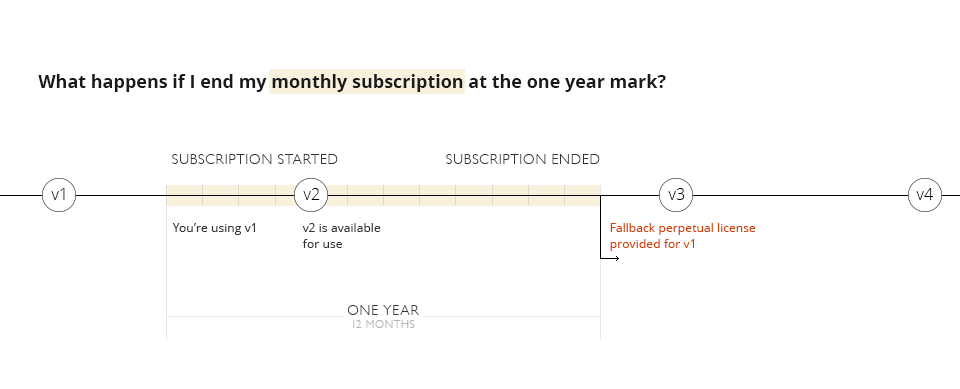

That being said; I dislike both full subscription (i.e. breaks on expiration) and lifetime licenses. Subscriptions are too expensive for software that rarely gets major investment and lifetime licenses are dishonest (e.g. company cannot work for free, so their funded is based on unlimited growth, which isn't realistic for most).
My current favorite business model is the "You're buying the current version and [years] of updates." Then typically you'll get some discount to renew your "[years] more of updates." This incentivizes them to deliver value, or you'll just stick with whatever version you purchased. Your software keeps working no matter what ("lifetime"). One example of someone who does this well is Jetbrains, but there are several companies.
Obviously subscription is the only option if they're delivering most of the value via a web-service of some kind (e.g. ChatGPT Plus).