The absolute pinnacle of cooking video chefs today has to be J. Kenji Lopez-Alt[0], in large part because of his use of first person view.
He straps a go-pro to this head and you see what he sees while he cooks. There's no cuts or retakes (unless he's waiting for something to cook or gets interrupted by his kids). There's no swaps. And it's all real- he's cooking dinner for his family.
And it doesn't always go perfectly. (See the excellent video titled "Doesn't matter, still pizza").
I'm a better cook for what I've learned watching him cook.
While I'm a huge fan of J. Kenji Lopez-Alt and Serious Eats is my go to web site before cooking just about anything, nothing I've seen before or since beats Alton Brown and Good Eats when it comes to video based cooking education.
Another YouTube cooking personality I really like is Internet Shaquille (https://m.youtube.com/@internetshaquille). His videos are very informationally dense without engaging in many of the typical YouTuber nonsense. And the ads are always at the end.
Yes, I love this guy's stuff. His style is very unique, expertly knowledgeable while still completely casual and humble. Like a very smart friend teaching you, rather than being in a class.
I was "A man, a can and a plan" cook prior to being introduced to Good Eats videos.
Particularly since Alton delves straight into the scientific 'why' things are happening. I don't remember exact recipes well, but processes and how things work I can hold well so his explanation of what's happening with the mallard reaction or gluten in bread or any number of topics have made it possible for me to execute very simple meals very well.
In hindsight, most other cooking shows at the time were basically just food porn. Watch me make this simple recipe, trust me it's easy in 30 minutes! (Ignore prep instructions, ignore how to pick produce, ignore any explanation of why you're doing what you're doing).
Good Eats sets the standard for educational cooking content, but actually implementing the recipes Alton demonstrates usually results in a nearly day-long cooking project.
I'm not entirely sure what else you expect? Cooking takes a long-ass time, it is a day-long full-time affair. You can hide the real time by doing prep, outright fully preparing parts of dishes agreed of time, having multiple people or buying premade but someone is putting in those hours somewhere.
Me and my wife cook meals with fresh ingredients every night and it takes between 20 and 40 minutes. Do you order takeout for every single meal? Did your family spend every day cooking all day growing up? I'm curious how someone can have this take.
I'm now realizing that I'm an elitist of a kind because when I say cooking I mean something totally different from "making something to eat" and more akin to dinner service. And that's what most of Alton's recipes are aimed at, not desperation dinners.
And when you're doing this kind of thing for family dinner you and up using shortcuts like bagged premixed salad, bottled dressing, rolls from the bakery, premade desserts, jarred sauces and gravies which all hide the real time it takes to put something like that together by outsourcing it. I think the miracle of modern logistics being so normal makes people forget how much of home cooking is shortcuts that weren't always available and were marketed toward homemakers who labored over a hot stove and needed a break.
> shortcuts like bagged premixed salad, bottled dressing ...
At what point is something no longer a shortcut? Do you also consider the time it takes you to track, shoot, carry, & butcher an animal? Or do you take the shortcut of buying your meat? Do you grow your own wheat? Grind your own flour? Or are those shortcuts too?
No, obviously. Are you being deliberately obtuse or do you really not know what ingredients are considered culturally to be atomic and what is considered composite and therefore a shortcut? Like there is a floor and it's not very far down.
* A cut of meat is atomic, that cut pre-marinated isn't.
* Flour is atomic, a Jiffy box is composite.
* Oil is atomic, bottled dressing is composite.
* Potatoes are atomic, frozen french fries aren't.
* 5 spice powder is atomic, but cinnamon sugar is composite.
* Cream is atomic, bottled Alfredo isn't.
* Hidden Valley packets are atomic, but bottled ranch isn't. But when bottled ranch is used as an ingredient in a larger dish it becomes atomic again.
* Rice is atomic, Uncle
Ben's isn't. Same rule as ranch when it's used in a larger dish.
* Bread is composite until you make a sandwich with it.
* But this rule doesn't apply to jarred pasta sauce when made into spaghetti. But it does apply to jarred pizza sauce when made into pizza.
Like sure the rules are organic and messy as all cultural norms all, but if you cook with any regularity you just "know" them because it defines when you're allowed to say "I made this" when presenting the dish to others.
Many of these items are complety arbitrary. As someone who's been cooking some pretty elaborate dishes for over a decade, I don't actually recall ever coming across these two distinctions.
Why is cinnamon sugar "composite" whereas 5 spice is atomic? Who defines these? Are you suggesting that if you use packaged cinnamon sugar on donuts you can't claim to have made them?
For reference, I mostly roast and grind from whole spices. If I need garam masala, Chinese 5 spice, Lebanese 7 spice, etc, I'll make it from scratch. If I new cumin or coriander powder, etc, I'll grind them in my spice grinder.
Are you suggesting that jarred pasta sauce and pizza are different to each other? Following your criteria, I'd classify both as composite.
Not to say that I disagree with most of the list - there's a distinction between highly processed and cooking dishes from scratch, but it's more nuanced than what you've presented here.
I cook a fairly standard south Indian dinner of daal stew, rice + stir fried veggies a couple times a week in ~30-45 minutes of total work. Nothing preprocessed, premixed, or premade other than (and these are really stretching the definitions thereof):
* Asofoetida powder that's been preground and dried for me
* The rice has been polished and debran-ed (ie, turned into white rice)
* pressure cooked lentils (I make a big batch every weekend or so and freeze it into dinner sized portions)
And that's what most of Alton's recipes are aimed at, not desperation dinners.
It's admittedly been years since I last watched Good Eats, but that is not how I remember it all. Almost everything he demonstrated was just as applicable when throwing together a quick pasta dish as it is to making a full 7 course dinner.
It really depends what you’re making. For example, some cuisines like asian food can take a very long time if you make it from scratch. Then there’s also a matter of balance, cooking a steak and sautéing some veggies can take minutes, at the same time if you’re trying to get a healthy balance of protein, carbs and veggies in all of your meals, then it can take forever unless you meal prep.
An added component is how many meals we are talking about. Making breakfast, lunch and dinner can be very painful unless you meal prep or get quick and easy items (readymade salads, overnight oats, frozen food etc.)
I always thought of Asian food as being relatively quick to prepare--a stir-fry can be done in the half-hour it takes to cook a pot of rice. It really does depend on the dish.
I think it largely depends on what’s being cooked. My mother used to make bone broth at home, which is definitely an all day affair, but it became the basis for noodles and stew dishes for the rest of the week which took much less time…
I've recently figured out that I've been looking at long cooking tasks wrong. Instead of blocking the whole time for that task I block out that time for another task and take breaks where I prep the next cooking step while the pot boils unattended. I had a big mental block on making sourdough starter, as it requires attention every day for three days, which I didn't figure I could manage. But now it's just something to do while I'm making coffee. Throw some more flour and water in there and mix it up. I don't actually have to sit by the counter for three days waiting for fermentation to happen. I can't believe it took me so long to realize this.
I noticed that’s something people don’t pick up on when they cook also, but some things really are all day affairs. Meaning my mom couldn’t leave the house for most of the day. Baking, certain stews, etc. function this way.
Saturdays are frequently spent with me watching sports and my wife puttering in the kitchen a few feet away. I’ll pop in to help with retrieving ingredients or prepping later steps so things are ready when she needs them but it’s her way to decompress after the work week. It can certainly be an all day affair though.
Mid-week meals involve one of us prepping steps during the day depending on who has free time at the right moment. We do the final steps together while catching up on each other’s day. Maybe an hour of total prep time but usually less than half of that time requires active involvement.
Cooking takes exactly as long as you want it to. While I do sometimes love spending all day in the kitchen when the mood takes me, I can equally turn out a decent in dish in less than 30 minutes on my own, including all prep time.
It is highly possible to take a whole day the first time you cook something new. Being a good cook is as much about managing time and processes as it is learning the recipe.
The more you cook something the quicker it is.
There are many shortcuts, such as:
- cooking rice in the evening before.
- Cooking extra.
- Using a pressure-cooker.
- Using a mini oven.
- Using the griller for more heat.
- Sometimes using the microwave to pre cook things can lead to faster times. (Not often for me).
- Purchasing partially prepared items. Pre cut carrots etc.
He also taught me something pretty critical - you don't need a huge fancy kitchen to execute great food. Most of the work he does happens on a large cutting board, the sink, or the stove. When I moved into my current place with a tiny kitchen, I wasn't nearly as freaked out about it. I knew I would be able to work in it just fine.
I was humbled and inspired by the creativity and resourcefulness of some prison inmates. There's a Youtube channel[0] where they recreate "dishes" that can only be sourced from the commissary or leftovers from a provided meal. Ones I saw included: Laffy Taffy, ice cream and a breakfast burrito. I now look at my small kitchen in a different light.
I found his written work (which is how he built his following) _much_ more useful, but part of that's just about how I process information. Certainly it's valuable to be able to see how certain things are done, and it's hard for cooks to describe techniques sometimes.
For my birthday my wife got me "The Food Lab" and I'm dying to read it, but it's like 800 pages and we have a toddler to take care of. The time has not been made yet.
Read the intro section - it'll be maybe 30 minutes, and then just flip through and find recipes or topics that look interesting. It's a reference book. Check out the chili section, the weeknight chili might be a good fit. I've had the book since it came out and there's still whole sections I haven't read
Food lab isn’t that dense I think it’s only 100 pages then recipes. The best reading is the first tome of modernist cuisine. The knowledge contained there on food safety really is mind blowing. Nobody else has dared to publish that kind of info in an accessible form.
His articles on SousVide cooking on SeriousEats have been very helpful to me. His writing style is accessible to beginners such as myself. And the results always beat restaurant foods in taste for similar meals.
That's a ridiculous thing to say without saying which restaurants (or some idea of a class thereof that) you're eating in. As if any 'dummy' armed with some articles is 'always' beating 'restauraunts'.
Don't get me wrong I'm not anti home cooking or massively pro restaurant, I love cooking & food, large categories of restaurant (and especially 'restauraunt') are no longer interesting to me due to the cost vs. taste relative to what I can do, but I don't kid myself, there's plenty of places I can eat the food of professional cooks and be impressed, inspired, enjoy it, find it good value; especially with company. And without touching the Michelin guide.
> That's a ridiculous thing to say without saying which restaurants (or some idea of a class thereof that) you're eating in. As if any 'dummy' armed with some articles is 'always' beating 'restauraunts'.
FWIW, I suspect your comment is getting downvoted because of the nasty tone, not because of the larger point your making.
Thanks, I try my best not to make assumptions about tone when reading comments, because it's not well conveyed in text. I did my best to quote " 'dummy' " for example, to allude to 'for dummies' texts rather than to describe the commenter I replied to as such. On re-reading myself though, probably that was still misunderstood.
As for writing comments, it helps not to worry about internet points :).
Agreed, I enjoy his YouTube videos, but find other YouTubers who are make as-good or better content, but his articles on Serious Eats were in a league of their own.
There are gems in his videos, but it's a few tidbits here and there compared to the content in his written articles.
His kids book "Every night is pizza night" is also great. I've read several "get your kid to try new foods" books to my child, but that one actually got her excited to try red beans and tagine and dumplings and green pozole soup, and now those are all foods she will happily ask for!
Kenji Lopez Alt really helped me learn how to cook. Much like software, when you read a cook book, there's normally all sorts of background knowledge required to understand how to make that recipe. Watching him do it conveys way more info than the written recipe. eg here's what that chop should look like, here's what the veggies should look like, here's how tolerant / not tolerant various pieces of the recipe are to changes, etc.
If you think you'd like to cook, you should watch 20 or 30 videos from his channel.
To me, Food Wishes is definitely the peak of practical home cooking videos in the tradition of Jacque Pepin. I feel like Kenji et al. make recipes tailored to hobbyist and for entertainment/spectacle, while Chef John makes recipes for the regular joe.
Much of Kenji's Serious Eats era output was the results-at-any-cost hobbyist stuff, but he's gotten much less obsessed with perfection since then. Even among the Serious Eats/Food Lab recipes there are some very practical recipes, like the Foolproof Pan Pizza and any of the 'weeknight' dishes in the Food Lab.
I've cooked several Chef John recipes to great results (real aioli, peanut butter fudge, beef stroganoff), but Kenji's decision to always provide weight measurements makes cooking easier for me.
Not only his first person view, but he's the only one that discusses how to cook while he's doing it. Not just little factoids. He keeps his recipes simple, so the average person could replicate it.
I've seen exactly one "Americas test kitchen" video.
It claimed with confidence that the only way to make pork skin crunchy (ie into crackling) is to fry the pork after it's been roasted (ie turn it upside down in a pan of oil/fat)
I didn't even watch the rest of the video. I don't know if they're catering to people who can't work the knob on an oven or if they themselves are just incompetent but that one claim was enough for me to never watch their shit again.
They've been operating in one form or another for like 20 years and their whole deal is experimenting to find optimal recipes. Kenji Lopez started on that show and has guest appeared recently.
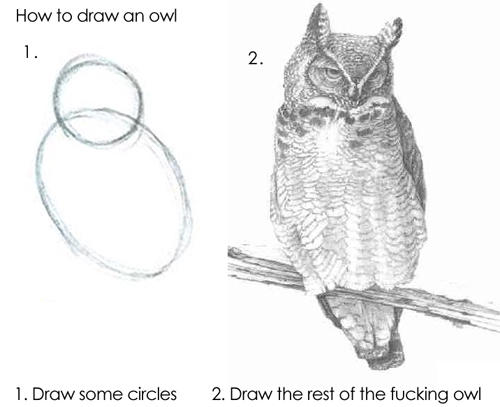
Most cookbooks tend to be like the meme about drawing an owl [0]. Mostly because the people making the instructions make assumptions about Stuff One Should Just Know and skip those bits in the instructions.
On video you can actually see the consistency of things as they are cooked and maybe even hear what the process sounds like (frying spices in oil has a distinct sound if the oil is at the correct temperature).
You can also see the proper cutting technique, hopefully saving your fingers from pain later on.
> Most cookbooks tend to be like the meme about drawing an owl [0]. Mostly because the people making the instructions make assumptions about Stuff One Should Just Know and skip those bits in the instructions.
You may wish to look at cookbooks produced by America's Test Kitchen. They try to create instructions that are clear and easy to follow.
This is done via a 'beta testing' program which you can join:
> As a recipe tester, you will be emailed in-development recipes. Recipe testers will receive one recipe per month on average. You can choose what to test; you are not required to test any or every recipe (but we hope you’ll want to!). When you test a recipe, please take the survey that accompanies it to tell us what you think. We will ask you questions about ingredient substitutions, recipe clarity, yields, and timing. And you get to rate the recipe.
> Occasionally, we’ll ask you to help us check ingredient availability at your local grocery store. We do this to ensure that the recipes we develop use ingredients that are widely available to all of our readers.
Watch their videos. Read their magazines. Happily pay them a $100/yr for the education. But throw their books (especially their "every recipe from the show for the past X years" books) in the trash. Honestly, their books are horrid. There's a marked qualitative difference between the writing of the recipes in the magazines and the writing of the recipes in the books. Dan Souza is editor-in-chief of the magazines which explains why the magazine is so good. I swear they outsource their book writing recipes and photography to failed college essay writers & photographers they found on Fiverr. An individual recipe in the books is all over the place. You'd think by the 12th edition they would have nailed the formatting or the writing style but it seems to just be a terrible copy & paste job from one year to the next. Their digital editions are even worse with broken formatting, unsearchable indexes, and bloated images.
I just used her fast caramelized onions technique last night actually. I like that she explains why she's doing everything and how it contributes to the flavour of the meal.
Their equipment review posts and videos are a must-watch. Even if you don't end up picking the winner, they will point out the best/worst aspects of their winners and losers that almost certainly apply to the products you're looking at.
ATK is one of the few digital subscriptions I'm thrilled to pay for -- it pays for itself every year just in bad equipment purchases.
(E.g., knowing that their top picks for kitchen timers will last many years despite being twice the price as cheapo ones, or knowing that buying the cheap bamboo wooden spoons is actually preferable.)
A lot what separates good and bad cooking is tacit understanding that can't be explained in words. You need to practice to detect the nuances in flavor. It's really basic and doesn't make good edutaninment content.
I'd say 90% of being a competent chef is just down to knowing how to balance the basic flavor components; and to figure out how these things change during the cooking process.
With practice and experimentation you can learn to infer what is lacking by taste and make anything go from bland to amazing.
Spices and ingredients are much less important. They aren't unimportant, but they aren't what makes something decent into something great. You can make a head cabbage more delicious than most what you'll find in a cookbook if you get this right.
Reading "Salt, fat acid heat" demonstrates this really well. Maybe almost to well, it takes away some of the mystery I guess between cuisines. Everything is the same, just different aromatics/spices added
That book changed how I approach cooking, I always wondered how people just make recipes, and now I can mostly do it
I found the flavor combinations and techniques easier to grasp than timing. That's what always gets me. Juggling two or three dishes with their own timing and requirements such that they all come out around the same time and one is not burning while stirring the other trips me up. After I practice a recipe a few times I get better at anticipating what it'll need when, but I'll never make the mistake again of cooking all new recipes for a dinner party and have each one fail spectacularly.
What works for me is figuring out which dishes (or partly completed dishes) can wait. Either on or off the flame. Most of the time only 1 or 2 dishes require exact timing. The rest can be (partially) prepared beforehand and reheated/finished at the end.
Most cuisine-based cookbooks have a bunch of chapters on ingredients, technique, equipment, and storage that easily get overlooked. Since it's difficult to share those things in a recipe format (but often come up in videos of preparation) I'm not surprised most people are finding them on YouTube.
I find cookbooks completely ignore is "kitchen management"--preparing a meal with entree and sides being cooked concurrently so they come to the table at the same time or reusing leftovers into new meals and meal prep. Thankfully, there's a bit of this on YouTube (mostly meal prep).
Like you mentioned knife skills are a giant ignored thing. I'm a huge proponent of sharpening your knifes (because odds are they've never done it) and taking a knife skills class. It pays dividends almost every time you cook, cuts prep time at least in half, and reduces frustration and friction to cooking.
Other than Salt Fat Acid Heat (mentioned elsewhere in this thread), any recommendations for building that baseline knowledge? Step-by-step videos are great for making that one dish, but are pretty inefficient for reaching a skill baseline.
This is a bit of a loaded recommendation - I own it and it's a fantastic compendium of literally all western cooking knowledge you might want to ever know.
It's also like 20lb and over a thousand pages and usually sells for textbook prices, so only invest in it if you really want to level up and have the time to read/work through it.
If you want to deep dive read the modernist cuisine 5 volume tome though you really most need the first couple. I don’t think I made a single recipe out of it. The recipes are too elaborate, but the knowledge and explanation of why things were done the way they were was really magical
The Food Lab, by J Kenji Lopez-Alt should be on the shelf of any HN reader who likes to cook. dives deep into the 'why' behind each recipe, includes a lot of A/B testing results (e.g. differences roasting russet potatoes vs gold vs red)
I learned to cook in the '90s and '00s, so before cooking videos. I was mostly self-taught, from cookbooks and magazines. I absolutely would have benefited from some of the basic techniques type videos available now: the kinds that show what simmering looks and sounds like compared to what boiling looks like. The kind that shows how to soften onions until they're glassy, and how to sauté garlic without burning it.
My main mistakes back then were simply using too high a heat (though on rare occasion not high enough, like when pan-searing fish), cooking too long, and not using enough oil. All of these things could have been corrected with basic technique videos.
On a somewhat related note, a long time ago I learned how to make gnocchi from an elderly Italian woman. Her teaching technique was immersive: she simply made a batch of it with me standing at her side. There's an art to how quickly you knead the flour into the potatoes: if you don't knead it in rapidly enough you work it too much and it gets tough. You also don't want to overshoot and knead too much flour in. She would work a certain amount in, then have me poke the dough to feel it, and she'd comment on the consistency and where in the process we were; things like "this is what it feels like when you're almost there" and "now it is ready". These things were remarkably hard to put into words, it was a much more immediate thing, like she could detect and point out to me how different it felt from thirty seconds ago. These were things like resilience, just how resistant the dough was to being poked and how quickly it popped back. I can't see how this kind of thing could be conveyed in text or a video, or any way other than in person.
I think some Jacques Pepin videos, especially old ones, helped me to the next level, more than anything else. I have a 70s print of La Methods and, while I was fairly advanced before getting it, it is pretty thorough on methods for cooking.
The thing I love about his later stuff especially is that it is practically freestyle. Ming Tsai has a bit of that too.
I love his philosophy and style, particularly in his various PBS series. He teaches you not just to cook different dishes, but how to gracefully cook several at once in a reasonable weeknight dinner timeframe. The way he’s relaxed about quantities and substitutions and focuses on making things the way he likes them versus how they’re “supposed to be made” completely changed my approach to the kitchen and gave me a fundamental ease with cooking. And I love the “waste not, want not” philosophy!
He is masterful, and I regularly use some of his simple dinners for my weekly rotation recipes. Like Anthony Bourdain said "if Jacques Pepin shows you how to roast a chicken, that's how you roast a chicken!"
I have a copy of the combined La Méthode and La Technique. Although I don't have any special affinity for French cooking, Jacques Pepin got me into cooking because he showed me that method and technique was universal. His knife skills were fun to watch.
The person who got me into knife skills was Martin Yan who had a show called "Yan Can Cook" (not to be confused with Wok with Yan by Stephen Yan from Canada).
Years ago I worked in the library at the French Culinary Institute and I had all of the demo videos on a shelf behind my desk, including the ones Chef Jacques made. And his demos often focused on very basic techniques like knife skills, but it was stuff you’d be doing every day, and he made it clear why getting good at them mattered.
Is there any cooking content that takes into account cleaning up after? In my limited viewing experience the focus often seems to be prep and the cooking, ignoring the reality of the inevitable clean up.
Is there anyone focusing on recipes and how to cook that minimises / reuses cookware and through to a reset clean kitchen? When I cook I enjoy getting into a flow where I’m ordering the prep or modifying the recipe so I’m able to reduce dirtying extra dishes and aim to have minimal clean up afterwards. Ideally the clean up of the cooking is essentially done by the time food is being served.
I’m half serious and half amused at the idea of a cooking competition style show where participants must plate up, serve and then scrub.
We all have our own journey. But one of the biggest improvements in enjoying to cook was to learn not to clean up after. It was a revelation to me and the big enabler which moved cooking from a chore to something I appreciate.
Do not clean up after - clean during!
Maybe annoying at first but it quickly turn into a habit
There is plenty of time (as a home cook!) during prep to clean the knives, bowls boards etc. What will seem like a huge mountain if left to linger will be a breeze when you learn to keep your station clean. And you never see this very simple fact of life in most videos.
I really used to optimize how few bowls etc. I would use as I hated the dishes afterwards. But quickly cleaning a bowl after use only take seconds and I no longer dread reaching for another if it ease my process.
This usually only leaves a pan and maybe a pot to clean when done eating. Not too bad even though I do them by hand as I am particular with what goes into the dishwasher
That. And doing mis en place rather than running head first into it. Absolute key lessons for me.
Sparks joy ;-)
EDIT: And if you stack things in the sink we cannot be friends. Sorry. Stack them elsewhere and keep them low.
This x100. I actually like cleaning up while cooking because it uses up the dead-time while waiting for something to cook, where I would normally let my ADHD brain take me out of the kitchen to do something else and then burn everything.
There are one pot or instapot/crock pot/rice cooker recipes that can help, but a lot of those still require some prep work. I 100% agree here, though. The key, especially in a small space, is to keep things clean as you work.
But, this also means managing sub-tasks through the day, like making sure clean items get pulled out of the dishwasher when it's done so that, to your point, things don't stack up in the sink through the day. There's nothing worse than trying to quickly throw a meal together and realizing the tool you need is at the bottom of the sink under a stack or pile. Things quickly turn to yak shaving.
Cooking and cleaning go hand and hand in my mind. I don't always have everything clean when I'm done cooking, but I'm proud when I'm able leave things at a good stopping point. That said, go eat the food you just cooked while it's hot. I think it can be difficult for people new to cooking to balance all these things, it takes practice. As you get a better sense of timing when things will be ready, you find time to clean something. [The more clean and organized your workspace is, the easier meals come together.]
Find a life partner. One cooks the other cleans up. :)
The clean as you go method works well with most recipes though. There are dishes that come together really quickly and you can’t walk away from or others that must be monitored constantly but most dishes have some downtime built in.
Prepping all of your ingredients ahead of time makes a huge difference. I used to try and slice the veg for step 3 while step 2 was simmering and it became a stressful race to get it done in time. Now I prep all of my ingredients ahead of time in small bowls or on my cutting board. It’s ready before I need it and the extra “cleanup” involves adding a few more dishes to the dishwasher.
I really hate it when my wife cooks and she leaves me the kitchen looking like a bomb went off. And then I cook and I leave her maybe two pans and a knife.
There are a fair number of "one pan" (pot/bowl/etc) recipes out there for this specific purpose, definitely try that search term :) though I haven't seen much of anything that includes cleanup explicitly. Only rare exceptions.
And yeah, number of dishes matters to me too, much of the time. Most of the stuff I make can be done with one, rarely two, and that's about where I draw the line.
> Ideally the clean up of the cooking is essentially done by the time food is being served.
Yes. Watch chef Jean-Pierre. I wouldn't say he minimizes the clean up, but he cleans as he goes and gives tips and general remarks on the overall process beyond just the recipe.
Sorted Food do a tonne of “mid-week” recipes and they actually sell an app that lets you plan your weeks meals with recipes that reuse ingredients, so they very much cover the “minimise total effort” side of cooking.
Ethan Chlebowski sometimes talks about this in his recipes. But there's not much to it really - you just have to get in the habit of cleaning while cooking. Most recipes will have a few intermissions where you're just waiting for something to cook, water to boil, some meat to brown/saute etc. I use those times to clean and usually only spend 2 minutes cleaning up after the cooking is done.
Another commenter mention one pan and sheet pan dinner - those are great. Similarly crock pot, Dutch oven, etc.
But much closer to what you’re looking for - I cannot for the life of me find the website, I thought it was owned by NYT, but all of the recipes are ~5 ingredients max. It negates tons of pans/etc when you only cook/cut a couple things.
I think that the internet is making everyone (on average), better at everything and we just don't really notice because we get used to it. I've seen higher standards for almost every hobby, chore, sport, and daily activity because everyone is comparing themselves to the global experts in whatever it is that they do and have access to being taught by them.
Can't seem to read the article. Some JS crap is freezing the page and can't scroll down (Firefox).
I've learnt lots from both books and videos. Being a "good cook" requires a few things:
* Skill in common techniques,
* Knowledge of ingredients,
* Good tools,
* Repertoire.
Videos are great for learning techniques. I've got books that do an admirable job of teaching how to knead or whisk etc., but nothing beats seeing someone do it. Some techniques are impossible to replicate without the right tools, though. You won't be able to replicate the chopping techniques you see with a cheap, blunt knife, for example. Videos often fail to mention this.
Books are the best for knowledge about ingredients. Videos could do it, but I've never seen one and it's probably not good for TV or the Youtube algorithm. You just need to know a few key things about ingredients like how to buy them, how to prepare them (which bit to peel, which tools to use etc.), how ingredients interact with each other (for example, a video will show you cooking the onions before putting in acidic ingredients like tomatoes, but will it tell you why?) Harold McGee's On Food and Cooking is a must-have.
Repertoire comes with time and I think you can get that from either books or videos. The best cooks don't really follow recipes after a while. A brief skim is often enough to assimilate a new recipe and it can then be carried out using existing knowledge and skills. For such a cook, a video can be a very inefficient way of learning a new recipe.
> Harold McGee's On Food and Cooking is a must-have.
I love McGee, but we only tend to pull it out when we have a history or science question, not so much when we're cooking.
A book we lean on heavily is 'The Flavor Profile Bible', Dornenberg and Page. The bulk of the book is an index of ingredients, listing ingredients/herbs/spices that pair well with each ingredient. We've profited from the videos mentioned here and we have our favorite cookbooks, but when we go to spice up the routine, this is the place we turn most often.
What I often miss is "the basics". After reading a recipe or following a video, I perhaps know how to make exactly that dish. But that's like a bootcamp programmer learning a single framework. I want to learn the concepts, how to apply them, how and when to break the rules, how to modify it and experiment with what I got. When I follow a recipe, and the result isn't pristine, how do I fix it? Should I add more salt? Should I get better at picking my tomatoes?
I don't want to follow a cooking video to make the same recipe. What I want is to learn these things. I tried MasterClass, but felt it was just more of the same. Well produced, but in the end still recipe-follow-along. Which I enjoy watching, but in the same way watching Veritasium or Numberphile it is mostly entertainment, and doesn't make me a mathematician.
The basics never end. There is no strict vertical.
When you stir-fry vegetables, salt the oil before adding the aromatics. That's basic. How many years was it until I figured that out? How many pro chefs have never figured that out? What's pro?
What about mincing your meat with one cleaver and one chef's knife? Not two cleavers. Not two chefs knives? That's basic. For a certain type of mince. How many people figure that out? It's basic once you know it. I'd bet that isn't taught in a masterclass.
There's no end to basics. There's a great chance your tomatoes don't come from the same vine as mine. Make it your own.
The reverse side is food engineering. When you're controlling for consistent results to ensure every loaf of bread of today's batches of 100,000 loaves are identical to yesterday, or last year. That's another ball game, and perfecting today's 100,000 loaves doesn't transfer much to making a pesto.
Your link says that they tested and found no difference between salted vs non salted oil and that while reusing it, a stir-fry would not leave oil enough to reuse.
I still don't know how salting the oil would improve anything though. Maybe it's a salting just before cooking vs later and not related to the oil?
Not GP but I'll often do so to test the heat. Doesn't read like that's what they meant though. It'd surprise me to learn that it made a difference either way to flavour or anything.
One is seasoning aromatics, the second is making a more even veg coating than seasoning at the end does; stirfry vegetables at a high heat won't release water thus won't have a 'sauce' to carry seasoning across the surface, this method makes it more even.
You want Good Eats by Alton Brown! Each episode is built around an ingredient or technique and he then goes deep on that one topic and explain all the how/why/when you should use it. While the episodes do generally demonstrate how to make a dish, the dish is more of the framing used to explain the underlying techniques and concepts.
See if there are any legit culinary classes in your area. If you don't want to take a class, you could maybe get by reading the textbooks they use. It at least go to the library and check out their culinary selection.
A couple decades ago, there was a tv show called Good Eats by Alton Brown. If you can find the reruns, it has a lot of information for newbies, but it will take a long time to watch it all.
I'm not an amazing chef but I do okay when I put my mind to it. Like anything else, it takes some up front effort to learn the basics and experience to learn the rest.
America's test kitchen has some playlists on basics[0] and technique[1]. There are other videos that cover basics too. And, sometimes you'll learn a new technique in a video for a dish you've never made before. You sound methodical; maybe you're baking, which is a little more scientific. (If that's the case Adam Ragusea[2] has some solid videos on showing how he got to his brownie and chocolate chip cookies iirc.) This is a case where videos can make you better, but you have to actually get your hands dirty and get a feel for things too.
At the end of the day, it's like learning a language: it's easy to get stuck in the learning/drilling/practice phase. Your actual goal is almost certainly to get to where you can immerse yourself in the skill and enjoy it as quickly as practical. If you want to make something fresh, give it a shot and be sure to taste things as you go. Sometimes it takes trial and error.
A lot of that is about developing intuition and like in most fields, there's not an easy way to develop intuition without a lot of experience.
What helped me a lot was starting to work through "On Cooking", which is geared towards culinary students, and at least has a more useful progression of skills (e.g. starts with equipment, knife skills, etc.) and techniques, and then starts building up from there. e.g. you learn to make sauces before starting on full dishes, etc. But doing something like that is a pretty large commitment (and all of the recipes have to be scaled down to non-restaurant sizes).
At one point in my early 30s I considered writing a cook book based on trying to teach my housemate to cook, starting with the assumptions that the person in question hadn't ever cooked and didn't own any reasonable cooking stuff, and trying to establish a baseline of recipes that could all be cooked from the same 20-ish ingredients that one could reasonably always have around.
There are definitely recipe-based and intuition-based approaches to cooking, and while I think teaching intuition is difficult, learning a particular vocabulary of skills in a certain order can help.
The Netflix show suuuuuucks, They completely disregarded the whole point of the book in favor of just doing a bog standard "make a pretty dish and eat it with some people" show. They barely went into any of the actually useful stuff the book talks about (it's in the name!).
I agree... people like to complain how Google is overrun with recipe spam, but I actually tried a bunch of stuff from whatever Google pointed me to,liked it, and now do a bunch of cooking I wouldn't have done otherwise.
I like the Chain Baker. He has a quite scientific approach, for example he bakes the same bread with salt before yeast, yeast before salt, and two other variations, to explore the difference it makes. In the next video he tries something else in four variations. Over time you learn what matters and not.
I love watching cooking videos. It's my number one go to, when I want to turn off my brain completely. But I never try to replicate recipes. I just pick up ideas.
I never ever cook from a recipe, either. Cooking is very much like programming. You have a goal (what you feel like eating that day), a framework (what you have laying around and your cooking skills) and you just execute something that approximates your goal. And just like programming you have to learn by doing.
Sometimes it is worth following recipes when you want to cook something new from a foreign cuisine, but I rarely do that. I cook almost exclusively European food, so I know instinctively how to combine the ingredients together to get the taste profile I am yearning for, and I also know how to cook each of the separate ingredients individually.
I really don't "get" people who seem to lack this cooking instinct. In my family there is nobody who doesn't know how to cook. My father rarely cooked when my mother was in good health, but once she fell ill, he picked it up at the ripe old age of 70, and is now able to cook pretty much everything. Baked savoury goods are his favourite.
If you don't know how to cook, you probably need to cancel your food delivery subscriptions and just force yourself to cook your own food. You'll pick it up amazingly quickly. I messed up quite a few times, but I don't remember ever having to throw food away. You always get something edible if you are creative enough.
A couple of weeks ago I had one of my worst disasters. I was attempting a Georgian savoury pie and my dough was a bit too highly hydrated and my filling a bit too warm due to my impatience, and I tried using a new technique for forming the pie instead of the usual one of sandwiching the filling between two pre-rolled layers of dough. The bottom of the pie tore apart and I was left with a mix of filling and raw dough. It seemed like a write-off, but I quickly added a bit more flour and mixed it all thoroughly together and baked it as a bread instead, and it turned out a bit dry but delicious.
Anyway, there is definitely value in cooking videos.
Usually, I will take a couple different recipes for the same dish and mix-and-match things I like from them to arrive at an approximation of the same result.
That's kind of like asking any variety of, "Can X videos make us better at X?"
Absolutely, but the more relevant question is if a particular cooking video or series, out of the vast set of "cooking videos" will make a particular viewer a better cook.
Probably not. I'd suggest a few questions to determine if that's true.
What is the specificity of the video? Some "cooking" videos only pretend to be about teaching cooking but they're actually about something entirely different. I love watching old episodes of Iron Chef but I don't expect to learn anything practical. Some cooking shows are about a particular aspect of cooking; a video on cooking with Spam won't make me a better cook because I don't cook with Spam. A video on how to make cakes look attractive with fondant won't make me a better cook because I like food made of food ingredients rather than construction materials.
Does the author know their subject matter? Many videos tell you stuff that's just plain wrong, or even dangerous (don't make popcorn on a soda-can stove with methanol or it could blow up in your face).
Are they level-appropriate? When I left for college, my mom gave me a copy of "How to boil an egg". I got a lot of benefit out of that book but something similar would be useless today. By the same token, years later, we got a lot of great information of of Rose Levy Beranbaum's "The Bread Bible", but it wouldn't have helped me at all as a freshman with a communal kitchen and minimal cooking ability.
There's also the question of what the viewer is going to do with it. You can watch videos all day long without getting any better at cooking. If you want to get better at cooking you primarily need to cook. Some videos may aid that effort but even the best ones will only help to the extent that you're willing to implement what they teach and practice it.
Of course. The vast majority of "cooking" videos are intended for entertainment, not instruction. I can honestly say that the majority of what I know today about cooking I learned from Youtube, but the most popular videos on Youtube are the most shallow ones, the ones that do three second cuts between unrelated images and spend most of their time showing people's faces instead of the purported subject matter. For most cooking videos, 95% of viewers will never even consider actually doing any cooking based on what they watched. But in spite of that, Youtube is an incredible learning resource for the minority of users who actually want to use it to learn. Maybe that's the best we can hope for.
I'd say the area where cooking videos particularly shine is technique and visual assessment.
It's much harder to describe the proper motion in text than to just show a video. A still image of dough doesn't show you the elasticity as well as a video does.
Areas they're particularly bad for is anything involving data; recipes, ratios, times. Those are all much easier to see in text.
They're both pretty bad at teaching "feel". There's no way around tasting and poking at any recipe you're not familiar with. Neither videos nor text will teach you how to do that. They'll tell you it's important but you really just need to do it a bunch.
It depends entirely on the cooking video. Cooking tiktoks? They are a waste of everybody's time. Nobody is going to make a recipe from TikTok. Videos like Townsends? Yeah, I make food from them all the time!
Here's another take: with the way blogospam and search engine fodder has ruined recipe sites, cooking videos are one of the best ways to actually capture new food ideas and recipes. It's also the best way I know to learn a new cuisine. I was a proficient cook before tuning in to videos, but the videos have enabled me to expand the options of what I can put on my family's table.
It's making me actually cook, which by default ia making me a better cook, because I don't cook. I watch Ethan Chlebowski on youtube. However, the comments thread here is full of so many ideas that I'm going to check them out when I get a chance. Thanks everyone for commenting!
I scrolled a ways and was surprised to not run across any shoutouts for Brian Langerstrom. Really clear, really concise, recipes and presentation that are so so good. https://youtube.com/@BrianLagerstrom
I can create delicious Korean recipes because of Maangchi. I can also create the perfect crispy breakfast potatoes because of J. Kenji Lopez Alt. Cooking videos gave me the confidence to try to replicate what is made. I never feel the same from cookbooks.
the right kind...of cooking videos make us better cooks...100% just like the right kind of recipe books. There are tonnes of both kinds.
I learnt to cook legitimate indian cuisine watching www.vahchef.com videos. I learnt to cook legitimate korean food by reading www.maangchi.com recipes. And i learnt bonafide Persian cooking from "Food of Life".
I think books, websites and videos all make for better cooks...so long as the recipe writer is aware of their assumed knowledge and can consisely deliver the tricks of the trade within a recipe that holds the cooks attention, be it on the page or in the video.
The written recipes from Vahchef were actual legit trash - with missing ingredients and steps. But his videos...un believable!
Chef John Food Wishes has made me a better cook. I’m not a chef but I have learned a lot from his videos. The great learning process in his videos is that he wants us to play with choices that cater to our needs. Definitely #1 rank in my listing
Dunno but it's definitely making me more creative - I've branched from american, brazilian, italian, french and japanese to adding chinese, korean, vietnamese, scottish, english and canadian.
I TiVo’d and watched “Everyday Italian” most nights in college but I never seemed to learn how to cook anything from the show. Still… time well spent. Ha!
There are very few things I cook, only rice and lentils, all the rest of my food I eat it crude (mostly vegetable, or even eggs, for fish I leave it in lemon juice, typically sardines, lemon also work for leek or onions to make them less strong. So cooking mostly happens in my guts now, and for vegetable digestion is incredibly better when outside, under the sun. Cooking destroy vitamins and many things
When it comes to cooking, it's hard to imagine someone getting progressively worse, especially when they are the ones tasting their creations. If it doesn't taste right, they'll naturally adjust and improve. The feedback loop is immediate and personal.
"Better" is very one-dimensional, but cooking isn't. You can get worse at taste but better at health. Better at health and taste but worse at time consumption. Better at price but worse at hygiene. Many things are possible, but without an audience or at least your own critical acclaim, you cannot prioritize.
And, of course, "there is no accounting for taste" meaning that some of the aforementioned dimensions are very subjective.
It's easy to imagine people getting worse over time. I see it regularly.
People don't do blind taste tests when they cook. They cook something and compare it to their previous memory. Then they slowly diverge and enter some crazy part of the space where no one should be cooking an ingredient that way. There's no notion of something tasting right on its own. You need to compare it against a better version of that dish.
It's easy for two people to cook exactly the same dish, following the same recipe, both of them to think it came out great, and then when they taste each other's to discover that one is dramatically better.
What helped me when learning to cook vegan was focusing on the basics.
I studied a few recipes (such as Indian curry) and identified the fundamental ingredients (onions, garlic, ginger, tomatoes, spices, and protein), creating a list of non-basic spices and other potential ingredients.
I mastered the process of this basic recipe: browning the onions with cumin and bay leaf, no salt, adding garlic and the remaining spices, introducing tomatoes with salt, then adding vegetable stock and protein, and cooking until finished.
From there, I began experimenting with additional spices, ingredients, vegetables (almost anything works), and proteins (beans, lentils, peas, etc.)
Always stick to the basics. Many recipes out there are needlessly complex. After all, you can make almost anything taste delicious with just onions, fat, salt, and pepper.
I'd recommend the book 'Salt, Fat, Acid, Heat' – I've only skimmed it, but it seems to ring true.
One of the fundamental parts of curry making is cooking the spices until the oil separates - that is until all the water boils off, and the tomato skins blacken. This is usually not explained terribly well in written recipes.
I think especially the videos that show the process, like J. Kenji's, are pretty good (don't expect to be as fast as him when making things, though). But you still have to try it and practice, not just watch.
The part of cooking I'm struggling with right now, and would love some guides and content on, is how to prepare a menu and plan groceries. It's a lot of work, but I'm sure there are ways to make it easier.
Do you mean menu as in a weekly schedule or for a single function where you invite guests?
Weekly menus have been easy for the family, if you plan in a few stews or rice/quinoa/bulgur/cuscus based dishes which are more forgiving with certain ratios of vegetables and stuff. So plan a few nice meals which need exact ratios, and with stuff you overbought/leftovers you can do these other dishes.
When people ask me to teach them how to cook I definitely set expectations that we will be talking and shopping first. By the time you're in the kitchen with your knife out 2/3 of the work is already done.
That said, on the general topic hinted at by the title: Yes, they do.
I followed Gordon Ramsay's many videos for a couple of years. I went from being able to a repertoire of eggs, rice and barbecue to cooking as close to world-class meals as I can imagine. This, to the point that we stopped going to expensive restaurants because, in most cases, the food is inferior to what I am able to cook at home. When you come out of a restaurant with your family, having dropped the equivalent of a car payment for the meal and your kids tell you "Dad, what you cook is massively better than that", well, you know you learned something.
I also helped me learn and understand about such things as sauces, spices, proper preparation and generally giving me a sense of the things I can experiment with, have fun cooking and have more variety at my fingertips than just three dishes.
So, yeah, for me, absolutely. Of course, what you get out of it is a function of the time and effort you put into it.
I'm a fan of the various Jacques Pépin videos on youtube because they give a lot of advice on technique. There is an hour long one I cannot find right now that basically has almost everything you'll ever need in a video. And I like (also on youtube) Italia Squisita, because they nicely show what variations you can do, showing italian classics and their michelin-star version of it side by side.
Jacques Pépin is an absolute treasure. Such a famous chef yet never a jerk to anyone.
Another favourite of mine is J. Kenji Lopez-Alt [1], or Kenji as everyone calls him . Really nice and non-pretentious guy. Tons of great advice for beginners. His cookbook even goes into details like how to stock and organize your fridge!
I think one of his most endearing qualities is that he doesn’t hide his mistakes. He leaves them in the video and talks about them and how to recover. Far too often we see TV shows about people making mistakes in the kitchen and getting reamed out by the celebrity chef or having a meltdown of their own.
Mistakes are inevitable in the kitchen, especially when you’re just starting out. Feeling really bad about it is a pretty surefire way to lose interest in learning to cook.
Kenji is great until you have misophonia and his mouth sounds get you and you have issues with how unclean everything he does is. But his videos are a goldmine for great skills, recipes, everything. It is very good if you have a little basic hygiene and food safety skills and do not pick up bad habits from him. The knife manufacturer he uses has been very, very good as well. I have a few of their knives and it's been wonderful.
Dude straight up uses a sponge to clean up the fluids from raw chicken and wipes down his stove with it. He rinses with water and uses utensils after handling raw meat.
Why are you taking my observations personally? It doesn't make sense.
You can beat a lot of restaurants as a shit cook simply because of economics. You are not under obligation to make a profit, so you don't need to cut the same corners. And the as you get to the high end stuff - that expensive stuff is really awful. Not hearty at all. It's like modern art, I am supposed to "get it" but I don't.
I've watched a lot of Gordon Ramsay videos and agree with you. His style is so efficient and not overly complicated, but he does everything perfect. Something else that he's led me to think about is to move more quickly. Making a great meal does not take very long once you have some base skills.
I think you got the wrong end of the stick with that guideline. It's intended for folks who accuse others of not having read the article, not for self admission that one didn't read the article. Also the article is behind a paywall and even with all my own usual tricks I can't get at it to read in any sensible way (even archive.is).
In this case the article's topic is fairly obvious that you could legitimately comment here.
If one reads my comment carefully, they will notice I did not comment on whether robomartin read any future Hacker News article. I will not comment on whether you read my comment.
I got unlucky one day and watched a cooking video while intoxicated... it's so awful how they have to put some more of this and some of that and it wouldn#t be good without another spice... it's like sorcery... and the ppl doing it behave like that as well... horrible vibes, doesn't help that they all look sick and fat.