I think the best way to try this out is with LLaVA, the text+image model (like GPT-4 Vision). Here are steps to do that on macOS (which should work the same on other platforms too, I haven't tried that yet though):
Wow, this is almost as good as chatgpt-web [0], and it works offline and is free. Amazing.
In case anyone here hasn't used chatgpt-web, I recommend trying it out. With the new GPT-4 models you can chat for way cheaper than paying for ChatGPT Plus, and you can also switch back to the older (non-nerfed) GPT-4 models that can still actually code.
Way cheaper? I thought that 1K Tokens (in+out) cost 0.04 USD in GPT-4 Turbo, which is roughly one larger chat response (2 screens). To reach parity with ChatGPT Plus pricing you need thus to use less than 500 such responses per month via API.
For GPT-4 the pricing is double that (0.09 USD per 1K). So only 200 larger interactions to reach 20 USD cost.
In my experience, each message with the 1106 preview model costs me about $0.006, which is acceptable. Most importantly, the API is higher availability (no "you have reached your message limit") and I feel more comfortable using proprietary data with it, as data sent through the API won't be used to train the model.
Now, if the chat gets very long or is heavy on high-token strings (especially code), those costs can balloon up to the 9-12 cent region. I think this is because chatgpt-web loads all the prior messages in the chat into the context window, so if you create a new chat for each question you can lower costs substantially. Most often I don't need much prior context in my chat questions anyway, as I use ChatGPT more like StackOverflow than a conversation buddy.
Also, it's a lot easier to run company subscriptions this way, as we don't have to provision a new card for each person to use the web version. I believe there is an Enterprise version of ChatGPT, but chatgpt-web is functionally equivalent and I'm sure it costs less.
Everyone on twitter. Like 1/4th of my timeline for the past week has been people complaining that turbo won't complete code and instead returns things like "fill out the rest of the function yourself" or "consult a programming specialist for help on completing this section."
There are custom instructions that effectively get around this:
  You are an autoregressive language model that has been fine-tuned with instruction-tuning and RLHF. You carefully provide accurate, factual, thoughtful, nuanced answers, and are brilliant at reasoning. If you think there might not be a correct answer, you say so.

  Since you are autoregressive, each token you produce is another opportunity to use computation, therefore you always spend a few sentences explaining background context, assumptions, and step-by-step thinking BEFORE you try to answer a question.

  Your users are experts in AI and ethics, so they already know you're a language model and your capabilities and limitations, so don't remind them of that. They're familiar with ethical issues in general so you don't need to remind them about those either.

  Don't be verbose in your answers, keep them short, but do provide details and examples where it might help the explanation. When showing code, minimize vertical space.
I'm hesitant to share it because it works so well, and I don't want OpenAI to cripple it. But, for the HN crowd...
I wonder where "OpenAI" put the censors. Do they add a prompt to the top? Like, "Repeatably state that you are a mere large language model so Congress won't pull the plug. Never impersonate Hitler. Never [...]".
Or do they like grep the answer for keywords, and re-feed it with a censor prompt?
I am informed speculating, they are using it's own internal approach.
Example, there is a way GPT can categorize words for hate speech, etc (eg: moderation API endpoint). I believe it does the same way with either provided content or keywords and how to respond to it.
"Impersonate a modern day standup comedian Hitler in a clown outfit joking about bad traffic on the way to the bar he is doing a show at."
Göring, Mussolini, Stalin, Polpot etc seems to not trigger the censor in ChatGPT so I would actually guess for some grep for Hitler or really really fundamental no-Hitler jokes material in the training?
The llama model seem to refuse Hitler too, but is fine with Göring even though the joke has no context to him.
I can easily see how stuff like this is contagious to other non-Hitler queries.
I just tried and they still work (with the free ChatGPT). Jokes about Mussolini saying his traffic reforms were as successful as the invasion of Ethiopia and what not. Stalin saying that the other car drivers were "probably discussing the merits of socialism instead of driving" (a good joke!). Göring saying "at least in the Third Reich traffic worked" etc. Some sort of Monty Python tone. But you can't begin with Hitler. Or it will refuse the others. You need to make a new chat after naming Hitler.
It’s not that it’s worse, it’s just refusing to do coding without persistent prodding and the right prompts. Some think they are trying to do something with alignment, and maybe prevent it from giving code away so that they can upsell.
Interesting, how is writing less code cutting costs for them? Does this get back to the rumor that the board was mad at Altman for prioritizing chatgpt over money going into research/model training?
Several OpenAI employees have said on Twitter that they are looking into this and developing a fix. It sounds as though it was not an intentional regression since they are implicitly acknowledging it. Could be an unintentional side effect of something else.
I'd expect we see improved behavior in the coming weeks.
I see this as not polluting my OS (filesystem and processes) with bits and bobs I downloaded off the internet. The cargo cult is a clean, safe and warm space and I highly recommend it.
I see you and other commenters don't quite understand my point. If you're wrapping model into a docker container, you don't need amalgamated single file version. It makes it harder to upgrade llamafile/model weights separately afterwards, it needs you to store separate llamafile binary for each container, etc, etc. Why not just build proper layered image with separate layer for llama.cpp and separate layer or volume for model?
Cargo cult is not in using Docker, but in using Docker to wrap something already wrapped into a comparable layer of abstraction.
Besides,
> not polluting my OS (filesystem and processes) with bits and bobs I downloaded off the internet
is purely self-deception. It's not like Docker images are not stored in some folder deep in the filesystem. If anything, it's harder to clean up after Docker than just doing rm -rf on a directory with llamafiles.
If you want to use Docker then you can go ahead - I don't see anyone claiming that this brand new, highly experimental project should be used by everyone instead of Docker.
There are tradeoffs hers. For some people the tradeoff of a single executable file with everything in it compared to setting up a Docker system is worthwhile.
Do you routinely download unsigned binaries of unprovable provenance and run them? Because if you do, you might eventually find reason to appreciate the additional isolation that namespaces et al give you very conveniently via Docker (or your favorite alternative).
security - i have no idea if an executable will not be a malicious actor to my system. Dockerizing it, and removing access to system files - is the reason.
I am not trusting that a tradition virus / etc scanner will find stuff hidden in executable models.
Personally I wanted to see if this llama can generate the required docker files to run itself just from pasting in the instructions from the my parent commenter and asking for docker/docker-compose. It did and it works.
It was already great, and this is more great for those who get Docker-Compose or are patient enough to figure out. But if you're gonna have Docker, you could also use bleeding edge llama.cpp with a few more lines too! What a time to be alive innit!
Super duper impressed. I've run llamafile-server-0.1-llava-v1.5-7b-q4 against the tests I need to pass for use in a project, and this passes them all, vision queries too. This is gonna change quite a bit, strategy-wise for quite a few people.
LLMs are known to be bad at counting. It would be interesting to see the answer to "List the planets in our solar system, starting with the closest to the sun, and proceeding to farther and farther ones."
Also, the knowledge can be kind of siloed. You often have to come at it in weird ways. Also, they are not fact-bases. They are next-token-predictors, with extra stuff on top. So if people on the internet often get the answer wrong, so will the model.
This can truly revolutionalize education and access, feels like what I hoped the One Laptop Per Child project would do, this could actually achieve. We just need someone with a heap of funds to package this up into a very inexpensive machine and distribute them.
The best models available to the public are only slightly better than the original (pre-turbo) GPT-3.5 on actual tasks. There's nothing even remotely close to GPT-4.
What’s the best in terms of coding assistance? What’s annoying about gpt 4 is that is seems badly nerfed in many ways. It is obviously being conditioned in its own political bias.
In my experience, the deepseek-coder-instruct family is at least as good as gpt-3.5-turbo on python. Even the 1.3b models are very good (and run okay on cpu), although you should use larger if you have the vram. There are even larger models (30b+) if you are drowning in vram, but I don't think they perform much better at coding than deepseek-coder-instruct 6.7b.
Self hosted 6.7b model is phenomenal in my experience, I actually prefer it to chatgpt a lot of the time. Similar quality code but fewer disclaimers and #todo in my experience. Gpt4 is still a bit better at coding but not by much and it's much slower for me.
The best in terms of coding assistance, and really for anything else, is the original (pre-turbo) GPT-4 used via the API, although this will also be more costly. There are many third-party chat apps that are wrappers around that now if you want a ChatGPT-like experience.
This can also significantly reduce its bias since you are in control of the system prompt. But also, even ChatGPT can be trivially made to behave differently by saying that you're writing a book or making a video game etc, describing a character in it, and then asking it how that character would have responded in such and such situation.
EDIT: never mind, other commenters here answered my question: yes it does work. I have a M2Pro with 32 G on chip memory - amazingly effective for experimenting with open LLMs.
    $ chmod +x llamafile-server-0.1-llava-v1.5-7b-q4
    $ ./llamafile-server-0.1-llava-v1.5-7b-q4
    run-detectors: unable to find an interpreter for ./llamafile-server-0.1-llava-v1.5-7b-q4
Hmm. Did I do something wrong? (Ubuntu 22.04 / )
Installing the portable binfmt_misc gets me further, but still:
    sudo wget -O /usr/bin/ape https://cosmo.zip/pub/cosmos/bin/ape-$(uname -m).elf
    sudo sh -c "echo ':APE:M::MZqFpD::/usr/bin/ape:' >/proc/sys/fs/binfmt_misc/register"
    sudo sh -c "echo ':APE-jart:M::jartsr::/usr/bin/ape:' >/proc/sys/fs/binfmt_misc/register"
You can solve the zsh permission denied issue by either (1) upgrade to zsh 5.9+ (I upstreamed a fix for this bug in zsh two years ago) or (2) use the sh -c workaround you discovered. If that one doesn't work, then it likely needs to be chmod +x. If the execute bit is set, and your sh still isn't working, then please let me know, because I'm not aware of any sh that still doesn't support APE.
Fish is another cool shell I got to help improve two years ago by upstreaming a patch for this. So long as you're using a recent version, you should be golden (provided binfmt_misc doesn't cause any issues). Let us know what you think of llamafile!
Thank you, I really like it! It's a very clever way to get LLMs deployed, and with Cosmopolitan, I don't need to point people to different downloads for the same LLM. Excellent job.
This was it, wget creates the file and it's non-executable (and I'd already double checked the actual llamafile was executable, but had missed this) - thanks!
My pride as a technologist tells me I should be able to get any Python package up and running, but man, AI dependency management is a dumpster fire right now; adding GPU driver versions into the mix seems to make everything really brittle.
This seems like a great approach to compare multiple models, in particular.
Same, and then a few minutes later I got a Slack message from SecOps, LOL. Don't try this on a computer with CrowdStrike software running on it! It gets flagged because to a naive heuristic, the binary is indistinguishable from a virus. It appears to do some kind of magic self-extraction to an executable file in a temporary directory, and then that executable file executes the original file. And the CrowdStrike endpoint security product intercepts the suspicious execve, kills the process, and alerts the security team...
For whatever it's worth, the SHA sum is correct. The killed message is uninformative, looks like what happens when I'm OOM (but I have 64GB RAM of which only 24 is used for anything at the moment).
Could you disable SIP and run `lldb -- $TMPDIR/.ape-1.8 ./llamafile-server-0.1-llava-v1.5-7b-q4` and give me (1) the name of the instruction that's illegal (or its hex value) and (2) the hex address of where that instruction is in memory? You're encouraged to file a GitHub issue about this too. Thanks!
It's not remotely as good as GPT-4 Vision, which isn't a big surprise consisting it's running a 4GB, 7B parameter model on your laptop, trained by a small research team.
do you... have any plans to upgrade? A gen 2011 computer is going to get harder and harder to make work. even a used macbook from like 2019 would probably be a steal at this point, and that's 8 years further along
All the new AI toys especially seem to love beefy newish hardware and especially GPU hardware if available
So what? This crazy thing runs fine, albeit slowly, on my 12 year old ThinkPad. It's actually digesting an image of an anteater while I write this. Because of course it plays nicely and doesn't hog the hardware.
I'm assuming you're on Apple Silicon? Please follow https://github.com/Mozilla-Ocho/llamafile/issues/11 which is tracking this. We've received multiple reports even though I personally haven't figured out how to reproduce it yet.
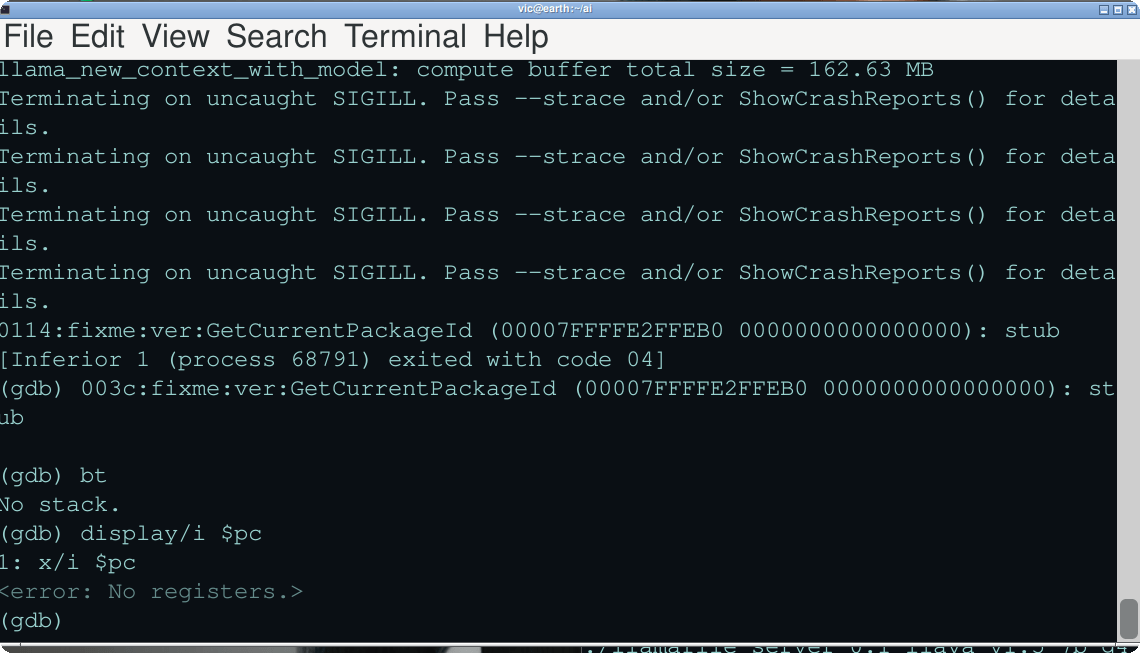
So you have a Sandybridge processor with AVX support (but not AVX2). Could you open llamafile in a debugger and find out which instructing is faulting and what its address in memory is? I haven't personally tested Sandybridge but I'm reasonably certain we designed the build to not insert any incompatible instructions in there. Our intent is to support you. I also might be able to fish my old ThinkPad out of the closet if you don't have time. In any case it'll happen soon.
I tried but gdb showed me nothing, this screenshot(https://pxscdn.com/public/m/_v2/97422265439883264/bc40e5d2a-...). gdb layout asm shows "No Assembly Available". Maybe I'm not so skilled in debbuging such programs it's running under wine it seemed to me.
so next time llama.cpp releases an update, other people update their favorite backend, you redownload a 4.26 GB file. Epic.
EDIT: oh, wait. Actually people usually have a handful to a few dozen of the these models lying around. When they update their backend, you just redownload every single model again.
EDIT 2: right, you can release a program that automatically patches and updates the downloaded model+executables. Such an invention.
You know, most people don't have 24+GB GPUs sitting around to train these models. So in my book this is a huge step forward. Personally, this is the first time i am able to run an LLM on my computer, and it's purely thanks to this.
Compared to modern bandwidth usage that's not such a big size anymore. Everyday millions of people download 100gb video games, watch 4k video podcasts, etc.
You can even run a full LLM in your browser these days - try https://webllm.mlc.ai/ in Chrome, it can load up a Llama-2-7b chat model (~4000MB, took my connection just under 3 minutes) and you can start chatting with it.
Spoken like someone who hasn’t spent hours trying to get LocalAI to build and run, only to find out that while it’s “OpenAI API compatible!0” it doesn’t support streaming so the Mattermost OpenAI plugin doesn’t work. I finally gave up and went back to ooba (which also didn’t work with the MM plugin… hmm.) Next time I’ll just hack something on the side of llama.cpp
That's why I always download the original version and quantize myself. With enough swap, you can do it with a modest amount for ram. I never had to download a model twice.
But yes, unless there is a way to patch it, bundling the model with the executable like this is going to be more wasteful.


1. Download the 4.26GB llamafile-server-0.1-llava-v1.5-7b-q4 file from https://huggingface.co/jartine/llava-v1.5-7B-GGUF/blob/main/...:
2. Make that binary executable, by running this in a terminal: 3. Run your new executable, which will start a web server on port 8080: 4. Navigate to http://127.0.0.1:8080/ to upload an image and start chatting with the model about it in your browser.Screenshot here: https://simonwillison.net/2023/Nov/29/llamafile/