> If the turning of the gas was the necessary mechanism for lift, planes in supersonic flight would fall out of the sky
Why would pressure (Bernoulli out of Euler) propagate supersonically while momentum (Newton) does so subsonically?
> Instead of relying on an airfoil shape for lift, you could fly by sucking air from the top of your wing and dumping out the back of your plane
Wings (and the other bits that contribute to lift) are bigger than engines. That’s the leverage you get with a lifting body: you move more molecules than your thruster alone.
The correct answer here is unintuitive. But the very wrong answer is pressure alone. (As the article we’re commenting on clearly shows with its brilliant flat-cardboard example. You don’t need camber to have a lifting body, just angle of attack.)
> Why would pressure (Bernoulli out of Euler) propagate supersonically while momentum (Newton) does so subsonically?
I'm sorry, I didn't understand the question.
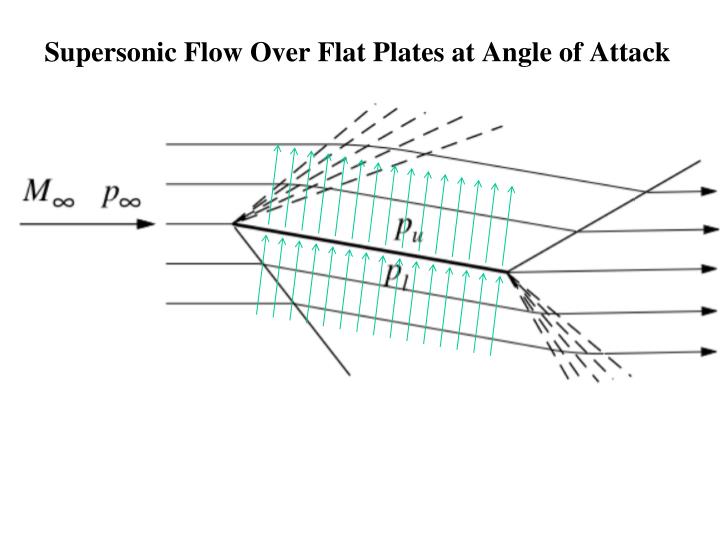
But in supersonic flight, with a flat plate, you don't have any rotation in the game, as illustrated here [0]. And yet you will be producing a lot of lift.
No, it really is the pressure alone. And viscous drag, if you want to be pedantic. Those are the only forces at play, the rest is only a side effect of those forces.
> you don't have any rotation in the game, as illustrated here
The arrows literally moved down!
> it really is the pressure alone
NASA, pilots and aerospace engineers would disagree with you. But yes, you can construct a working model of flight with just pressure. Same way you can make a Copernican model match our observations of how the stars and planets move.
On the top part, you've got a supersonic free-stream deflected with an expansion fan to a supersonic parallel flow over a plate, deflected back and slowed-down to free-stream conditions through an oblique shock. The only thing the upper-surface "sees" is a parallel, supersonic flow.
On the lower part, you've got a supersonic free-stream deflected to a lower-speed supersonic flow through an oblique shock, creating a parallel supersonic flow over the lower surface of the plate, deflected back and re-accelerated to free-stream conditions through an expansion fan. The only thing the lower surface "sees" is a parallel, supersonic flow.
Now, unless you can come up with a force component emanating either from the oblique shocks or from the expansion fans and contributing to the lift vector, it fair to say that the flow deflection is not directly what is causing lift on the angled plate.


Why would pressure (Bernoulli out of Euler) propagate supersonically while momentum (Newton) does so subsonically?
> Instead of relying on an airfoil shape for lift, you could fly by sucking air from the top of your wing and dumping out the back of your plane
Wings (and the other bits that contribute to lift) are bigger than engines. That’s the leverage you get with a lifting body: you move more molecules than your thruster alone.
The correct answer here is unintuitive. But the very wrong answer is pressure alone. (As the article we’re commenting on clearly shows with its brilliant flat-cardboard example. You don’t need camber to have a lifting body, just angle of attack.)