Keep the 4Runner and buy something new for a family hauler.
New vehicles are much safer from a structural standpoint than older ones. Modern high strength steels form the safety cage of the vehicle, and greatly reduce the risk of injury in offset frontal impacts, side impacts, and rear impacts.
And then you have the multitudes of air bags.
Finally, the various electronic gizmos that further reduce risk of injury.
The presence of high strength steels alone warrants a new vehicle purchase. Vehicles are disposable, people are not.
>New vehicles are much safer from a structural standpoint than older ones.
Perhaps if you compare the same model 15 years ago and now that is true, but people rarely buy the same model used as they would new. At least among my aquitances it is common to consider a higher class used car, or a much cheaper lower class new car. I doubt a 6 years old lexus rx350 is less safe than 2023 Toyota Yaris for example. Two cars of comparable price around here in Central EU.
Depends on the new safety tech; it often comes into the luxury brands and works it's way down. 6 years could be long enough for something significant to be in the Yaris.
I can believe that. I've currently got an oldish Merc E class which is statistically one of the safest cars and didn't cost so much to buy. Servicing and petrol are a fair bit more than a small new car though.
> I doubt a 6 years old lexus rx350 is less safe than 2023 Toyota Yaris for example.
Ok, but those two vehicles are significantly different sizes regardless of year, are they not? And that’s usually very relevant where safety is concerned.
that may be true of these two cars, but I don't think he was cherry-picking those just to make his general argument. are you making the general argument that this larger vs smaller car issue will always be the difference? what happens to the difference in safety improvements over time, always overshadowed by size in the used market?
My point was that, depending on the type of collision, a 6 year old rx350 could easily be a lot safer than a Yaris due its much larger size.
Maybe there would be less of a difference in a single vehicle collision, but AIUI in a multi vehicle collision size (and relative height) usually matters a lot. So it didn't seem to make their point very well.
> The presence of high strength steels alone warrants a new vehicle purchase. Vehicles are disposable, people are not.
Agreed. Although the steels used for safety critical parts of new vehicles are now "ultra-high-strength steels", with tensile strengths exceeding a gigapascal. These can be 4x stronger than "high strength steel", and 6x stronger than steel from the "good ol' days"
    - Improved FEM makes modern crumple zones deeper and smoother
    - Heavy use of composites dramatically improve the raw amount of energy absorbed by the car instead of the passengers
    - Better manufacturing methods mean parts can be shaped/placed to be less likely to enter the cabin
    - Better placement of more airbags means you're more likely to hit something soft
    - Better seats and better placements of better seat belts means you're less likely to snap something due to whiplash
    - Better brakes and steering geometry reduces your chance of losing control
    - Better brakes and steering geometry improves your ability to avoid other vehicles
    - Electronic stability control _massively_ reduces chances of rollovers
    - Electronic stability control _massively_ improves your ability to dodge other cars in emergency maneuvers
    - Electronic stability control _massively_ improves your ability to handle bumps and potholes and waves and black ice and other disruptions
    - Electronic stability control _massively_ improves the car's ability to go where you point the wheels regardless of speed or condition
Seriously, especially if you're driving a truck or SUV, you _need_ electronic stability control.
    > According to the U.S. National Highway Traffic
    > Safety Administration and the Insurance
    > Institute for Highway Safety in 2004 and 2006
    > respectively, one-third of fatal accidents
    > could be prevented by the use of the technology

    > Additionally, SUVs with stability control are
    > involved in 67% fewer accidents than SUVs
    > without the system

    > The IIHS study concluded that ESC reduces
    > the likelihood of all fatal crashes by
    > 43%, fatal single-vehicle crashes by 56%, and
    > fatal single-vehicle rollovers by 77–80%.

    > ESC is described as the most important advance
    > in auto safety
Not "the most important since seat belts", not "the most important since air bags", not "the most important current advance". Electronic stability control is THE most important safety feature in modern automotive vehicles, the single biggest factor in whether you will die because you got in a car _period_, more than air bags, more than seat belts, more than crumple zones, more than _headlights_ or _tire compounds_ or _safety glass_. Preventing an accident entirely is better than any mitigation and ESC is incredibly good at preventing a huge class of accidents.
And those numbers are from 2005-ish. Modern active rollover prevention and traction control systems and anti-understeer/oversteer controls are _even better_.
Electronic stability control is pure wizardry. It’s useful to dig up some videos on YouTube watching it in action, or, even better, when it’s not in action. Look up the “Moose maneuver”.
Traction and stability control, are one of those things I wonder if they aren't negated by human factors.
I have an old 90's tachoma that doesn't even have antilock brakes. It drives a bit like a car when compared with a modern truck, but the rear will slide out even on gentle curves, in the rain it can slide hundreds of feet when stopping (yah pulse the breaks manually), and its narrow and high meaning they roll over if you look at it wrong. One doesn't feel "safe" in it, and you know to maintain a lot of stopping distance, slow down before curves, and generally drive like a 90 year old. I have a much newer tundra. It is a brick on wheels with magic traction control, and it feels glued to the road because of it. Except it is easy to fail to respect it and discover one is simply going too fast into a turn, or a stoplight/whatever, and the antilock and traction control aren't going to save you. The one significant advantage is that you can steer it into a ditch while panicking rather than ramming it straight into oncoming traffic when that happens.
So, i'm betting in the end, the more aggressive driving the turndra encourages by giving people more of a feeling of being in control negates some of the additional safety. It's like power steering lets tiny women (and men) drive massive trucks/SUVs they wouldn't otherwise drive if they had to crank those huge tires holding all that weight manually.
I've disabled ESC and it's pretty amazing how much of a difference it makes in my car. But I can still make it go crazy by driving over a small bump while turning and accelerating (like, out of a driveway onto a busy street)
Well considering that SUVs have a higher CG and people tend to drive them like they are small cars I'm not surprised ESC is so effective for SUV drivers.
ESC in a car for me can be helpful or detrimental depending on the vehicle and the implementation.
Having watched some youtube of most dramatic webcam recorded crashes, I can believe that. They often start with some car losing stability and going sideways.
Not even slightly. I wouldn't touch a human-safety-critical system like that if you paid me twice what I'm currently making. No, I just would really like it if people didn't die in car accidents, I think that modern controls theory is Really Neat, and I'm entirely willing to evangelize for modern safety technology when it has the potential to prevent ONE THIRD of all deaths in automotive accidents in the US.
I remember when ABS braking was introduced, with all the fanfare of your enthusiasm. ABS braking was supposed to reduce accidents but actual statistics said it didn't. It made people write articles that said "it's almost as if humans have a built-in riskiness gauge, and as we make cars safer, they drive more recklessly" (and not "wreck"lessly haha).
I just checked wikipedia and there is a paucity of info showing actual effectiveness, and some showing what I just mentioned. It's a little suspicious that there is not overwhelmingly positive data https://en.wikipedia.org/wiki/Anti-lock_braking_system#Effec...
It's interesting that motorcycles show a flat and unambiguous 30% fewer fatal crashes when riding bikes equipped with ABS. Which does somewhat support the theory that it's down to a Jevons-paradox-alike effect, given that AFAICT motorcyclists tend to be reckless enough drivers that there's no physical way for them to become more reckless in response to improved safety technology.
I believe motorcycles are in a different category than cars for a few reasons:
1. If you are too fast to squeeze the brake lever, the tire carcass will not deform properly, giving you the the maximum braking potential. There's a large difference in braking performance just grabbing vs. applying in a controlled manner. You can look up motorcycling racing brake application for more info on this.
2. Breaking too hard can cause a stoppie (a wheelie using your front wheel). Done improperly, that creates a lot of fear in the rider.
3.If you lock the brakes and steer, you are likely to have the front end of the motorcycle dip, causing it to lowside.


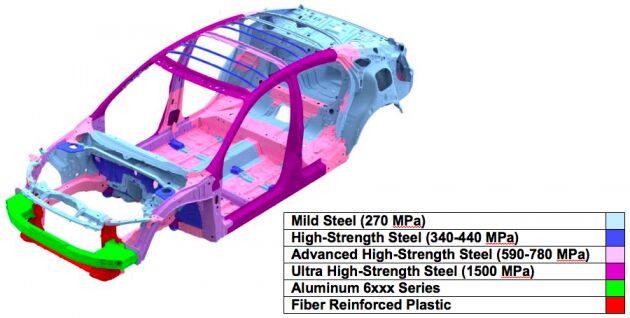
New vehicles are much safer from a structural standpoint than older ones. Modern high strength steels form the safety cage of the vehicle, and greatly reduce the risk of injury in offset frontal impacts, side impacts, and rear impacts.
And then you have the multitudes of air bags.
Finally, the various electronic gizmos that further reduce risk of injury.
The presence of high strength steels alone warrants a new vehicle purchase. Vehicles are disposable, people are not.