Do we still teach kids that planes fly because of Bernoulli's principle?
I remember learning about it and wondering why newton's 3rd law wouldn't suffice. It's pretty obvious that the wings push air down and it's not that difficult to understand (even as a kid) that newton's 3rd law works.
The essence of the Bernoulli argument is that the top of the wing is longer -> air has to move further -> faster air has lower pressure "because Bernoulli" -> pressure imbalance means lift.
Ok, cool, but the "Bernoulli principle" I got as a kid was "faster air is lower pressure", which is both empirically wrong (the air in a compressor hose is obviously moving faster than the air in the workshop) and logically inconsistent (speed is relative, after all). You add in a half dozen qualifiers and it becomes true, but I wonder if this is more complicated than "the wings push air down, the air pushes the wing up".
A lot of the difficulty of explaining lift of airfoils is that generally explanations try to follow a neat chain of cause an effect. But with the wing there isn't really a clear one. All these statements:
- There is an upwards force on the wing
- The pressure above the wing is lower than the pressure below it
- The air around the wing follows a curved path downwards
- The air above the wing travels faster than the air below it (NB: not in equal time!)
- The air behind the wing has a downward momentum
are related to all the others, but not straightforwardly: they all imply each other to some extent, both caused by and causing some of the others. So basically all explanations try to follow some path through the tangled web, but by doing so they always cause some oversimplification. The only top level chain is: shape of wing and angle of attack -> ????? (tangled mess of fluid dynamics few people fully understand) -> lift!
Exactly, this is why understanding fluid dynamics is so difficult. You can't look at some physical laws and assume that the right hand side "causes" the left hand side. They all represent relations and it so happens that the fluid configuration that fulfill all the relations (and that the world adopts) is the one that causes lift. Just trying to talk about cause and effect is a misunderstanding.
My favorite example of this was in the air-data computer I was working on for a fighter trainer. I was just on the software side rather than the aerodynamics, but it was notable that the corrections to angle-of-attack and angle-of-sideslip measured by the multifunction probes (which are way up at the nose of the plane) included terms related to the position of the flaps (which are way back at the trailing edges of the wings).
I'm not surprised about the angle-of-attack needing correction. The angle-of-attack is defined as the angle between the average chord (an imaginary line running from the leading edge of the wing to the trailing edge of the wing) and the relative wind. Since changing the flap position changes the position of the trailing edge, the angle-of-attack will also change.
Usually you draw a line from the trailing edge (which is sharp so unambiguous) to the point on the leading edge that makes the line the longest.
The definition that makes the most sense, though, is to disregard the geometry of the wing and define zero angle of attack as the zero-lift angle, because then lift is proportional to AoA.
> explanations try to follow a neat chain of cause an effect. But [...] there isn't really a clear one. All these [...] are related to all the others, but not straightforwardly
There seems a pattern of misattributing pervasive failures of science education content design, to physical system complexity and student deficiency. A favorite of mine was a PhD thesis "We taught grade G young students common incoherent nonsense about atoms. Surprisingly, that's didn't work out well. We draw the obvious conclusion: students in G are developmentally incapable of understanding atoms." Which might even be valid... for a "regurgitate incoherence" definition of "understand atoms".
Here, I wonder if an atomistic explanation might work better? Could one craft a nicely accessible, coherent, transferably powerful, molecular superball mosh pit story of wings? The confusion and disagreements here sound a bit like "It's net molecular motion! No, surface impacts! No, differential surface impacts!". An abstraction/model fail, rather than underlying irreducible system complexity.
It's easiest to understand as a black box, or a "control volume". Consider the air coming in the front (horizontal) and the air going out the back (velocity is deflected downwards). Momentum change, needs a force to keep things in balance. Simple! Fluid mechanics is all about that kind of thinking.
This is exactly one of the common pathways through that middle section, which is nice and simple but doesn't really explain anything (why is the air deflected downards?).
If I'm not wrong, it seems dead simple when you put it like this:
- Imagine the jet moves the wing forwards some small distance in some small amount of time.
- Due to the shape of the wing, there is now a temporary vacuum above the wing as air particles have yet to rush in and occupy the space where the wing used to be.
- There is now an unbalanced pressure around the wing sufficient to overcome gravity and give lift.
No Bernoulli, no math, just visualizing a bunch of particles getting pushed around.
If you think about air this way it also becomes obvious why a helium balloon moves in the direction of acceleration inside a car. Car moves forward, air in the rear of the cabin is now squished while the air in front is stretched out as it hasn't caught up to the car yet, pressure gradient sends the balloon forwards.
As a purely conceptual illustration of the fact that the air must be deflected downwards by the wing, sure. It doesn't really work, though. For example, there's no reason for the air to move faster over the top of the wing in your scenario, and without that you'd underestimate the amount of lift a wing actually generates.
> there's no reason for the air to move faster over the top of the wing in your scenario
I suppose the compressed air at the top of the wing will find its way into a vacuum and travel a bit faster than the air at the bottom that's encountering normal pressure, but I'm honestly out of my depth at this point. Not sure if the air coming in on the left cancels that out either, I'd have to run the equations. https://webwhiteboard.com/board/KhTCsoDvhyGTy0uJtmPpQNhvldF1...
Published in 1944, Stick and Rudder[0] by Wolfgang Langeweische has this to say:
>Forget Bernoulli's Theorem
>When you studied theory of flight in ground school, you were probably taught a good deal of fancy stuff concerning an airplane's wing and just how it creates lift. As a practical pilot you may forget much of it. Perhaps you remember Bernoulli's Theorem: how the air, in shooting around the long way over the top of the wing, has to speed up, and how in speeding up it drops some of its pressure, and how it hence exerts a suction on the top surface of the wing. Forget it. In the first place, Bernoulli's Theorem does not really explain- the explanation is more puzzling than the puzzle! In the second place, Bernoulli's Theorem doesn't help you in the least bit in flying. While it is no doubt true, it usually merely serves to obscure to the pilot certain simpler, much more important, much more helpful facts.
>The main fact of all heavier-than-air flight is this: the wing keeps the airplane up by pushing the air down.
>It shoves the air down with its bottom surface, and it pulls the air down with its top surface... In exerting a downward force upon the air, the wing receives an upward counterforce- by the same principle, known as Newton's law of action and reaction, which makes a gun recoil as it shoves a bullet out forward...
>Say that the wing is basically simply a plane, set at a slight inclination so as to wash the air down... But it was early found that the drag, lifting, and stalling characteristics of such an inclined plane can be improved by surrounding it with a curving, streamlined housing [emphasis mine]; hence our present wing "sections". The actual wing of an airplane is therefore not simply an inclined plane; it is a curved body containing an inclined plane.
Don't compare the pressure of the air in the workshop to the fast moving air in the nozzle - compare the air in the system of the compressor.
In an air compressor, the lowest pressure air is the air moving through the hose and out the nozzle - the highest pressure air in the system is the 'still air' in the cannister. Think of an inflated balloon that you blow up and let go of, the highest pressure air is in the balloon, the lowest pressure air is immediately next to the mouth of the balloon, despite being the fastest moving.
It might feel surprising, but the air that moves faster across the top of the wing is lower pressure than the slower moving air below the wing. That both the air below and above the wing are higher pressure than 'all the rest of the air in the sky' is inconsequential to the the plane - we only need to consider the air directly interacting with the wing. (though this is not to deny the impacts of angle of attack etc etc.)
The thing I never found satisfying was this notion that the air over the top moves faster because it has further to go - in what way does the length of a path that lies in the air's future have any effect on its speed now? As if the air over the top somehow has to match up with the air it was next to before the wing split it away below? What mysterious force would account for that?
The best I could arrive at was that the forward motion of the wing causes the back side of the curved wing top simply to pull away from the air in that region, reducing the pressure there, and incidentally (because Bernoulli) that air then moves faster as a result.
>The thing I never found satisfying was this notion that the air over the top moves faster because it has further to go
On the one hand I agree that it is a stupid way to phrase it. On the other hand if the air doesn't "make it" then there is nothing where the wing just was aka a vacuum. The low pressure area that forms above the wing sucks the air along making it faster. Why doesn't all the air rush to fill the low pressure area? Well for air below the wing there is a wing in the way, air above the air flowing over the wing does rush down to fill the void providing lift, air behind the wing does as well creating some drag.
Same for angle of attack it deflects the air that would normally be above and behind the wing down (providing some lift),making a low pressure area form above the wing which the air speeds to fill.
> air above the air flowing over the wing does rush down to fill the void providing lift, air behind the wing does as well creating some drag
Just a nitpick, but these forces are never pulling, only pushing. The air rushing to fill the voids is not pulling the wing, is the air below or in front if the wing that pushes (and doesn't find an equal push on the other side).
Imagine I fill a bathtub full of marbles - and I pull a solid semi circle through the marbles. The marbles that flat side moves past will barely have to move, the marbles that are displaced by the round side will have to 'move further'. They won't come out exactly at the same time, but they will have had to move further and move faster as the semi circle moves through the bath.
I guess you could do the same thought experiment with foam/sponge balls in a bath - no matter if they squeeze, they will still be moved out the way and follow the path of the semi-circle shape.
The speed of the wing is what causes the air to move around the two faces of the wing. The air has to move around the wing as it is being pulled through it.
Imagine pulling a fixed walled tube though the air, the air will move through the tube at roughly the speed that the tube is pulled through the air.
Now imagine pulling a funnel that starts off large and gets smaller. The same air will now have to move faster to get through the funnel (higher pressure at the mouth of the funnel, lower at the end).
> the air that moves faster across the top of a wing.
Except absolutely flat wings also work where the air is traveling the same distance. They aren’t nearly as efficient, but still produce lift.
Wings shape relates to skin effects, vortexes, turbulence, and drag. There’s a lot of complex interactions involved which don’t simplify to faster moving air creates lift.
Does that flat wing work with a zero angle of attack (that is, parallel to the ground) or does it have to point upwards?
Race cars use downward pointing wings to generate the opposite of lift, to push the car into the ground. Of course even car wings have evolved into more efficient shapes, because there is a competition to win those races.
All wings need a positive or negative when upside down angle of attack to generate lift. People often draw the cord line incorrectly because the flat part of a wing isn’t zero and wings are mounted with a positive angel of attack so aircraft can be level in flight even with a ~15 degree angle of attack.
Car aerodynamics is complicated. People talk about spoiler downforce without really considering the details. If you push down on the rear spoiler of a toy F1 car the front end lifts up because it’s located behind the rear wheel. The goal is specifically downforce on the rear tires.
Similarly the rotational force on an axle wants to lift the front end. There’s another torque from the tires being located below the force of drag which again wants to lift the front of a car.
For strait line dragsters they accept the front wheels having reduced contact with the road for improved acceleration because they don’t need to turn. Where Indy and F1 uses front wings, but winged sprint cars pushed the classic spoiler forward on top of adding a wing for additional control. In racing it’s all about different trade offs for each sport.
I should have said to generate lift in level flight. Drop anything with air resistance and it’s technically generating lift. However it’s important to separate the angle of attack relative to the airstream vs angle of attack relative to the ground for falling objects.
Anyway non-semmetric airfoils are about efficiency when the aircraft never flies upside down. Unfortunately you occasionally see mislabeled diagrams where the angel of attack seems to be zero when the wing is laying flat rather than the leading and trailing edge being level which creates a great deal of confusion.
The Newton's 3rd law explanation and the Bernoulli explanation are both reasonable approaches and both work, very similar to the way that one can explain the path of a thrown ball both by Newton's laws and by the principle of least action.
NASA has a good explanation here [1]. Here's a brief summary.
The gas flow has to simultaneously conserve mass, momentum, and energy.
If you analyze lift by considering conservation of momentum you get that there are velocity differences in the flow at different parts of the wing. Integrate those around the whole wing and you find a net turn of the flow downward. Conservation of momentum (Newton's 3rd) requires an opposite upward force on the wing.
If you analyze lift by considering conservation of energy you also get velocity differences which lead to pressure differences. Integrate pressure over the whole wing and you get a net upward force on the wing.
This doesn't really explain why those velocity variations occur in the first place, or am I missing something?
It sounds like "We observe velocity variations on the wing and these correspond to pressure variations that create lift due to conservation of energy." But it leaves the question on what is causing the velocity variations in the first place.
If you just mean there's a gravitational force on the Earth from the plane then, sure, but that's true for any object (including you and me). For an object on the ground, the normal force of that object on the ground balances their gravitational pull on the Earth, so the Earth experiences a net force of zero from the object and so isn't accelerated by it.
But I guess you mean that the plane has a net force pulling the earth towards it. But that would violate conservation of momentum – in fact the net force is zero, just as for an object on the ground. The plane's wings push the air down (the reaction to that is what keeps the plane up) and the resulting downdraft of that air exerts a force downwards on the earth.
That's all assuming the plane is in steady flight. If it's taking off, or just ascending, then overall it is pushing the Earth away from it. Conversely, when descending the Earth is pulled, overall, slightly towards it. The same thing happens when you jump: you push the Earth away from you (a much smaller distance than you travel away from it!), then on the way back down the Earth travels back towards you.
Crud I think you're right. I had it in my head that in steady flight, the plane had zero change in momentum, whereas, the air, collectively, gained net downward momentum. So to balance it all out, the earth must be gaining upward momentum (though of course spread over such an enormous mass as to make the velocity term imperceptible.)
Newton's third law doesn't explain stalls – or, at least, not their suddenness.
As angle of attack increases (or speed decreases) there comes a certain point where the lift suddenly drops in a dramatic way that wouldn't make sense from a naive application of Newton's laws. What's really happened is that the airflow has separated from the wings and Bernoulli's principle no longer applies. That's when you get a stall, and the plane starts falling rather than flying.
> It's pretty obvious that the wings push air down
The air being pushed down is actually a side-effect of the lift-creation process, not the cause of it.
A nice "counter example" is a wing in ground effect (flying very close to the ground), where there is less downwash, because of the ground, and yet the wing produces more lift. It's an effect that can make high aspect-ratio airplanes tricky to land.
> air being pushed down is actually a side-effect of the lift-creation process, not the cause of it
The turning of the gas is absolutely what causes lift. (Where the Newtonian explanation is misleading is in “neglect[ing] the physical reality that both the lower and upper surface of a wing contribute to the turning of a flow of gas” [1].
Put another way: if you know the mass and acceleration of the gas about the wing, you can calculate lift. (This is impractical for many reasons.)
> a wing in ground effect
VTOL aircraft also experience ground effect due to the fountain effect.
> Curvature of streamlines is related to pressure gradient across said streamlines
Sure. Ultimately just considering pressure or mass deflection doesn’t work without elaborate workarounds. Because neither describes the reality of an airfoil turning a moving viscous fluid.
> If the turning of the gas was the necessary mechanism for lift, planes in supersonic flight would fall out of the sky
Why would pressure (Bernoulli out of Euler) propagate supersonically while momentum (Newton) does so subsonically?
> Instead of relying on an airfoil shape for lift, you could fly by sucking air from the top of your wing and dumping out the back of your plane
Wings (and the other bits that contribute to lift) are bigger than engines. That’s the leverage you get with a lifting body: you move more molecules than your thruster alone.
The correct answer here is unintuitive. But the very wrong answer is pressure alone. (As the article we’re commenting on clearly shows with its brilliant flat-cardboard example. You don’t need camber to have a lifting body, just angle of attack.)
> Why would pressure (Bernoulli out of Euler) propagate supersonically while momentum (Newton) does so subsonically?
I'm sorry, I didn't understand the question.
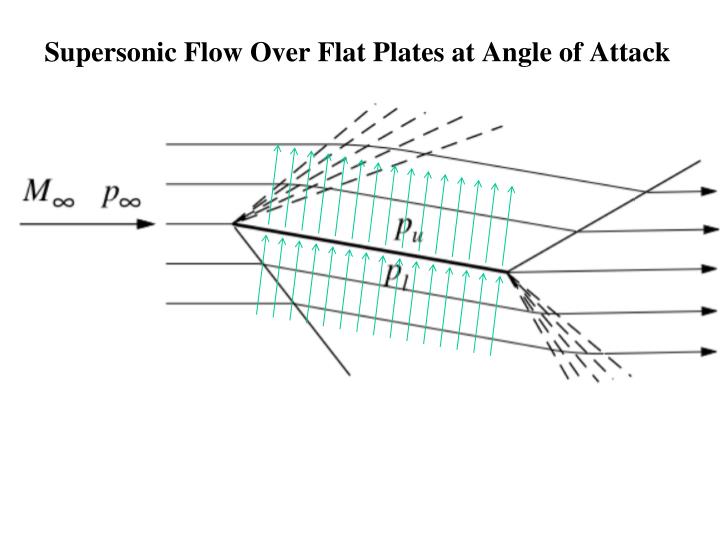
But in supersonic flight, with a flat plate, you don't have any rotation in the game, as illustrated here [0]. And yet you will be producing a lot of lift.
No, it really is the pressure alone. And viscous drag, if you want to be pedantic. Those are the only forces at play, the rest is only a side effect of those forces.
> you don't have any rotation in the game, as illustrated here
The arrows literally moved down!
> it really is the pressure alone
NASA, pilots and aerospace engineers would disagree with you. But yes, you can construct a working model of flight with just pressure. Same way you can make a Copernican model match our observations of how the stars and planets move.
On the top part, you've got a supersonic free-stream deflected with an expansion fan to a supersonic parallel flow over a plate, deflected back and slowed-down to free-stream conditions through an oblique shock. The only thing the upper-surface "sees" is a parallel, supersonic flow.
On the lower part, you've got a supersonic free-stream deflected to a lower-speed supersonic flow through an oblique shock, creating a parallel supersonic flow over the lower surface of the plate, deflected back and re-accelerated to free-stream conditions through an expansion fan. The only thing the lower surface "sees" is a parallel, supersonic flow.
Now, unless you can come up with a force component emanating either from the oblique shocks or from the expansion fans and contributing to the lift vector, it fair to say that the flow deflection is not directly what is causing lift on the angled plate.
To create lift with a symmetrical airfoil, you are going to need a non-zero angle of attack. You can see the effect of a varying angle of attack on a symmetric NACA 0012 airfoil here [0].
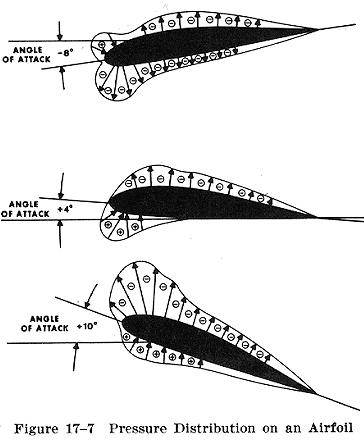
The following plot shows the pressure distribution over a wing at 3 different angles of attack [1]. As you can see from the first plot, some lift is created at -8 degrees AOA, but clearly a lot less than the +10 AOA example, as that airfoil is optimized for positive angles of attack.
Explanation based on Bernoulli effect requires longer path of air taking on top than on the bottom of the airfoil to create speed/pressure difference. With symmetrical airfoil both paths are the same regardless of the angle of attack. So when you mention AoA you implicitly lead to the explanation that lift, in majority, is not based on the Bernoulli effect.
I've read excellent article debunking the Bernoulli effect and lift many years ago, I'm not sure I can find it again...
Explanations based on the Bernoulli effect are trying to explain a speed differential by pretending that two particles that were separated on the leading-edge of an airfoil, to then travel one above the airfoil, one below, would then rejoin at the trailing edge of the airfoil. And so, if you were to change the upper-camber of the airfoil, the flow on the upper part would need to accelerate to be able to join the trailing edge at the same time. And that would create a lower pressure, therefore lift.
The nonsensical part of this model is that a particle on an upper streamline has anything to do with a particle on a lower streamline and that it is trying to keep up with it. Not so of course.
But the lift created by a pressure difference due to a locally faster flow still holds.
> So when you mention AoA you implicitly lead to the explanation that lift, in majority, is not based on the Bernoulli effect.
For a NACA 0012, you'll need an AoA, to have a faster flow on the upper part of your airfoil, as it it symmetric. Other airfoils are perfectly fine creating lift at 0 AoA.
The Bernoulli effect only contributes to making wings more efficient. It isn’t fundamentally why lift occurs.
You can make almost anything fly if you have enough power and a tail. But how efficient will it be? Not as efficient as an airfoil that takes advantage of all the fluid motion properties.
I think you wanted to respond to the parent comment. My questions have been a lead to debunk myth that the major contributor to the lift is the Bernoulli effect.
The pressure differential, in essence, is created by a faster airflow over the airflow. As the total pressure in your flow stays constant, if you increase the local dynamic pressure (with a faster flow), the local static (measurable) pressure decreases.
So if you manage to shape your airfoil so that one surface experiences a faster flow (on average) than the other, you can create a pressure difference, and therefore lift.
And in effect it is true that the gas will most probably need to be turned and displaced, but that is really the airflow adapting locally to the obstacle (airfoil) it encounters. The nose of the airfoil, where the acceleration is high, can be a place where a lot of lift is created, but it is not necessarily so.
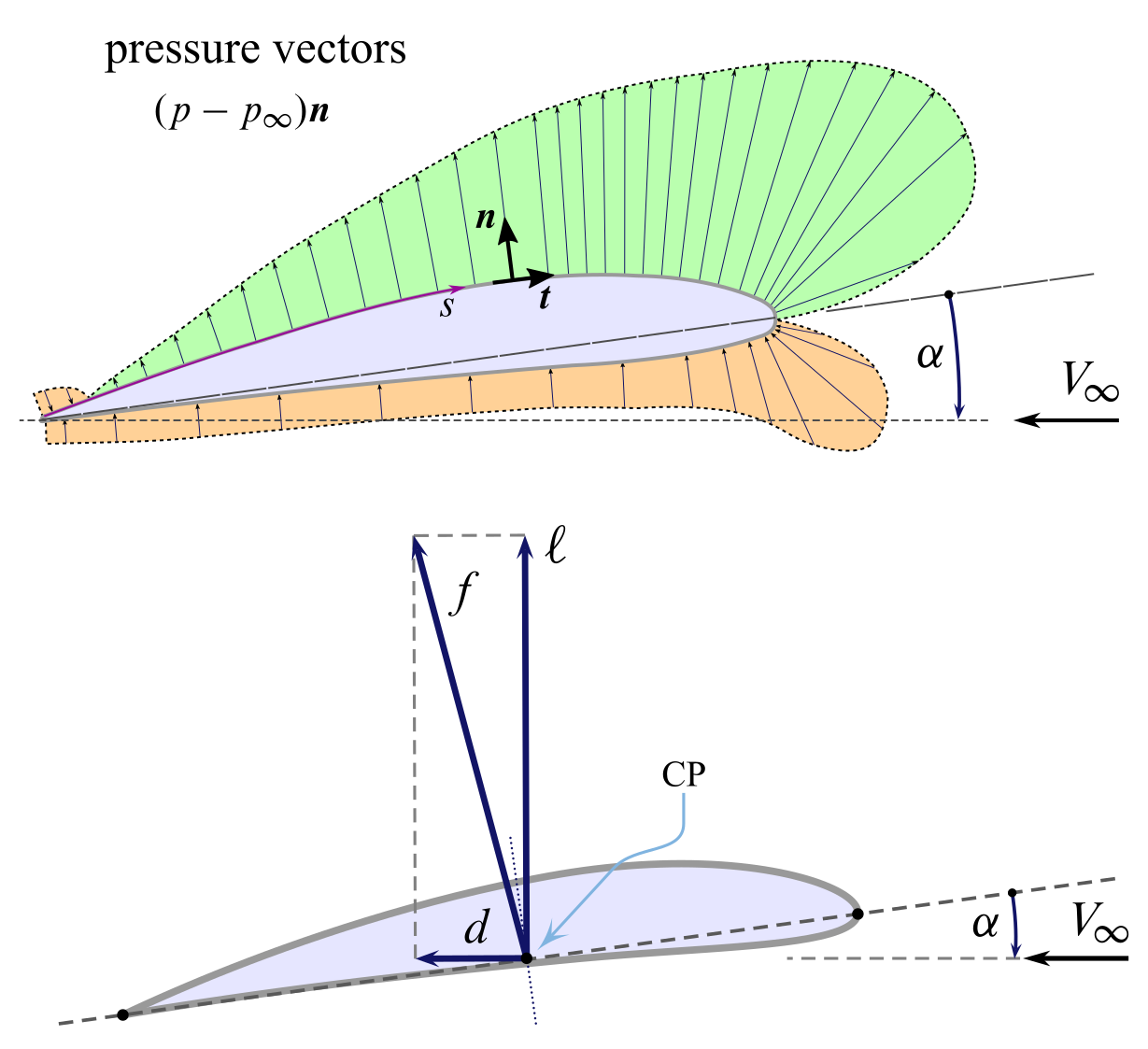
You can see example pressure distribution plots below:
It's not a cause and effect situation, because you can't have one without the other. A pressure differential can only exist if the flow is altered somehow, because a pressure differential means that the air molecules are subject to a net force which accelerates them. This is really just Bernoulli's theorem, which is Newton's second law. However, it doesn't tell you anything about why the flow around a wing arranges itself into such a configuration.
The Newtonian explaination of lift is partially but not completely correct. It only explains some of the lift which is empirically observed. Particularly the "push air down" model; the tops of wings also pull air down along themselves (assuming there isn't flow separation, e.g. a stall) and direct it down. To really explain that flow you need fluid dynamics.
In school when our physics teacher explained how the shape of an airplane wing creates lift and allows the plane to fly, I asked how it is that airplanes can fly upside down? I got the classic "that would be a great thing for you to research on your own time".
This is actually really cool, because an upside down airfoil will still create a high pressure ridge toward its leading edge. This causes air that would ostensibly flow along the bottom (high pressure) surface to sort of reverse and end up being pushed to the upper (low pressure) surface. The separation point is further down the leading edge than would be intuitively expected. This means the top stream of air still goes further, and faster, than the bottom stream of air.
So inverted wings still fly, just less efficiently.
Depends what we mean by grade school. For young kids (and honestly most adults) I don't think you need much more than this: "A wing, or anything that sends air moving past it down toward the ground will cause some lift (a push toward the sky), but also some drag (a push on your front toward your back). How much of each depends on the shape of the wing and how it's moving through the air. Really good wings cause a lot of lift without a lot of drag, which is good for not using a lot of fuel to get where you're going or for going really fast."
From my perspective, a much superior explanation would be something like: "A wing causes an aircraft to fly because its shape, and the angle at which it moves through the air, creates regions of higher air pressure under the wing, and lower air pressure above the wing. This causes an upwards force on the wing, and a corresponding reaction force downwards on the air itself."
The turbulence caused by a sharp leading edge of something like a flat board causes momentum transfer to the top of the wing. The problem isn't in explaining how a conventional airfoil works, Newton's law works well enough for that. The problem is in explaining what happens when things go wrong. Turbulence has been a problem for physicists for a long time...
The Newton's third-law explanation is "air bangs into a bottom of airfoil and pushes it up". Without having the concepts of boundaries layers, laminar and turbulent flow, flow separation and (more generally) the entire Navier-Stokes toolbox you don't have the tools for explaining why turbulent flow is a problem, for example.
The explanation based on Newton's laws of motion is more to the effect that the wing interacts with the air in such a way as to accelerate some of the air towards the ground. The reaction force is upwards.
The Navier-Stokes equations merely model fluid flows. Understanding them provides no understanding of the behaviour of such flows. That behaviour is emergent from the interaction of a great many particles.
>The explanation based on Newton's laws of motion is more to the effect that the wing interacts with the air in such a way as to accelerate some of the air towards the ground. The reaction force is upwards.
But that doesn't have any explanatory power at all. If we assume Newton's laws hold, then obviously if there's a force upward on the airfoil then there's a reaction force downward on the air.
It'd be like explaining the combustion engine by saying "the drive shaft from the engine rotates this way, and the reaction force - because the engine is more-or-less rigidly mounted to the frame - is resisted through the suspension by the wheels being in contact with the ground". OK, sure, but I still don't know how the engine actually works.
I dunno. If I look at even a very simple diagram of the flow of air around a wing I see air deflected downward on the bottom and air accelerated around a curve on the top. Both would be expected to produce a downward reaction force.
Added: Or more Newtonish (no action at a distance), there is more upward vertical force contributed by the particles in both cases than downward force.
Yes, if someone tells you how the air flows around a wing you can immediately deduce that it's producing lift, since the air is deflected downwards. The real task is explaining why the air flows the way it does.
If I stick out a flat board from a moving car window, and hold it at an angle, it will "lift up". So indeed, airfoil shape does not matter. Angle of attack matters more, because that dictates the path of least resistance.
Planes fly by slicing through a lattice of air, with blades (wings) that only slice easily in directions that lie on a single plane. Orthogonal tail fins means that the vehicle doesn't go from side to side as easily, so it mostly keeps flying on a line. Take a `+`-shape and elongate it so you get a "dentastix" like shape, then hold that out the car window. It will go in whichever direction you point it.
Same idea of a boat rudder. And yet with boat rudders, we don't say "force of lift". The angle of attack changes, which means it now cuts through the water in a different direction (and the rudder piece wants to go straight in the direction it is pointing, since that way has comparatively little resistance in the water), which changes the way the rear of the ship moves which ultimately steers the ship.
... what do you mean by that? If you mean "you can demonstrate the aerodynamic force using a flat plate", then yes you can do that. If you mean "a flat plate is a good tool to explain the aerodynamic force", then that's much less true. If you mean "in the real world, airfoil shape is irrelevant to aerodynamics" that's obviously false.
I was being a bit facetious, sorry. It matters, but I think what I was getting at is often simply overlooked in favor of airfoil shape and the pressure difference explanation. The situation of gravity no longer being a factor such as with vertical rudders seems often missed. Then, it's suddenly called "rudder force". Even though it's the same thing as "lift". It seems the field of physics has trouble with isolating this concept/phenomenon and coming up with an apt name for it.
Rudders are symmetric, i.e. don't have camber to create high/low pressure on one specific side all the time, and yet they work in redirecting (the relative) flow and thereby through Newtons 3rd redirecting the vessel!
The pressure difference explanation is the basic explanation, though. The name of the force is "the aerodynamic force", and there's not really any confusion on that point.
The difference of shape between hydrofoils and airfoils is determined by the properties of the masses in which they move, explained by the same theories of fluid dynamics, rather than any fundamental difference.
That's just because when you angle the sheet, more molecules of air hit one side imparting part of their kinetic energy, and fewer molecules on the other side to counteract this. I do realize I'm explaining pressure on a molecular level here, but to me it's still "slicing through" and "pushing against" a lattice of molecules.
It’s still Newton’s third law; Push air down and minimize pushing air sideways or in swirling vortices because pushing air the wrong way wastes energy as per newtons law.
That’s what the aerofoil does. It pushes air down but mimimizes wasting energy on drag. It’s still newtons law.
For just a Newton's third law analysis, you have to have the air moving downward behind the wing. Doesn't the shape of the upper surface matter a lot in order to get the air moving downward?
>> The essence of the Bernoulli argument is that the top of the wing is longer -> air has to move further -> faster air has lower pressure "because Bernoulli" -> pressure imbalance means lift.
That argument doesn't hold up (no pun intended). Just because the distance is longer does not mean the air will go faster, it could just take longer to get there.
Not only that, but depending on the particular FAA designated examiner you get, failing to tell him Bernoulli can result in a disapproval. I've heard of it happening.
Fortunately, none of this has ever mattered in the least for actually flying a plane, and there are plenty of sane examiners out there.
You can experience faster air is lower pressure when you are trying to breath in strong wing (like sky diving or by an open window on a car on the motorway). It makes you usually gasp for air.
But yeah I was taught planes fly that way in the 90s.



I remember learning about it and wondering why newton's 3rd law wouldn't suffice. It's pretty obvious that the wings push air down and it's not that difficult to understand (even as a kid) that newton's 3rd law works.
The essence of the Bernoulli argument is that the top of the wing is longer -> air has to move further -> faster air has lower pressure "because Bernoulli" -> pressure imbalance means lift.
Ok, cool, but the "Bernoulli principle" I got as a kid was "faster air is lower pressure", which is both empirically wrong (the air in a compressor hose is obviously moving faster than the air in the workshop) and logically inconsistent (speed is relative, after all). You add in a half dozen qualifiers and it becomes true, but I wonder if this is more complicated than "the wings push air down, the air pushes the wing up".